Lien Laws Quote by Eric Foner
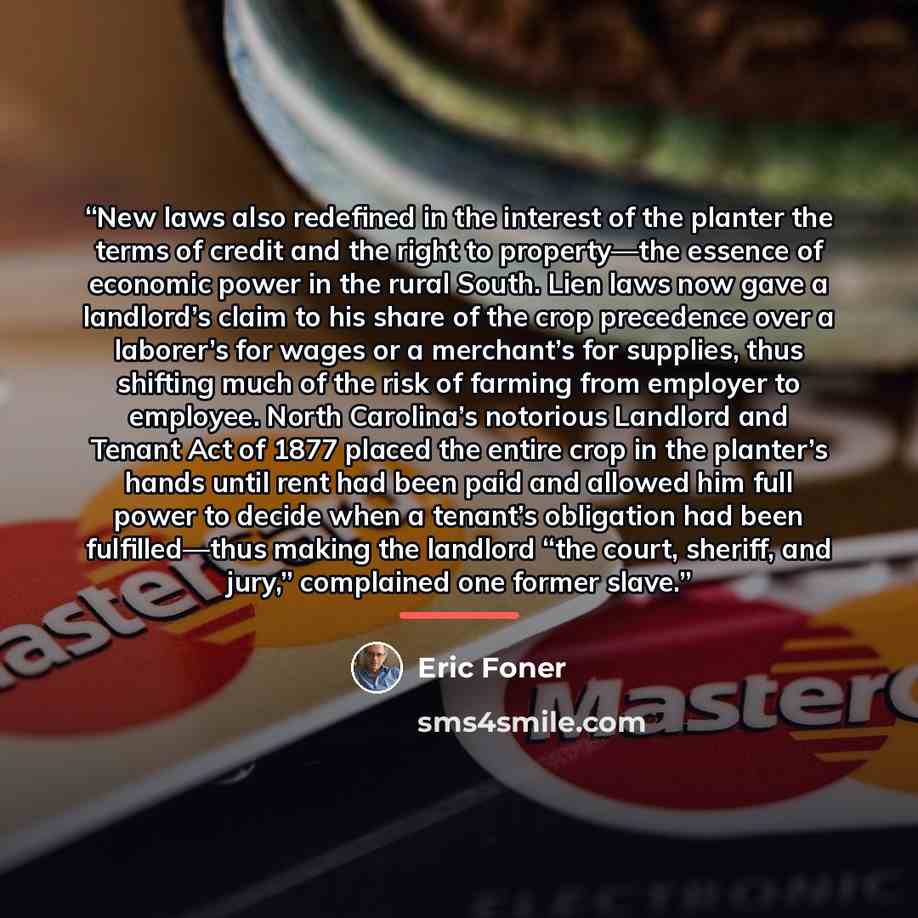
““New laws also redefined in the interest of the planter the terms of credit and the right to property—the essence of economic power in the rural South. Lien laws now gave a landlord’s claim to his share of the crop precedence over a laborer’s for wages or a merchant’s for supplies, thus shifting much of the risk of farming from employer to employee. North Carolina’s notorious Landlord and Tenant Act of 1877 placed the entire crop in the planter’s hands until rent had been paid and allowed him full power to decide when a tenant’s obligation had been fulfilled—thus making the landlord “the court, sheriff, and jury,” complained one former slave.””
About This Quote
Source Book: Reconstruction: America's Unfinished Revolution, 2008
Post‑Civil War Southern laws gave landlords overwhelming power over tenants, turning agriculture into a system of economic coercion.
In simple terms: Landlords controlled credit and crops, leaving workers vulnerable.
Key Takeaway
Recognize and challenge exploitative labor structures.
Themes
labor rights
economic power
post‑civil war
racial inequality
Mood
critical
historical
Type
analytical
educational
When to use this quote
- tenant farming
- legal reform
- historical analysis
- social justice advocacy
Key Concepts
property law
economic exploitation
Questions to Reflect On
- How did these laws affect freedpeople’s autonomy?
- What modern parallels exist in labor‑credit relations?
A Different Perspective
Legal reforms alone may not erase entrenched power dynamics.








![“I don't [even] know the number of books on Abraham Lincoln. Ten thousand, twelve thousand? I have seen various numbers. It seems like every generation is always trying to come to terms with Lincoln.” quote by Eric Foner](https://sms4smile.com/quotes/img-quotes/e00/eric-foner-20891_abraham_i-don-t-even-know-the-number-of-books-on_316134.jpg)