British-literature Quote by Edmund Spenser
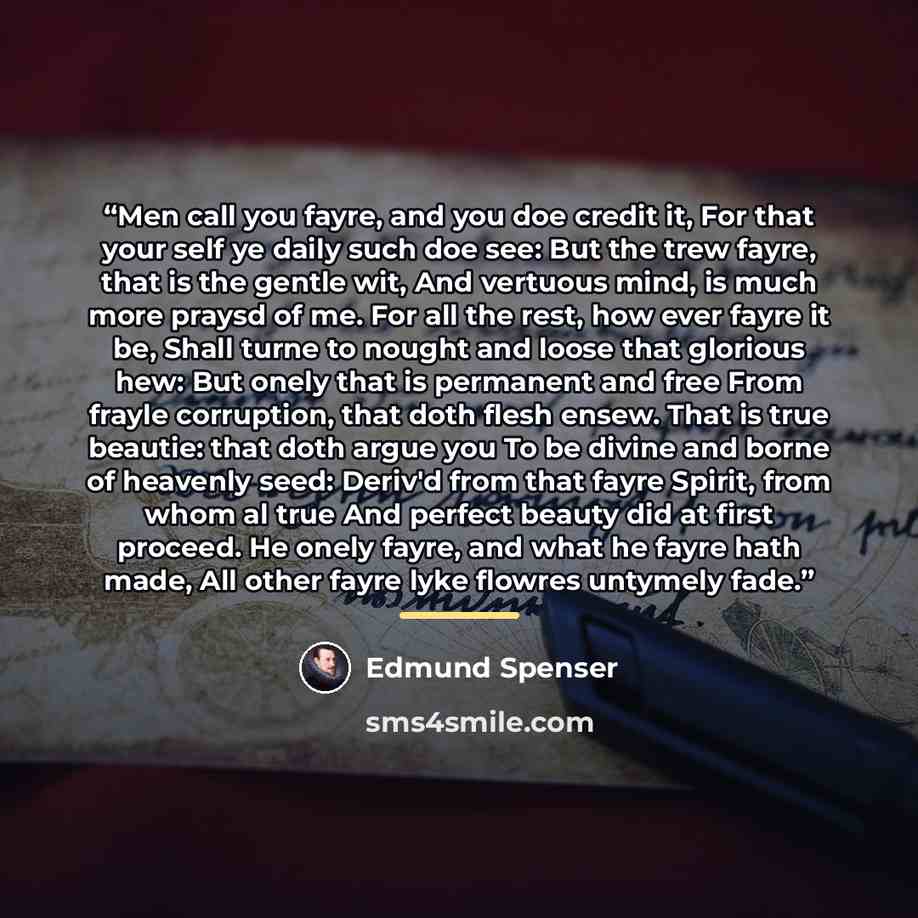
““Men call you fayre, and you doe credit it, For that your self ye daily such doe see: But the trew fayre, that is the gentle wit, And vertuous mind, is much more praysd of me. For all the rest, how ever fayre it be, Shall turne to nought and loose that glorious hew: But onely that is permanent and free From frayle corruption, that doth flesh ensew. That is true beautie: that doth argue you To be divine and borne of heavenly seed: Deriv'd from that fayre Spirit, from whom al true And perfect beauty did at first proceed. He onely fayre, and what he fayre hath made, All other fayre lyke flowres untymely fade.””
About This Quote
Source Poem: The Faerie Queene, Book I, 1590
True beauty lies in virtue and gentle wit, not fleeting physical attractiveness, which fades over time.
In simple terms: Inner virtue outlasts outward beauty.
Key Takeaway
Cultivate inner goodness.
Themes
beauty
virtue
transience
spirituality
Mood
reflective
inspirational
Type
philosophical
poetic
When to use this quote
- personal relationships
- self‑esteem
- spiritual practice
Key Concepts
moral philosophy
human nature
Questions to Reflect On
- How do you prioritize inner virtues?
- What does lasting beauty mean to you?
A Different Perspective
Physical appeal is temporary and can be misleading.

![“Comus. The Star that bids the Shepherd fold, Now the top of Heav'n doth hold, And the gilded Car of Day, [ 95 ] His glowing Axle doth allay In the steep Atlantick stream, And the slope Sun his upward beam Shoots against the dusky Pole, Pacing toward the other gole [ 100 ] Of his Chamber in the…” quote by John Milton](https://sms4smile.com/quotes/img-quotes/c70/john-milton-191_love_comus-the-star-that-bids-the-shepherd-fo_792363.jpg)