Long ago Quote by Edgar Allan Poe
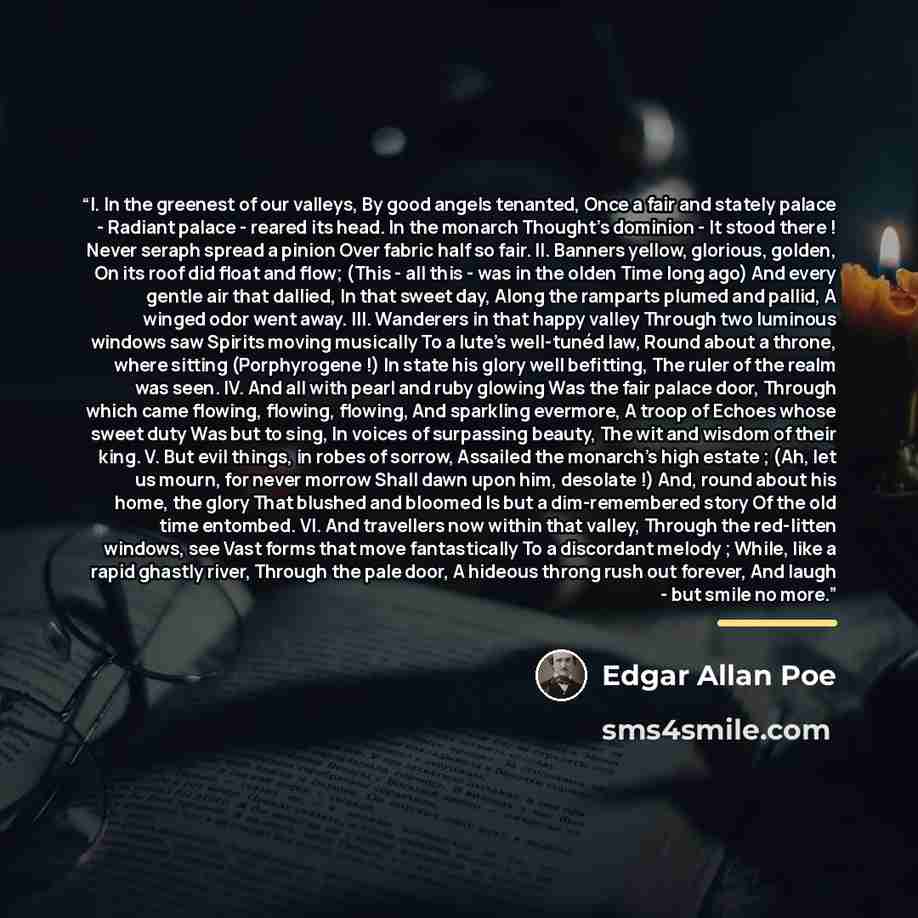
““I. In the greenest of our valleys, By good angels tenanted, Once a fair and stately palace - Radiant palace - reared its head. In the monarch Thought's dominion - It stood there ! Never seraph spread a pinion Over fabric half so fair. II. Banners yellow, glorious, golden, On its roof did float and flow; (This - all this - was in the olden Time long ago) And every gentle air that dallied, In that sweet day, Along the ramparts plumed and pallid, A winged odor went away. III. Wanderers in that happy valley Through two luminous windows saw Spirits moving musically To a lute's well-tunéd law, Round about a throne, where sitting (Porphyrogene !) In state his glory well befitting, The ruler of the realm was seen. IV. And all with pearl and ruby glowing Was the fair palace door, Through which came flowing, flowing, flowing, And sparkling evermore, A troop of Echoes whose sweet duty Was but to sing, In voices of surpassing beauty, The wit and wisdom of their king. V. But evil things, in robes of sorrow, Assailed the monarch's high estate ; (Ah, let us mourn, for never morrow Shall dawn upon him, desolate !) And, round about his home, the glory That blushed and bloomed Is but a dim-remembered story Of the old time entombed. VI. And travellers now within that valley, Through the red-litten windows, see Vast forms that move fantastically To a discordant melody ; While, like a rapid ghastly river, Through the pale door, A hideous throng rush out forever, And laugh - but smile no more.””
About This Quote
Source Poem: Untitled (Attributed to Poe), 19th Century
A vivid, lyrical description of a once‑glorious palace now haunted by sorrow, contrasting beauty with decay.
In simple terms: Palace once beautiful now haunted.
Key Takeaway
Recognize fleeting beauty and inevitable decline.
Themes
beauty
decay
memory
loss
art
Mood
melancholic
reflective
Type
literary
poetic
When to use this quote
- Historical reflection
- artistic inspiration
- creative writing
- meditation
Key Concepts
Transience
nostalgia
contrasts
Questions to Reflect On
- What does the palace symbolize?
- How does decay affect our perception of beauty?
A Different Perspective
The poem’s ornate language may obscure its core warning.



![“The main thing that distinguishes mealtimes with Jesus, as Conrad Gempf has shown, from the meals of his contemporaries are four verbs.[44] Whether it’s the feeding of the five thousand, the Last Supper, or the Emmaus meal, four things take place: First, Jesus takes something. Second, Jesus…” quote by Leonard Sweet](https://sms4smile.com/quotes/img-quotes/df1/leonard-sweet-10435_black-church_the-main-thing-that-distinguishes-mealti_1013192.jpg)
![“[Obituary of atheist philosopher Richard Robinson] An Atheist's Values is one of the best short accounts of liberalism (a term Robinson accepted) and humanism (a term he ignored) produced during the present century, all the more powerful for its lucidity and moderation, its wit and wisdom. It may…” quote by Nicolas Walter](https://sms4smile.com/quotes/img-quotes/549/nicolas-walter-98536_an-atheist-s-values_obituary-of-atheist-philosopher-richard_988296.jpg)