Fall in love Quote by David Eagleman
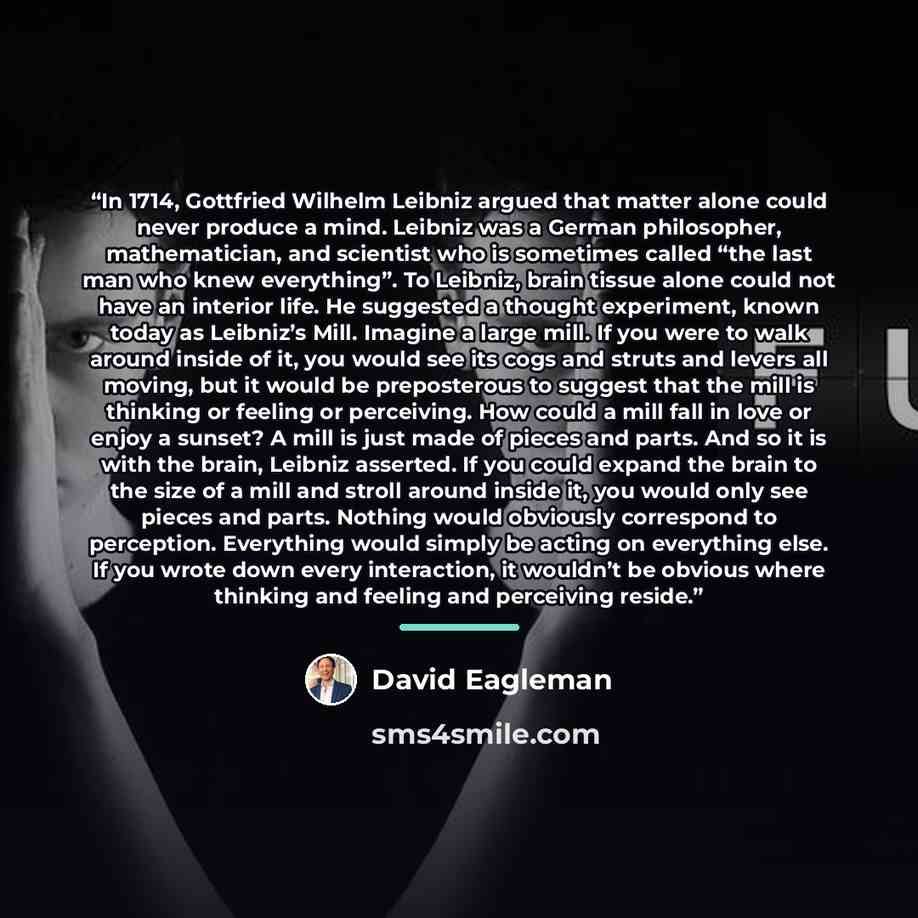
““In 1714, Gottfried Wilhelm Leibniz argued that matter alone could never produce a mind. Leibniz was a German philosopher, mathematician, and scientist who is sometimes called “the last man who knew everything”. To Leibniz, brain tissue alone could not have an interior life. He suggested a thought experiment, known today as Leibniz’s Mill. Imagine a large mill. If you were to walk around inside of it, you would see its cogs and struts and levers all moving, but it would be preposterous to suggest that the mill is thinking or feeling or perceiving. How could a mill fall in love or enjoy a sunset? A mill is just made of pieces and parts. And so it is with the brain, Leibniz asserted. If you could expand the brain to the size of a mill and stroll around inside it, you would only see pieces and parts. Nothing would obviously correspond to perception. Everything would simply be acting on everything else. If you wrote down every interaction, it wouldn’t be obvious where thinking and feeling and perceiving reside.””
About This Quote
Source Book: Sum: The Universe in the Palm of Your Hand, 2011
Leibniz argues that physical processes alone cannot explain consciousness; the brain's parts lack a place for subjective experience.
In simple terms: Physical parts alone cannot create mind.
Key Takeaway
Recognize limits of materialism.
Themes
philosophy
mind
consciousness
materialism
Mood
thoughtful
inquisitive
Type
philosophical
theoretical
When to use this quote
- neuroscience research
- philosophical debate
- AI ethics
- education
- public policy
Key Concepts
dualism
emergent properties
Questions to Reflect On
- Can consciousness arise from complexity alone?
- What evidence could bridge the gap?
A Different Perspective
The argument may overlook how complex interactions could generate emergent properties.