Accounts Quote by Claude Bernard
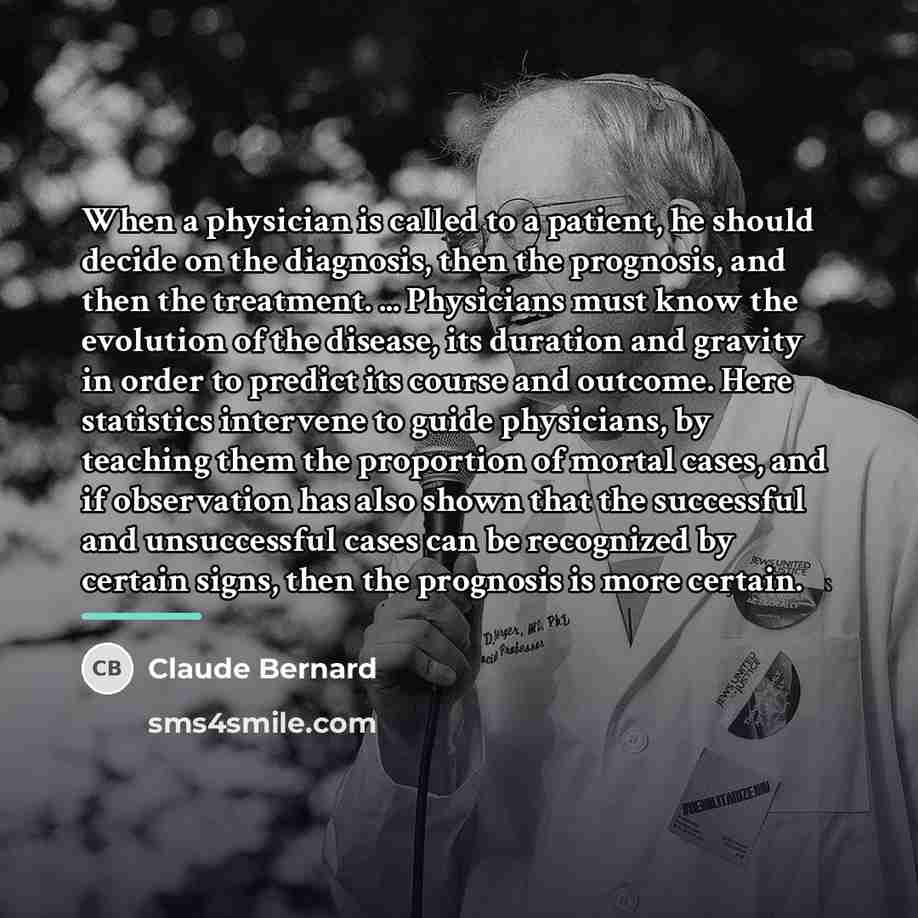
“When a physician is called to a patient, he should decide on the diagnosis, then the prognosis, and then the treatment. ... Physicians must know the evolution of the disease, its duration and gravity in order to predict its course and outcome. Here statistics intervene to guide physicians, by teaching them the proportion of mortal cases, and if observation has also shown that the successful and unsuccessful cases can be recognized by certain signs, then the prognosis is more certain.”
About This Quote
Source Treatise: Introduction to the Study of Experimental Medicine, 1865
A physician must sequentially assess diagnosis, prognosis, and treatment, using statistical data to predict disease outcomes.
In simple terms: Diagnose, predict, then treat.
Key Takeaway
Follow a systematic diagnostic process.
Themes
medicine
diagnosis
prognosis
treatment
Mood
analytical
clinical
Type
educational
professional
When to use this quote
- patient care
- medical education
- public health policy
- research design
Key Concepts
clinical reasoning
evidence‑based practice
Questions to Reflect On
- How can doctors balance statistics with patient uniqueness?
- When should intuition override data?
A Different Perspective
Statistics can’t capture individual variability fully.


![“[After a poor prognosis for recovery from her doctor following her 1990 bus accident] I said if it is up to me, I'm going to be OK.” quote by Gloria Estefan](https://sms4smile.com/quotes/img-quotes/144/gloria-estefan-2160_accidents_after-a-poor-prognosis-for-recovery-from_1056626.jpg)