Brandy Quote by Chuck Palahniuk
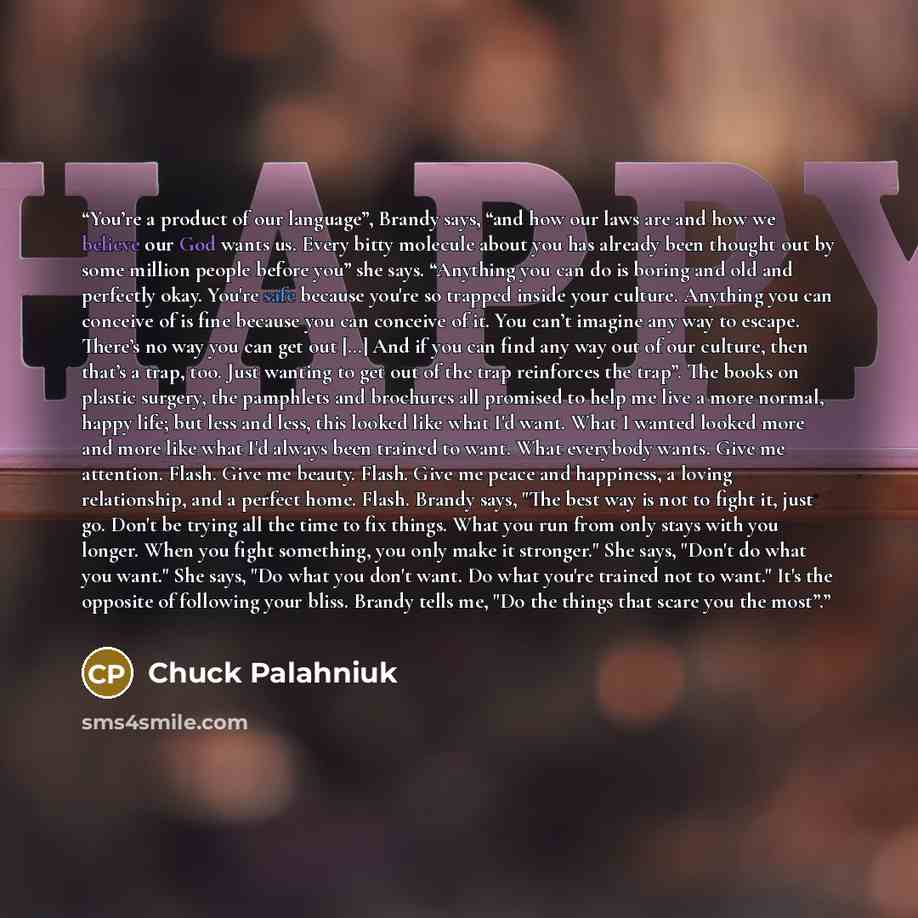
““You’re a product of our language”, Brandy says, “and how our laws are and how we believe our God wants us. Every bitty molecule about you has already been thought out by some million people before you” she says. “Anything you can do is boring and old and perfectly okay. You're safe because you're so trapped inside your culture. Anything you can conceive of is fine because you can conceive of it. You can’t imagine any way to escape. There’s no way you can get out […] And if you can find any way out of our culture, then that’s a trap, too. Just wanting to get out of the trap reinforces the trap”. The books on plastic surgery, the pamphlets and brochures all promised to help me live a more normal, happy life; but less and less, this looked like what I'd want. What I wanted looked more and more like what I'd always been trained to want. What everybody wants. Give me attention. Flash. Give me beauty. Flash. Give me peace and happiness, a loving relationship, and a perfect home. Flash. Brandy says, "The best way is not to fight it, just go. Don't be trying all the time to fix things. What you run from only stays with you longer. When you fight something, you only make it stronger." She says, "Don't do what you want." She says, "Do what you don't want. Do what you're trained not to want." It's the opposite of following your bliss. Brandy tells me, "Do the things that scare you the most”.””
About This Quote
Source Novel: Fight Club by Chuck Palahniuk, 1996
The quote explores how cultural conditioning shapes identity, desires, and perceived limits, suggesting that confronting fears and acting against ingrained expectations can break internal traps.
In simple terms: Culture shapes us; confronting fears can free us.
Key Takeaway
Act against conditioned desires.
Themes
identity
conformity
fear
freedom
self‑discovery
Mood
reflective
challenging
hopeful
Type
philosophical
motivational
inspirational
When to use this quote
- personal growth
- therapy
- creative work
- social activism
- education
Key Concepts
psychology
social conditioning
existentialism
Questions to Reflect On
- What fears are truly yours versus taught?
- How can you identify authentic desires?
A Different Perspective
Escaping cultural norms may cause isolation or new constraints.



























![“I don't know that Brandy [Burre] would ever categorize herself as being trapped, but I felt like I saw her being trapped. When she's cleaning the room and she puts the labels on the toys, that was something that my wife, who's also friends with Brandy, was very adamant that we try to capture. My…” quote by Robert Greene](https://sms4smile.com/quotes/img-quotes/222/robert-greene-498_adamant_i-don-t-know-that-brandy-burre-would-eve_70659.jpg)


![“We started filming [with Brandy Burre ]and didn't really know, at first, what we were doing. Eventually, the thing just grabbed a hold of both of us and became what it is. But, yeah, we were very close before and we're even closer now.” quote by Robert Greene](https://sms4smile.com/quotes/img-quotes/562/robert-greene-498_brandy_we-started-filming-with-brandy-burre-and_163942.jpg)