Dead man Quote by Christopher Hitchens
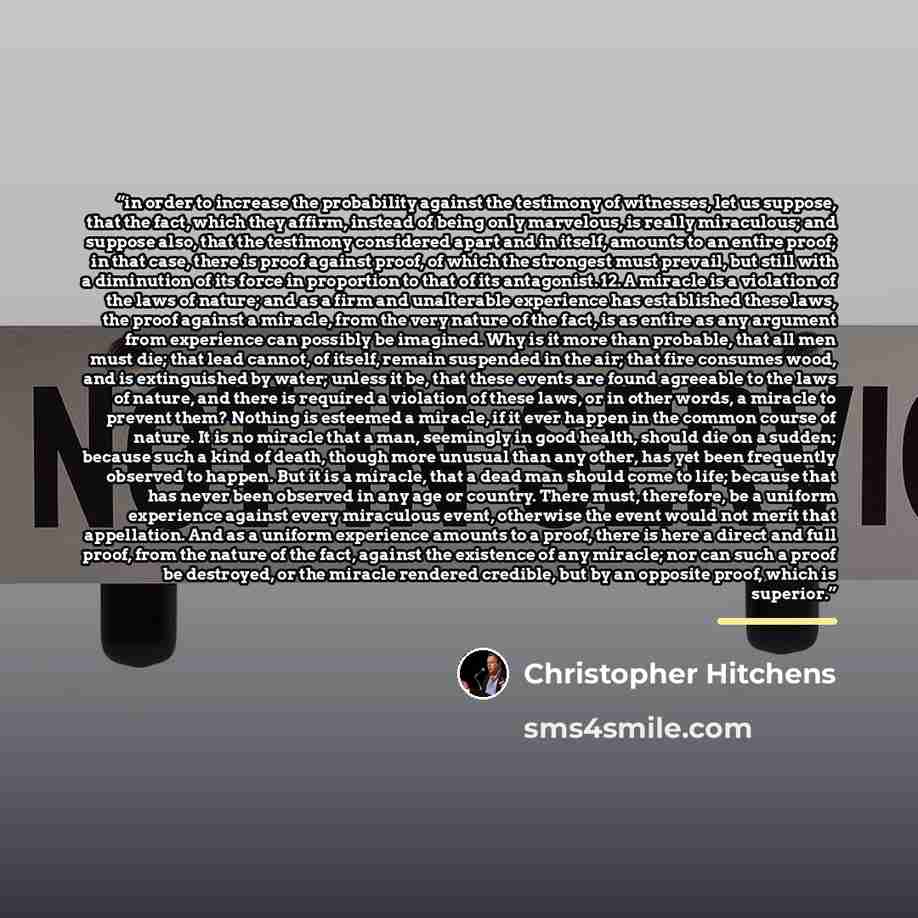
““in order to increase the probability against the testimony of witnesses, let us suppose, that the fact, which they affirm, instead of being only marvelous, is really miraculous; and suppose also, that the testimony considered apart and in itself, amounts to an entire proof; in that case, there is proof against proof, of which the strongest must prevail, but still with a diminution of its force in proportion to that of its antagonist. 12. A miracle is a violation of the laws of nature; and as a firm and unalterable experience has established these laws, the proof against a miracle, from the very nature of the fact, is as entire as any argument from experience can possibly be imagined. Why is it more than probable, that all men must die; that lead cannot, of itself, remain suspended in the air; that fire consumes wood, and is extinguished by water; unless it be, that these events are found agreeable to the laws of nature, and there is required a violation of these laws, or in other words, a miracle to prevent them? Nothing is esteemed a miracle, if it ever happen in the common course of nature. It is no miracle that a man, seemingly in good health, should die on a sudden; because such a kind of death, though more unusual than any other, has yet been frequently observed to happen. But it is a miracle, that a dead man should come to life; because that has never been observed in any age or country. There must, therefore, be a uniform experience against every miraculous event, otherwise the event would not merit that appellation. And as a uniform experience amounts to a proof, there is here a direct and full proof, from the nature of the fact, against the existence of any miracle; nor can such a proof be destroyed, or the miracle rendered credible, but by an opposite proof, which is superior.””
About This Quote
Source Book: God Is Not Great, Christopher Hitchens, 2007
The argument claims that miracles contradict established natural laws, and because uniform experience disproves them, miracles lack credible proof.
In simple terms: Miracles conflict with known natural laws and are unsupported by consistent evidence.
Key Takeaway
Question extraordinary claims with consistent evidence.
Themes
philosophy
science
skepticism
religion
logic
Mood
critical
inquisitive
skeptical
Type
philosophical
analytical
debate
When to use this quote
- debates on religion
- scientific inquiry
- legal evidence
- personal belief
- historical claims
Key Concepts
empiricism
burden of proof
natural law
Questions to Reflect On
- Can personal experience ever outweigh statistical evidence?
- How do we balance faith and reason?
A Different Perspective
Extraordinary claims may be subjectively meaningful despite lack of empirical proof.










![“It's [Los Angeles] mostly full of nonsense and delusion and egomania. They think they'll be young and beautiful forever, even though most of them aren't even young and beautiful now.” quote by Christopher Hitchens](https://sms4smile.com/quotes/img-quotes/a86/christopher-hitchens-117_beautiful_it-s-los-angeles-mostly-full-of-nonsense_10462.jpg)

![“[Religion] attacks us in our deepest integrity - the core of our self-respect. Religion says that we would not know right from wrong, we would not know an evil, wicked act from a decent human act without divine permission, without divine authority or without, even worse, either the fear of a…” quote by Christopher Hitchens](https://sms4smile.com/quotes/img-quotes/ab6/christopher-hitchens-117_action_religion-attacks-us-in-our-deepest-integ_23299.jpg)