Asking god Quote by Cheryl Strayed
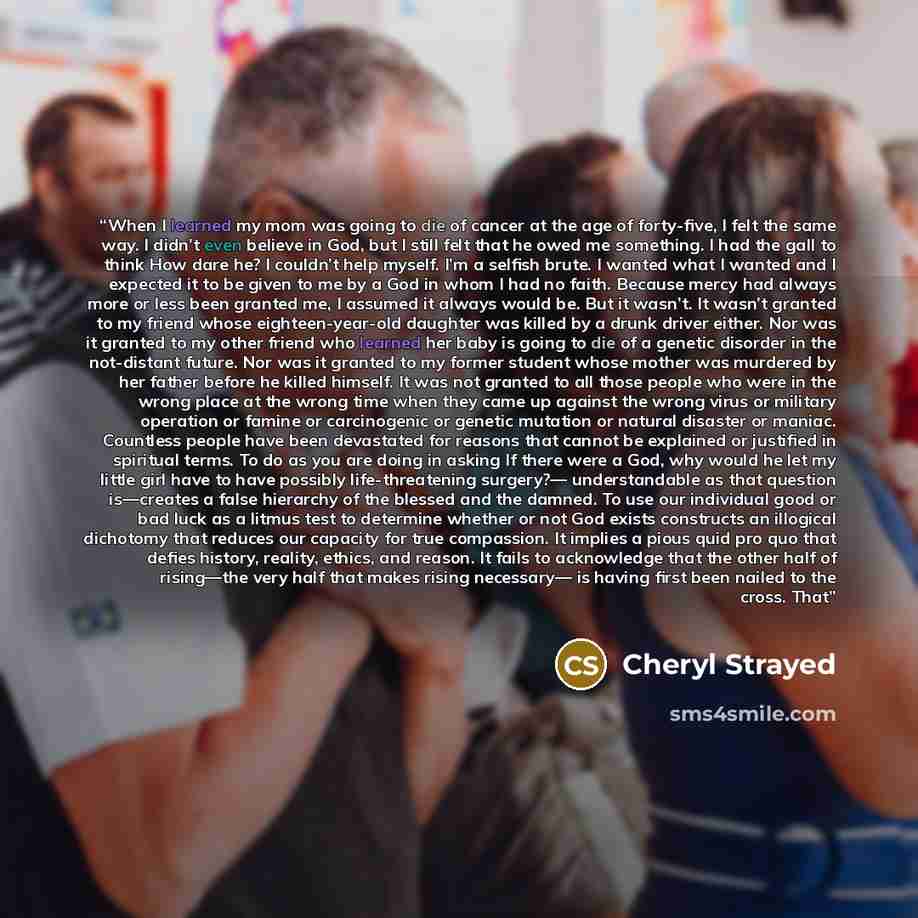
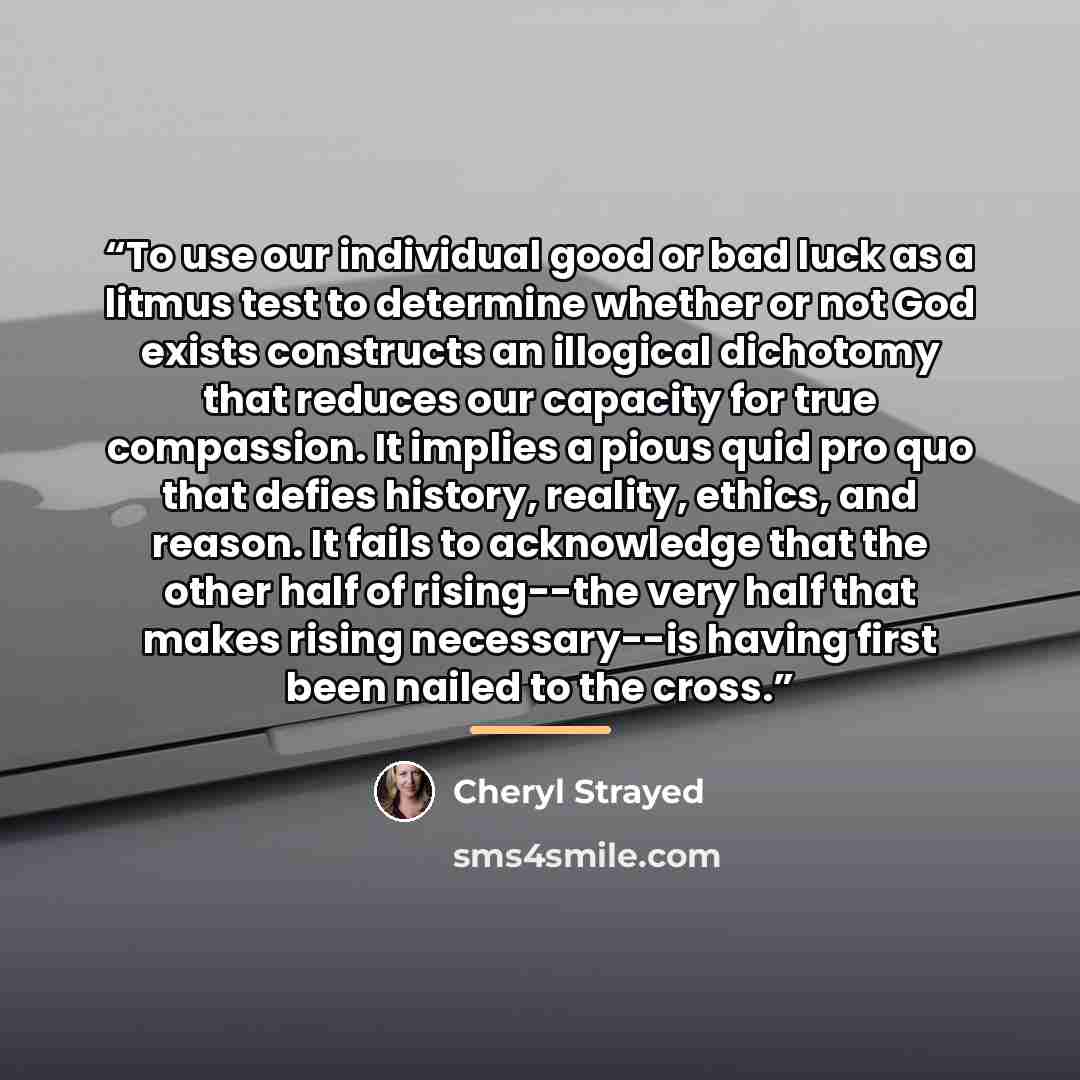
““When I learned my mom was going to die of cancer at the age of forty-five, I felt the same way. I didn’t even believe in God, but I still felt that he owed me something. I had the gall to think How dare he? I couldn’t help myself. I’m a selfish brute. I wanted what I wanted and I expected it to be given to me by a God in whom I had no faith. Because mercy had always more or less been granted me, I assumed it always would be. But it wasn’t. It wasn’t granted to my friend whose eighteen-year-old daughter was killed by a drunk driver either. Nor was it granted to my other friend who learned her baby is going to die of a genetic disorder in the not-distant future. Nor was it granted to my former student whose mother was murdered by her father before he killed himself. It was not granted to all those people who were in the wrong place at the wrong time when they came up against the wrong virus or military operation or famine or carcinogenic or genetic mutation or natural disaster or maniac. Countless people have been devastated for reasons that cannot be explained or justified in spiritual terms. To do as you are doing in asking If there were a God, why would he let my little girl have to have possibly life-threatening surgery?— understandable as that question is—creates a false hierarchy of the blessed and the damned. To use our individual good or bad luck as a litmus test to determine whether or not God exists constructs an illogical dichotomy that reduces our capacity for true compassion. It implies a pious quid pro quo that defies history, reality, ethics, and reason. It fails to acknowledge that the other half of rising—the very half that makes rising necessary— is having first been nailed to the cross. That””
About This Quote
Source Essay: “The God Question” in “Wild: From Lost to Found on the Pacific Crest Trail”, 2012
The passage challenges the belief that divine justice determines who suffers, arguing that such thinking creates a false moral hierarchy and hinders genuine compassion.
In simple terms: Questioning God’s fairness can block empathy.
Key Takeaway
Recognize suffering as random, not a test of faith.
Themes
faith
justice
compassion
human suffering
theology
Mood
reflective
somber
thoughtful
Type
philosophical
emotive
critical.
When to use this quote
- grieving a loved one
- coping with illness
- confronting tragedy
- seeking meaning after loss
Key Concepts
existentialism
moral philosophy
randomness
inequality
Questions to Reflect On
- How can we cultivate compassion without attributing suffering to divine judgment?
- What alternative frameworks help us understand random tragedy?
A Different Perspective
It may oversimplify complex theological debates and ignore personal spiritual experiences.