Analytic Quote by Benjamin Franklin
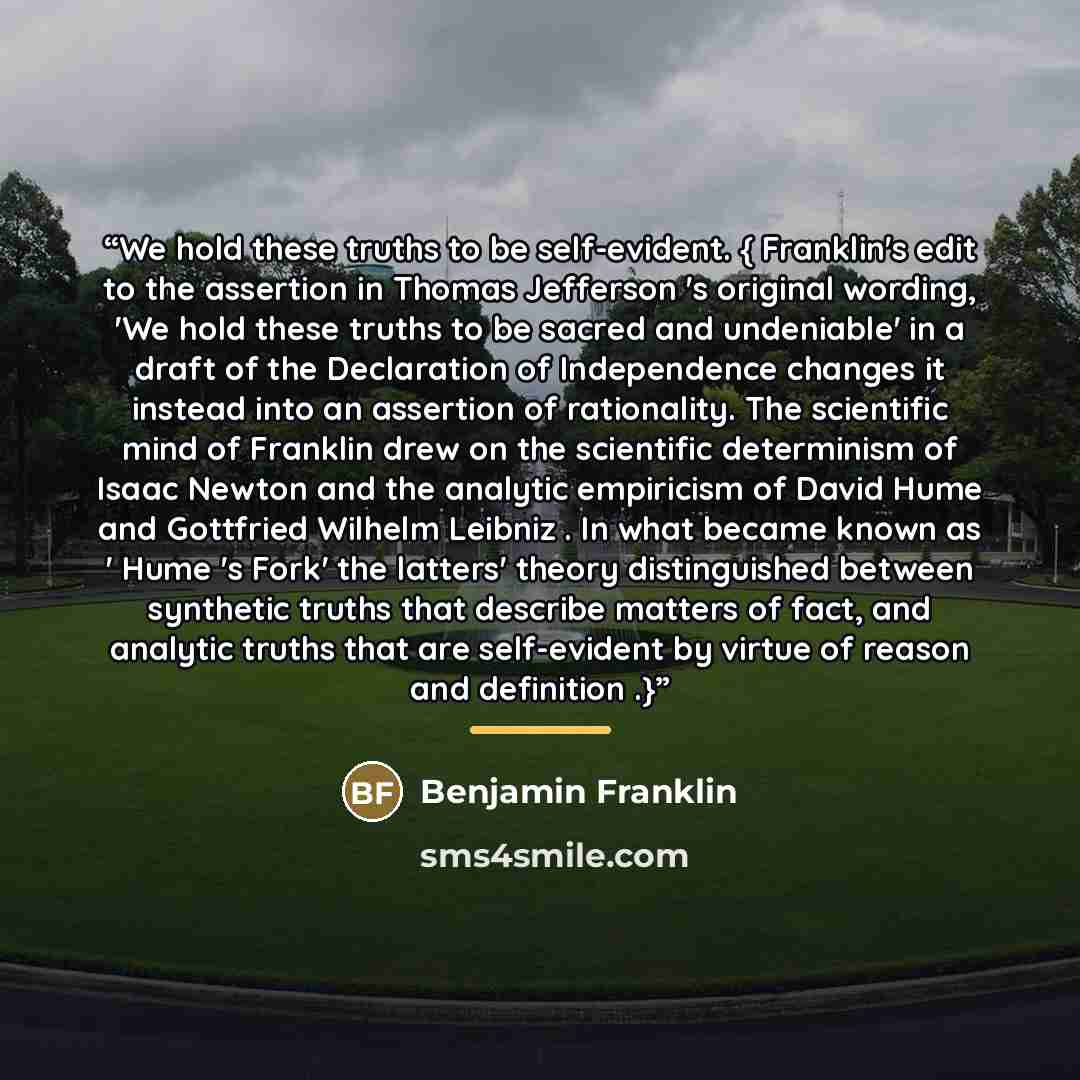
““We hold these truths to be self-evident. { Franklin's edit to the assertion in Thomas Jefferson 's original wording, 'We hold these truths to be sacred and undeniable' in a draft of the Declaration of Independence changes it instead into an assertion of rationality. The scientific mind of Franklin drew on the scientific determinism of Isaac Newton and the analytic empiricism of David Hume and Gottfried Wilhelm Leibniz . In what became known as ' Hume 's Fork' the latters' theory distinguished between synthetic truths that describe matters of fact, and analytic truths that are self-evident by virtue of reason and definition .}””
About This Quote
Source Document: Draft of the Declaration of Independence, 1776
The passage reflects a shift from absolute, sacred truths to rational, self‑evident principles, influenced by Enlightenment thinkers.
In simple terms: Truths become based on reason, not sacredness.
Key Takeaway
Embrace reasoned principles over unquestioned tradition.
Themes
philosophy
politics
enlightenment
truth
Mood
reflective
inquisitive
optimistic
Type
historical
political
When to use this quote
- constitutional drafting
- educational curricula
- public discourse
- legal reasoning
Key Concepts
rationalism
empiricism
synthetic vs analytic distinction
Questions to Reflect On
- How does rationalism shape modern legal foundations?
- Can sacred values coexist with rational principles?
A Different Perspective
The claim may oversimplify the complex historical development of the Declaration's language.



![“[On Gottfried Wilhelm Leibniz] The answer is unknowable, but it may not be unreasonable to see him, at least in theological terms, as essentially a deist. He is a determinist: there are no miracles (the events so called being merely instances of infrequently occurring natural laws); Christ has no…” quote by Peter Loptson](https://sms4smile.com/quotes/img-quotes/a6d/peter-loptson-150065_deism_on-gottfried-wilhelm-leibniz-the-answer_3128811.jpg)