Being true Quote by Bart D. Ehrman
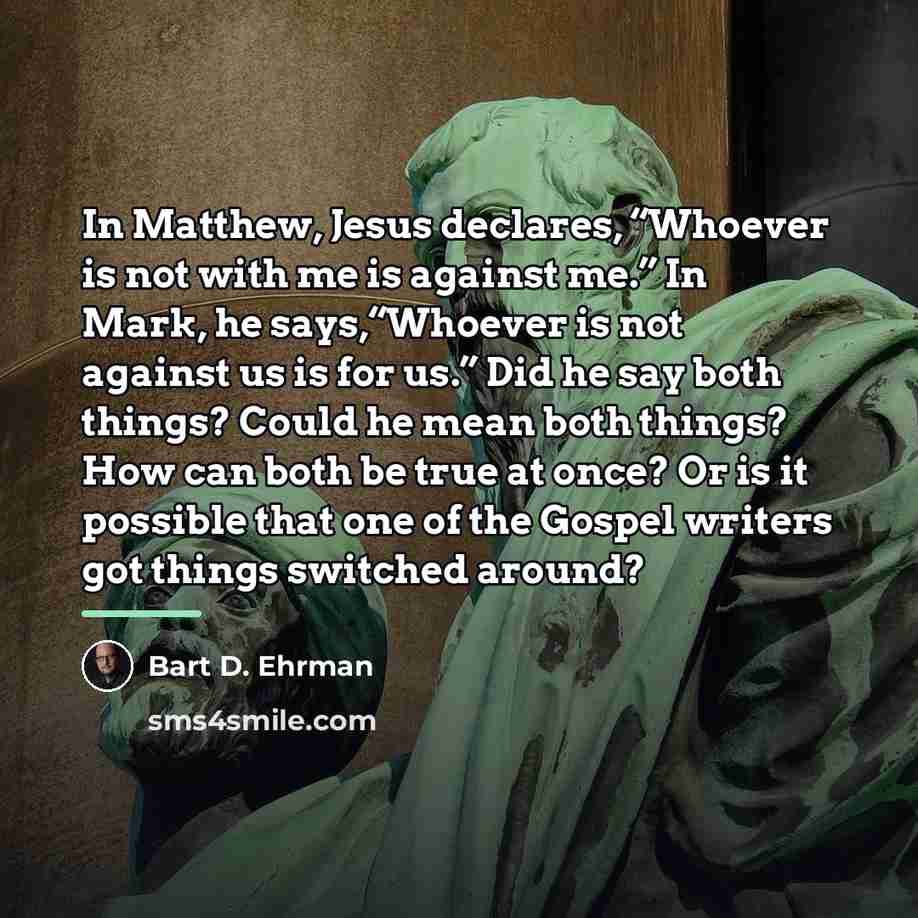
“In Matthew, Jesus declares, “Whoever is not with me is against me.” In Mark, he says,“Whoever is not against us is for us.” Did he say both things? Could he mean both things? How can both be true at once? Or is it possible that one of the Gospel writers got things switched around?”
About This Quote
Source Bible: New Testament Gospels, Matthew 12:30 & Mark 9:40
The two statements reflect different rhetorical contexts: one emphasizes exclusive loyalty, the other highlights inclusivity toward neutral parties.
In simple terms: One says “against me,” the other “for us.”
Key Takeaway
Recognize the nuance in each gospel’s message.
Themes
faith
interpretation
context
exclusivity
inclusivity
Mood
thoughtful
inquisitive
Type
theological
interpretive
scholarly
When to use this quote
- church teaching
- interfaith dialogue
- personal belief
- academic study
Key Concepts
Theology
hermeneutics
biblical criticism
Questions to Reflect On
- How do you reconcile exclusive and inclusive language in religious texts?
- What does each statement imply about community boundaries?
A Different Perspective
The verses may be paraphrased or translated differently, affecting perceived meaning.








![“Out of the guys, I'm closest to Matthew Perry. He's a great friend. He cracks me up[on the set].” quote by Courteney Cox](https://sms4smile.com/quotes/img-quotes/9a4/courteney-cox-4841_closest_out-of-the-guys-i-m-closest-to-matthew-p_138416.jpg)
![“All I cared about was the music, like hearing Townes [ Van Zandt] talking about "For the sake of the song"; it's all that mattered. In spite of me a couple of things happened, mainly the Eagles and Seven Bridges Road. That certainly helped me survive. Joan Baez, Rita Coolidge, and Ian Matthews did…” quote by Steve Young](https://sms4smile.com/quotes/img-quotes/053/steve-young-2710_bridges_all-i-cared-about-was-the-music-like-hea_124821.jpg)