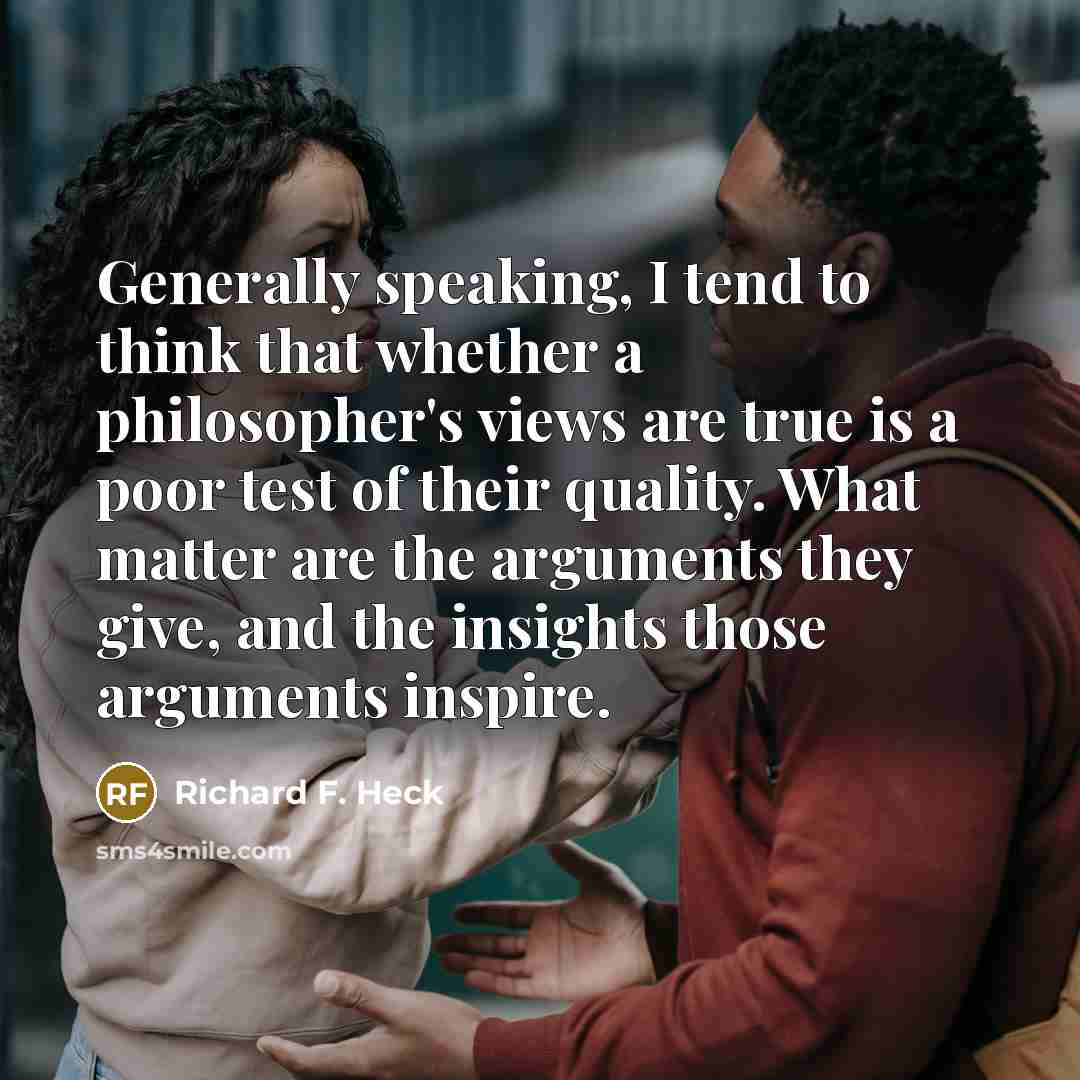
Being true Quote by Richard F. Heck
“Intuitionists think that there are cases in which, say, some identity statement between real numbers is neither true nor false, even though we know that it cannot possibly be false. That is: We know that it cannot not be that a = b, say, but we cannot conclude that a = b. We can't, in general, move from not-not-p to p in intuitionistic logic. , I suggest that the believer in vague objects should say something similar. It can never be true that it is vague whether A is B. But that does not imply that there is always a fact of the matter whether A is B.”
About This Quote
Intuitionistic logic rejects the law of excluded middle, allowing statements that are neither provably true nor false, even when falsity is impossible; similarly, vagueness does not guarantee a determinate fact.
In simple terms: Intuitionism limits double‑negation inference; vagueness lacks a fixed truth value.
Key Takeaway
Not all undecidable statements become true.
Themes
logic
philosophy of mathematics
vagueness
epistemology
intuitionism
Mood
analytical
critical
inquisitive
Type
philosophical
technical
When to use this quote
- formal proof analysis
- semantic debates on vagueness
- teaching intuitionistic logic
- philosophical discussions on truth
Key Concepts
law of excluded middle
double negation
vague predicates
Practical Applications
- designing constructive algorithms
- modeling fuzzy concepts
Questions to Reflect On
- How does rejecting double negation affect mathematical practice?
- Can vagueness be formally captured without assuming hidden facts?
A Different Perspective
Some argue that vagueness must resolve to a fact of the matter, contrary to the claim that it can remain indeterminate.