Kashmir-shaivism Quote by Balajinnatha Pandita
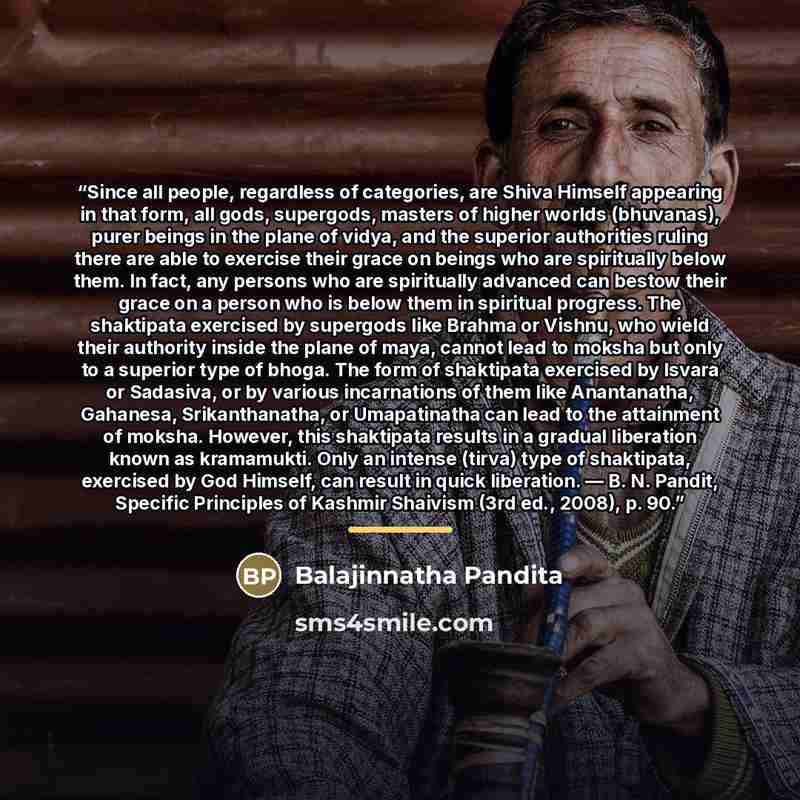
““Since all people, regardless of categories, are Shiva Himself appearing in that form, all gods, supergods, masters of higher worlds (bhuvanas), purer beings in the plane of vidya, and the superior authorities ruling there are able to exercise their grace on beings who are spiritually below them. In fact, any persons who are spiritually advanced can bestow their grace on a person who is below them in spiritual progress. The shaktipata exercised by supergods like Brahma or Vishnu, who wield their authority inside the plane of maya, cannot lead to moksha but only to a superior type of bhoga. The form of shaktipata exercised by Isvara or Sadasiva, or by various incarnations of them like Anantanatha, Gahanesa, Srikanthanatha, or Umapatinatha can lead to the attainment of moksha. However, this shaktipata results in a gradual liberation known as kramamukti. Only an intense (tirva) type of shaktipata, exercised by God Himself, can result in quick liberation. — B. N. Pandit, Specific Principles of Kashmir Shaivism (3rd ed., 2008), p. 90.””
About This Quote
Spiritual hierarchy allows higher beings to grant grace, but only divine, intense shaktipata can bring swift liberation; other forms lead to gradual emancipation.
In simple terms: Higher spiritual beings can help, but only God's direct power frees quickly.
Key Takeaway
Divine grace varies in intensity and result.
Themes
Kashmir Shaivism
spiritual hierarchy
grace
moksha
shaktipata
Mood
reverent
philosophical
mysterious
Type
philosophical
religious
didactic
When to use this quote
- Guiding a disciple
- rituals seeking divine favor
- spiritual mentorship
- philosophical study of liberation
Key Concepts
gradual vs. instant liberation
authority of divine vs. superhuman
Practical Applications
- Seek authentic divine connection for rapid growth
- Use gradual practices for steady progress
Questions to Reflect On
- How do we recognize true divine grace?
- Can gradual practice ever equal the impact of intense divine intervention?
A Different Perspective
The distinction between 'intense' and 'gradual' shaktipata may be subjective and hard to verify.

![“Perfectly pure beings, having evolved the world through their own natural vilasa [exuberant divine play], and offering all things as oblations to the sacred fire of their own pure and perfect Consciousness, excel all while drinking deep the nectar of the blissfulness of their own vilasa, vibrating…” quote by Balajinnatha Pandita](https://sms4smile.com/quotes/img-quotes/e23/balajinnatha-pandita-24889_amritavagbhava_perfectly-pure-beings-having-evolved-the_1915112.jpg)
![“Moksha is natural and spontaneous [sahaj], straightforward [sarad] and easy [soogam], but difficult to attain. Because a moksha-swaroop purush - One who is the embodiment of liberation, should be available.” quote by Dada Bhagwan](https://sms4smile.com/quotes/img-quotes/9ca/dada-bhagwan-31_enlightened-one_moksha-is-natural-and-spontaneous-sahaj_1302320.jpg)

![“[T]his philosophy [of Kashmir Shaivism] posits a transcendental Absolute that is theistic in nature. This Absolute is not some separate divine source, but is identical with the Self of every being. Nor is It just some inert, Self-absorbed form of Consciousness. It is vibrant, luminous, Self-aware…” quote by Balajinnatha Pandita](https://sms4smile.com/quotes/img-quotes/2c5/balajinnatha-pandita-24889_absolute_t-his-philosophy-of-kashmir-shaivism-pos_1644936.jpg)