Creative energy Quote by Balajinnatha Pandita
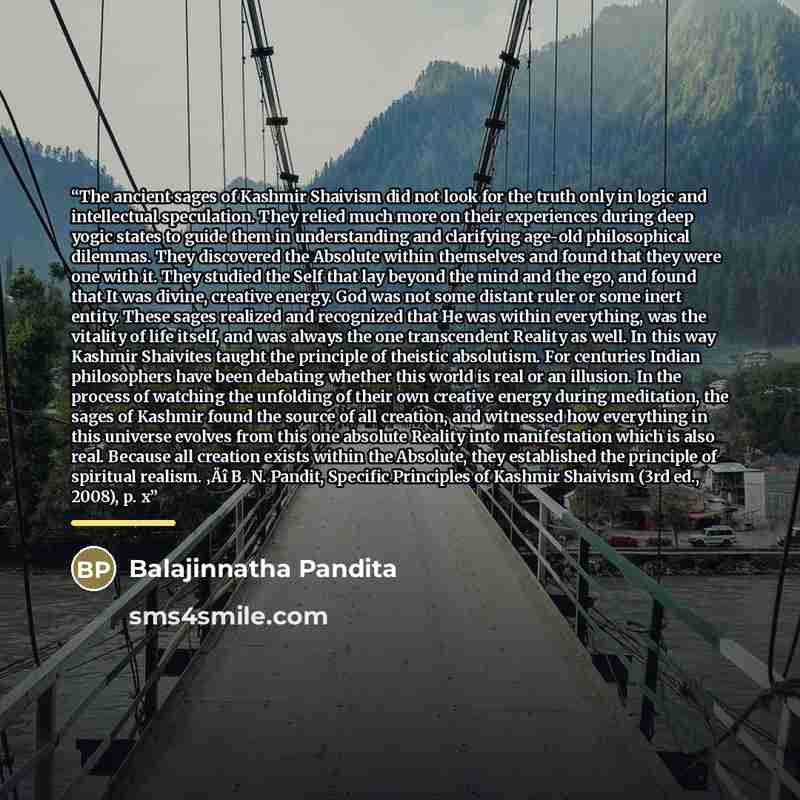
““The ancient sages of Kashmir Shaivism did not look for the truth only in logic and intellectual speculation. They relied much more on their experiences during deep yogic states to guide them in understanding and clarifying age-old philosophical dilemmas. They discovered the Absolute within themselves and found that they were one with it. They studied the Self that lay beyond the mind and the ego, and found that It was divine, creative energy. God was not some distant ruler or some inert entity. These sages realized and recognized that He was within everything, was the vitality of life itself, and was always the one transcendent Reality as well. In this way Kashmir Shaivites taught the principle of theistic absolutism. For centuries Indian philosophers have been debating whether this world is real or an illusion. In the process of watching the unfolding of their own creative energy during meditation, the sages of Kashmir found the source of all creation, and witnessed how everything in this universe evolves from this one absolute Reality into manifestation which is also real. Because all creation exists within the Absolute, they established the principle of spiritual realism. ‚Äî B. N. Pandit, Specific Principles of Kashmir Shaivism (3rd ed., 2008), p. x””
About This Quote
Source Book: Specific Principles of Kashmir Shaivism by B. N. Pandit, 2008
The sages emphasized direct experiential insight over intellectual reasoning, seeing the divine as an inner, creative force that permeates all reality.
In simple terms: Experience, not logic, reveals the divine within and the true nature of reality.
Key Takeaway
Seek inner experience to understand reality.
Themes
spirituality
philosophy
self‑realization
metaphysics
Mood
contemplative
reverent
Type
philosophical
inspirational
When to use this quote
- meditation practice
- philosophical study
- spiritual counseling
- personal transformation
Key Concepts
non‑dualism
theistic absolutism
creative energy
Questions to Reflect On
- How can you balance inner experience with rational inquiry?
- What practices help you perceive inner creative energy?
A Different Perspective
Relying solely on experience may neglect critical analysis and lead to subjective bias.
![“[T]his philosophy [of Kashmir Shaivism] posits a transcendental Absolute that is theistic in nature. This Absolute is not some separate divine source, but is identical with the Self of every being. Nor is It just some inert, Self-absorbed form of Consciousness. It is vibrant, luminous, Self-aware…” quote by Balajinnatha Pandita](https://sms4smile.com/quotes/img-quotes/2c5/balajinnatha-pandita-24889_absolute_t-his-philosophy-of-kashmir-shaivism-pos_1644936.jpg)
![“Perfectly pure beings, having evolved the world through their own natural vilasa [exuberant divine play], and offering all things as oblations to the sacred fire of their own pure and perfect Consciousness, excel all while drinking deep the nectar of the blissfulness of their own vilasa, vibrating…” quote by Balajinnatha Pandita](https://sms4smile.com/quotes/img-quotes/e23/balajinnatha-pandita-24889_amritavagbhava_perfectly-pure-beings-having-evolved-the_1915112.jpg)


![“The [character-]armored, mechanistically rigid person thinks mechanistically, produces mechanistic tools, and forms a mechanistic conception of nature. The armored person who feels his orgonotic body excitations in spite of his biological rigidity, but does not understand them, is mystic man. He…” quote by Wilhelm Reich](https://sms4smile.com/quotes/img-quotes/f11/wilhelm-reich-2565_atom-bomb_the-character-armored-mechanistically-ri_559961.jpg)