Education Quote by Arundhati Roy
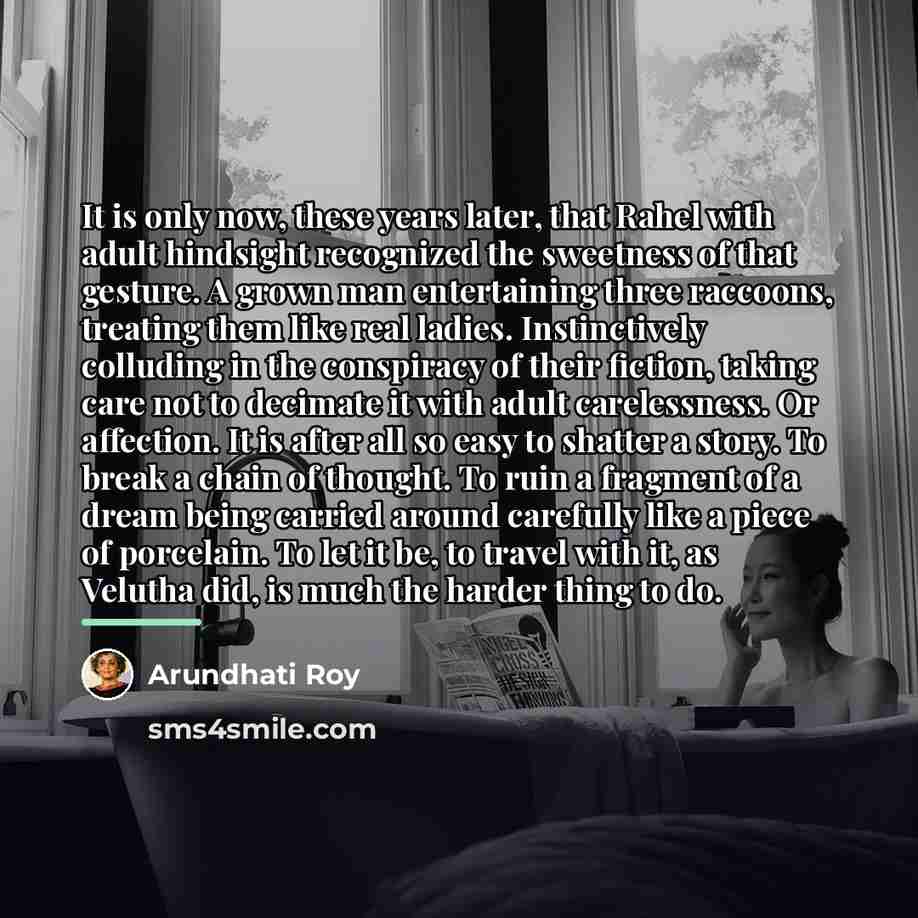
““They visited him in saris, clumping gracelessly through red mud and long grass ... and introduced themselves as Mrs. Pillai, Mrs. Eapen and Mrs. Rajagopalan. Velutha introduced himself and his paralyzed brother Kuttappen (although he was fast asleep). He greeted them with the utmost courtesy. He addressed them all as Kochamma [an honorific title for a woman] and gave them fresh coconut water to drink. He chatted to them about the weather. The river. The fact that in his opinion coconut trees were getting shorter by the year. As were the ladies in Ayemenem. He introduced them to his surly hen. He showed them his carpentry tools, and whittled them each a little wooden spoon. It is only now, these years later, that Rahel with adult hindsight recognized the sweetness of that gesture. A grown man entertaining three raccoons, treating them like real ladies. Instinctively colluding in the conspiracy of their fiction, taking care not to decimate it with adult carelessness. Or affection. [emphasis mine] It is after all so easy to shatter a story. To break a chain of thought. To ruin a fragment of a dream being carried around carefully like a piece of porcelain. To let it be, to travel with it, as Velutha did, is much the harder thing to do.””
About This Quote
Source Novel: The God of Small Things, 1997
Velutha’s humble hospitality illustrates how small, sincere gestures can preserve dignity and memory amidst social hierarchies.
In simple terms: Kind acts protect fragile stories.
Key Takeaway
Offer genuine kindness without expectation.
Themes
hospitality
memory
class
gender
humanity
Mood
warm
reflective
nostalgic
Type
literary
philosophical
When to use this quote
- family gatherings
- cross‑cultural encounters
- intergenerational dialogue
Key Concepts
social hierarchy
empathy
storytelling
Questions to Reflect On
- How do simple acts become lasting symbols?
- What responsibilities arise when we witness vulnerability?
A Different Perspective
Such gestures can be misread or dismissed in oppressive contexts.