Different path Quote by Arthur Schopenhauer
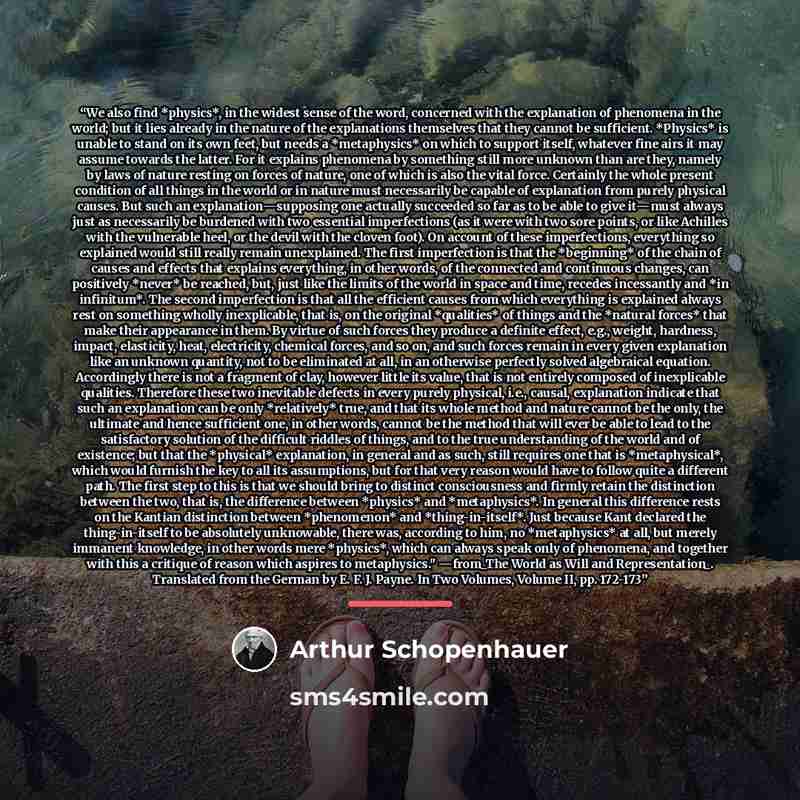
““We also find *physics*, in the widest sense of the word, concerned with the explanation of phenomena in the world; but it lies already in the nature of the explanations themselves that they cannot be sufficient. *Physics* is unable to stand on its own feet, but needs a *metaphysics* on which to support itself, whatever fine airs it may assume towards the latter. For it explains phenomena by something still more unknown than are they, namely by laws of nature resting on forces of nature, one of which is also the vital force. Certainly the whole present condition of all things in the world or in nature must necessarily be capable of explanation from purely physical causes. But such an explanation―supposing one actually succeeded so far as to be able to give it―must always just as necessarily be burdened with two essential imperfections (as it were with two sore points, or like Achilles with the vulnerable heel, or the devil with the cloven foot). On account of these imperfections, everything so explained would still really remain unexplained. The first imperfection is that the *beginning* of the chain of causes and effects that explains everything, in other words, of the connected and continuous changes, can positively *never* be reached, but, just like the limits of the world in space and time, recedes incessantly and *in infinitum*. The second imperfection is that all the efficient causes from which everything is explained always rest on something wholly inexplicable, that is, on the original *qualities* of things and the *natural forces* that make their appearance in them. By virtue of such forces they produce a definite effect, e.g., weight, hardness, impact, elasticity, heat, electricity, chemical forces, and so on, and such forces remain in every given explanation like an unknown quantity, not to be eliminated at all, in an otherwise perfectly solved algebraical equation. Accordingly there is not a fragment of clay, however little its value, that is not entirely composed of inexplicable qualities. Therefore these two inevitable defects in every purely physical, i.e., causal, explanation indicate that such an explanation can be only *relatively* true, and that its whole method and nature cannot be the only, the ultimate and hence sufficient one, in other words, cannot be the method that will ever be able to lead to the satisfactory solution of the difficult riddles of things, and to the true understanding of the world and of existence; but that the *physical* explanation, in general and as such, still requires one that is *metaphysical*, which would furnish the key to all its assumptions, but for that very reason would have to follow quite a different path. The first step to this is that we should bring to distinct consciousness and firmly retain the distinction between the two, that is, the difference between *physics* and *metaphysics*. In general this difference rests on the Kantian distinction between *phenomenon* and *thing-in-itself*. Just because Kant declared the thing-in-itself to be absolutely unknowable, there was, according to him, no *metaphysics* at all, but merely immanent knowledge, in other words mere *physics*, which can always speak only of phenomena, and together with this a critique of reason which aspires to metaphysics." ―from_The World as Will and Representation_. Translated from the German by E. F. J. Payne. In Two Volumes, Volume II, pp. 172-173””
About This Quote
Source Book: The World as Will and Representation, Arthur Schopenhauer, 1818
Physics alone cannot fully explain reality; it requires metaphysical foundations because explanations always leave unknown causes and an unreachable first cause.
In simple terms: Physics needs metaphysics to fill gaps in explanations.
Key Takeaway
Recognize limits of scientific explanations.
Themes
philosophy
science
metaphysics
epistemology
Mood
thoughtful
inquisitive
Type
analytical
philosophical
When to use this quote
- academic research
- theoretical physics
- philosophical debate
- education
- personal reflection
Key Concepts
causality
first cause
unknown forces
Questions to Reflect On
- What are the limits of scientific explanation?
- How do we address the unknown in causality?
A Different Perspective
Physical explanations always retain hidden assumptions and an infinite regress.










![“[T]he appropriate form of address between man and man ought to be, not monsieur, sir, but fellow sufferer, compagnon de miseres.” quote by Arthur Schopenhauer](https://sms4smile.com/quotes/img-quotes/be6/arthur-schopenhauer-226_addresses_t-he-appropriate-form-of-address-between_32897.jpg)


![“[Materialism] seeks the primary and most simple state of matter, and then tries to develop all the others from it; ascending from mere mechanism, to chemism, to polarity, to the vegetable and to the animal kingdom. And if we suppose this to have been done, the last link in the chain would be…” quote by Arthur Schopenhauer](https://sms4smile.com/quotes/img-quotes/88c/arthur-schopenhauer-226_animal-kingdom_materialism-seeks-the-primary-and-most-s_50402.jpg)