Clear water Quote by Arthur Schopenhauer
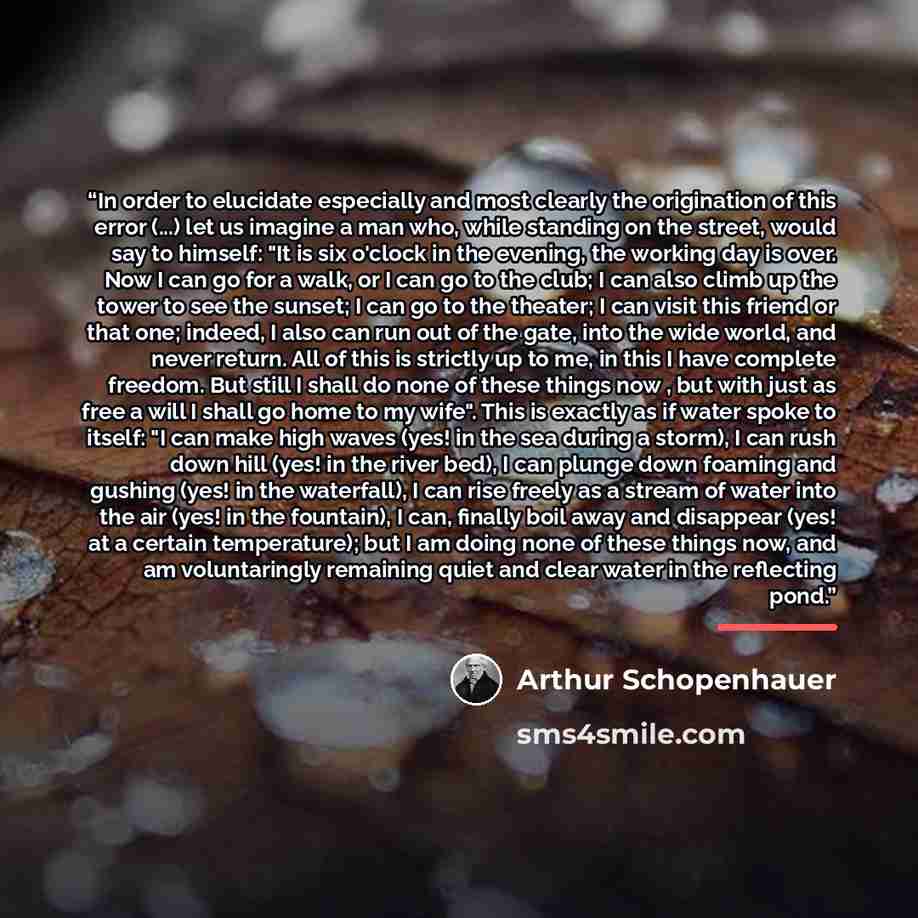
““In order to elucidate especially and most clearly the origination of this error (...) let us imagine a man who, while standing on the street, would say to himself: "It is six o'clock in the evening, the working day is over. Now I can go for a walk, or I can go to the club; I can also climb up the tower to see the sunset; I can go to the theater; I can visit this friend or that one; indeed, I also can run out of the gate, into the wide world, and never return. All of this is strictly up to me, in this I have complete freedom. But still I shall do none of these things now , but with just as free a will I shall go home to my wife". This is exactly as if water spoke to itself: "I can make high waves (yes! in the sea during a storm), I can rush down hill (yes! in the river bed), I can plunge down foaming and gushing (yes! in the waterfall), I can rise freely as a stream of water into the air (yes! in the fountain), I can, finally boil away and disappear (yes! at a certain temperature); but I am doing none of these things now, and am voluntaringly remaining quiet and clear water in the reflecting pond.””
About This Quote
Source Philosophical Essay: On Freedom of the Will, 1841
Even with unlimited choices, one may choose inaction, illustrating true freedom as restraint.
In simple terms: Freedom can mean choosing to do nothing.
Key Takeaway
Recognize the power of deliberate stillness.
Themes
freedom
choice
will
Mood
contemplative
calm
Type
philosophical
inspirational
When to use this quote
- daily decision making
- creative pauses
- meditation
- strategic planning
Key Concepts
determinism
existentialism
Questions to Reflect On
- When does restraint become stagnation?
- How does deliberate stillness serve growth?
A Different Perspective
Inaction can be missed as avoidance.







![“[T]he appropriate form of address between man and man ought to be, not monsieur, sir, but fellow sufferer, compagnon de miseres.” quote by Arthur Schopenhauer](https://sms4smile.com/quotes/img-quotes/be6/arthur-schopenhauer-226_addresses_t-he-appropriate-form-of-address-between_32897.jpg)
![“[Materialism] seeks the primary and most simple state of matter, and then tries to develop all the others from it; ascending from mere mechanism, to chemism, to polarity, to the vegetable and to the animal kingdom. And if we suppose this to have been done, the last link in the chain would be…” quote by Arthur Schopenhauer](https://sms4smile.com/quotes/img-quotes/88c/arthur-schopenhauer-226_animal-kingdom_materialism-seeks-the-primary-and-most-s_50402.jpg)