Books Quote by Andrew Solomon
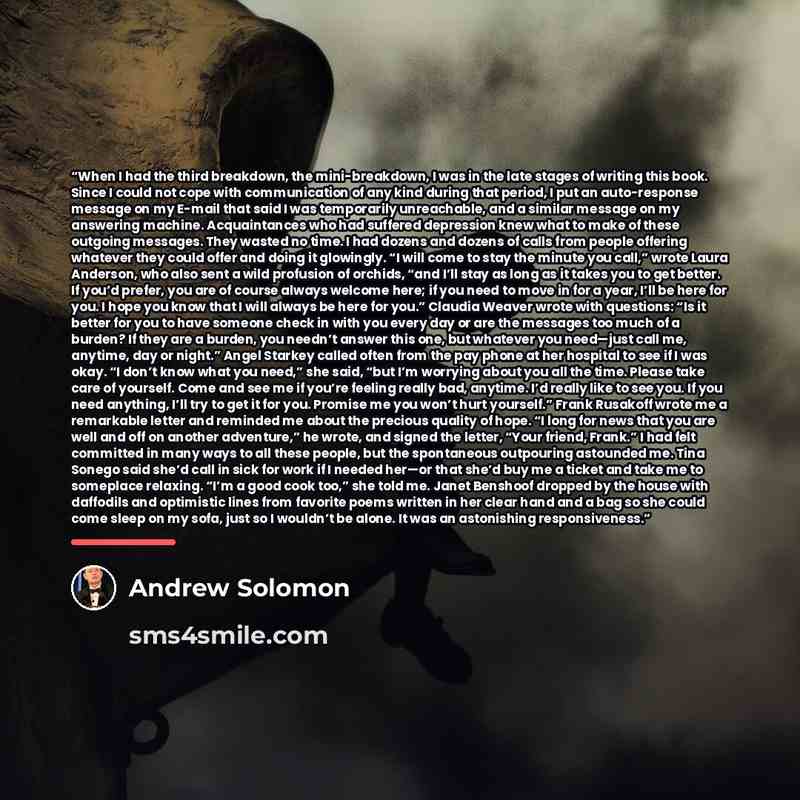
““When I had the third breakdown, the mini-breakdown, I was in the late stages of writing this book. Since I could not cope with communication of any kind during that period, I put an auto-response message on my E-mail that said I was temporarily unreachable, and a similar message on my answering machine. Acquaintances who had suffered depression knew what to make of these outgoing messages. They wasted no time. I had dozens and dozens of calls from people offering whatever they could offer and doing it glowingly. “I will come to stay the minute you call,” wrote Laura Anderson, who also sent a wild profusion of orchids, “and I’ll stay as long as it takes you to get better. If you’d prefer, you are of course always welcome here; if you need to move in for a year, I’ll be here for you. I hope you know that I will always be here for you.” Claudia Weaver wrote with questions: “Is it better for you to have someone check in with you every day or are the messages too much of a burden? If they are a burden, you needn’t answer this one, but whatever you need—just call me, anytime, day or night.” Angel Starkey called often from the pay phone at her hospital to see if I was okay. “I don’t know what you need,” she said, “but I’m worrying about you all the time. Please take care of yourself. Come and see me if you’re feeling really bad, anytime. I’d really like to see you. If you need anything, I’ll try to get it for you. Promise me you won’t hurt yourself.” Frank Rusakoff wrote me a remarkable letter and reminded me about the precious quality of hope. “I long for news that you are well and off on another adventure,” he wrote, and signed the letter, “Your friend, Frank.” I had felt committed in many ways to all these people, but the spontaneous outpouring astounded me. Tina Sonego said she’d call in sick for work if I needed her—or that she’d buy me a ticket and take me to someplace relaxing. “I’m a good cook too,” she told me. Janet Benshoof dropped by the house with daffodils and optimistic lines from favorite poems written in her clear hand and a bag so she could come sleep on my sofa, just so I wouldn’t be alone. It was an astonishing responsiveness.””
About This Quote
Source Book: Far From the Tree, Andrew Solomon, 2012
The author describes how during a severe depressive episode, he isolated himself but received an overwhelming outpouring of support from friends, offering practical help, emotional presence, and hope.
In simple terms: Even in deep crisis, people often reach out with care and assistance.
Key Takeaway
Accept help and stay connected.
Themes
mental health
support
vulnerability
community
hope
Mood
grateful
hopeful
reflective
Type
personal narrative
inspirational
empathetic
When to use this quote
- personal crisis
- depression recovery
- friendship outreach
- caregiver support
Key Concepts
social support
empathy
reciprocity
boundaries
Questions to Reflect On
- How do you balance accepting help with maintaining personal boundaries?
- What signals indicate you need more or less support?
A Different Perspective
Support can sometimes feel overwhelming or intrusive, requiring clear communication.