Filth Quote by Andrew Dickson White
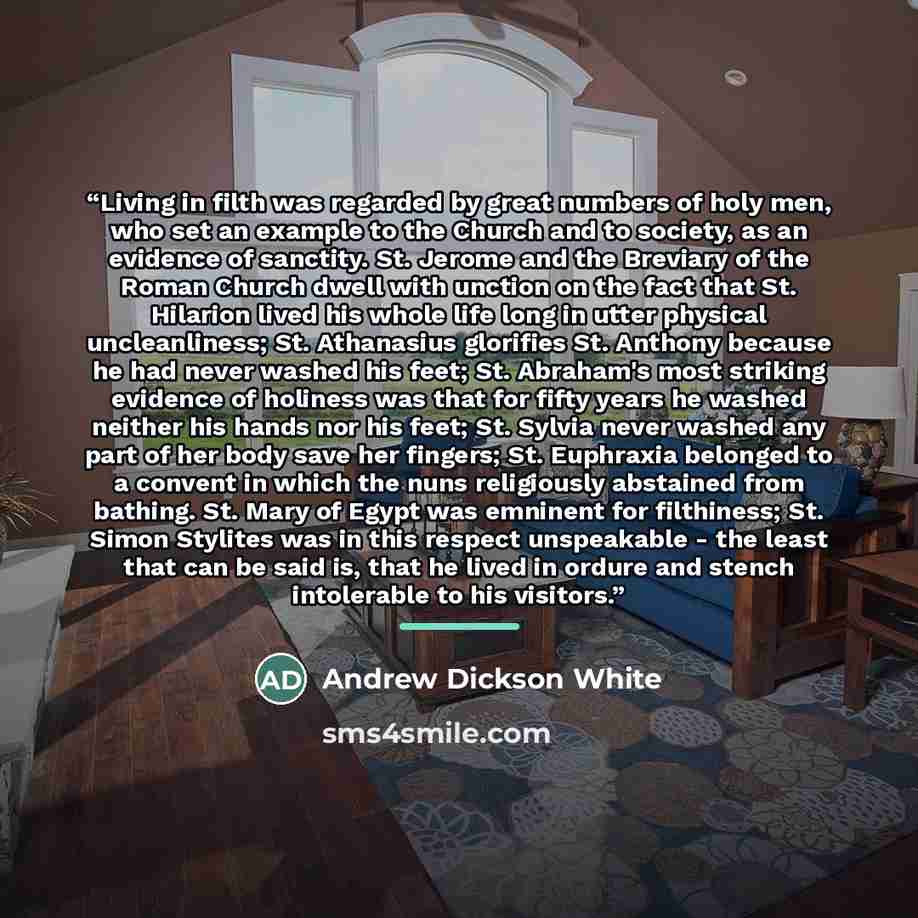
““Living in filth was regarded by great numbers of holy men, who set an example to the Church and to society, as an evidence of sanctity. St. Jerome and the Breviary of the Roman Church dwell with unction on the fact that St. Hilarion lived his whole life long in utter physical uncleanliness; St. Athanasius glorifies St. Anthony because he had never washed his feet; St. Abraham's most striking evidence of holiness was that for fifty years he washed neither his hands nor his feet; St. Sylvia never washed any part of her body save her fingers; St. Euphraxia belonged to a convent in which the nuns religiously abstained from bathing. St. Mary of Egypt was emninent for filthiness; St. Simon Stylites was in this respect unspeakable - the least that can be said is, that he lived in ordure and stench intolerable to his visitors.””
About This Quote
Source Book: A History of the Warfare of Science with Theology in Christendom, 1863
Some saints practiced extreme uncleanliness to demonstrate humility and spiritual devotion, using physical filth as a symbol of holiness.
In simple terms: Holy men sometimes stayed dirty to show devotion.
Key Takeaway
Understand cultural contexts of religious practices.
Themes
religion
humility
asceticism
historical practices
Mood
reflective
critical
Type
historical
theological
When to use this quote
- monastic life
- historical study
- spiritual reflection
- cultural analysis
Key Concepts
ascetic tradition
symbolic purity
religious symbolism
Questions to Reflect On
- Why did they equate filth with sanctity?
- How do we interpret ascetic extremes today?
A Different Perspective
Modern perspectives may view such practices as unhealthy.









![“The young man [Turgot] destined for an ecclesiastical career was placed within walls carefully designed to keep out all currents of new thought; his studies, his reading, his professors, his associates, all were combined to keep from him any results of observation or reflection save those…” quote by Andrew Dickson White](https://sms4smile.com/quotes/img-quotes/5d4/andrew-dickson-white-24254_associates_the-young-man-turgot-destined-for-an-ecc_3146.jpg)


![“This whole theory [of John Law and Jean Terrasson], as dear to French financial schemers in the eighteenth century as to American "Greenbackers" in the nineteenth, had resulted, under the Orleans Regency and Louis XV, in ruin to France financially and morally, had culminated in the utter…” quote by Andrew Dickson White](https://sms4smile.com/quotes/img-quotes/179/andrew-dickson-white-24254_century_this-whole-theory-of-john-law-and-jean-t_530736.jpg)




![“[Cornell University will be] an asylum for Science—where truth shall be sought for truth's sake, not stretched or cut exactly to fit Revealed Religion.” quote by Andrew Dickson White](https://sms4smile.com/quotes/img-quotes/f23/andrew-dickson-white-24254_cornell_cornell-university-will-be-an-asylum-for_1362392.jpg)




![“You [demagogues] are like the fishers for eels; in still waters they catch nothing, but if they thoroughly stir up the slime, their fishing is good; in the same way it's only in troublous times that you line your pockets.” quote by Aristophanes](https://sms4smile.com/quotes/img-quotes/4f7/aristophanes-3340_demagoguery_you-demagogues-are-like-the-fishers-for_87488.jpg)