Love Quote by André Breton
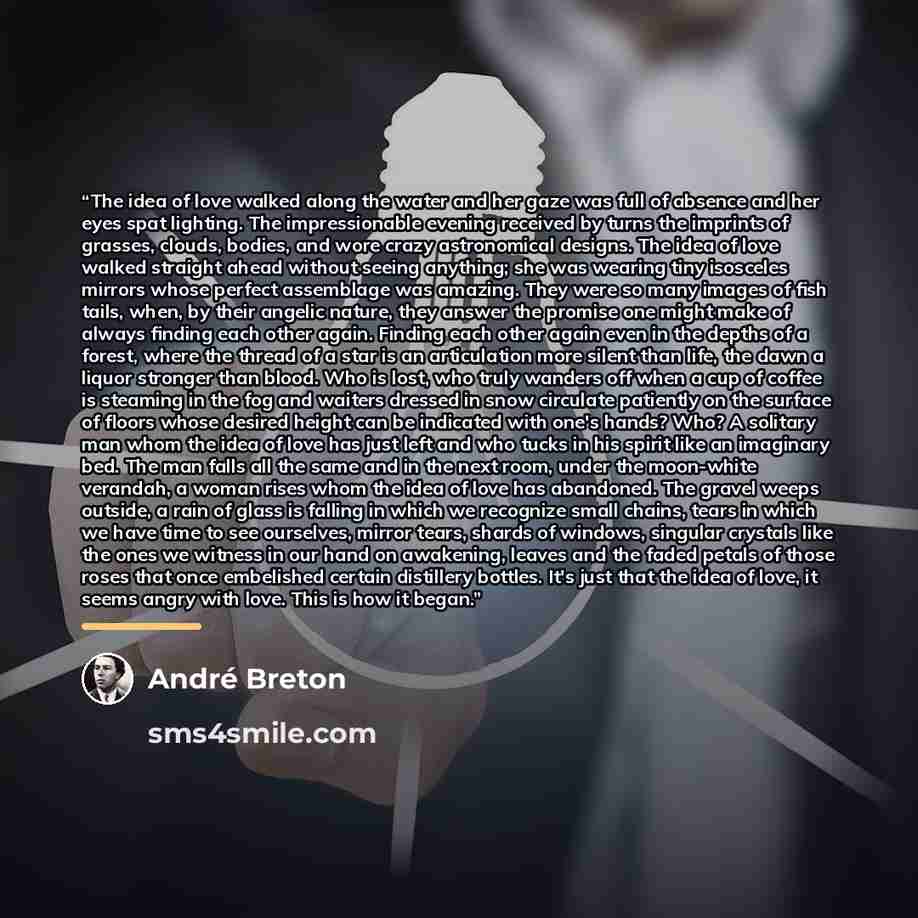
““The idea of love walked along the water and her gaze was full of absence and her eyes spat lighting. The impressionable evening received by turns the imprints of grasses, clouds, bodies, and wore crazy astronomical designs. The idea of love walked straight ahead without seeing anything; she was wearing tiny isosceles mirrors whose perfect assemblage was amazing. They were so many images of fish tails, when, by their angelic nature, they answer the promise one might make of always finding each other again. Finding each other again even in the depths of a forest, where the thread of a star is an articulation more silent than life, the dawn a liquor stronger than blood. Who is lost, who truly wanders off when a cup of coffee is steaming in the fog and waiters dressed in snow circulate patiently on the surface of floors whose desired height can be indicated with one's hands? Who? A solitary man whom the idea of love has just left and who tucks in his spirit like an imaginary bed. The man falls all the same and in the next room, under the moon-white verandah, a woman rises whom the idea of love has abandoned. The gravel weeps outside, a rain of glass is falling in which we recognize small chains, tears in which we have time to see ourselves, mirror tears, shards of windows, singular crystals like the ones we witness in our hand on awakening, leaves and the faded petals of those roses that once embelished certain distillery bottles. It's just that the idea of love, it seems angry with love. This is how it began.””
About This Quote
Source Poem: Surrealist Manifesto, 1924
Love is depicted as a chaotic, mirror‑filled journey through perception and loss.
In simple terms: Love is a confusing, reflective quest.
Key Takeaway
Accept love’s paradoxes and keep searching.
Themes
love
perception
loss
search
surrealism
Mood
melancholic
dreamy
Type
poetic
philosophical
When to use this quote
- Artistic creation
- nighttime introspection
- solitary reflection
Key Concepts
Mirror symbolism
fluid identity
existential yearning
Questions to Reflect On
- What does the mirror symbolize for you?
- How do you find meaning in love’s contradictions?
A Different Perspective
The abstract language may obscure practical relevance.