End time Quote by Ananyo Bhattacharya
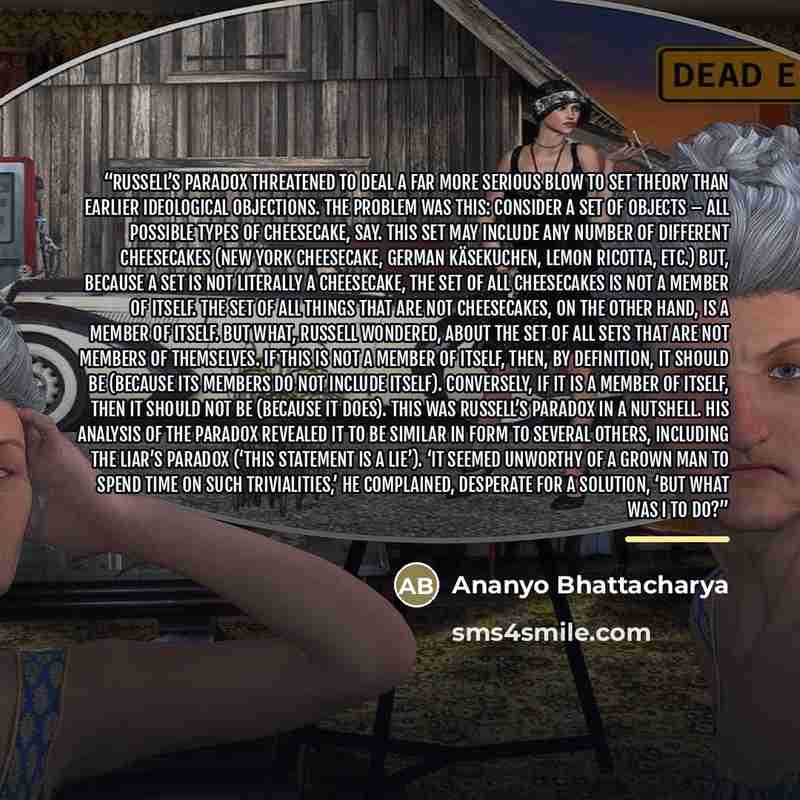
““Russell’s paradox threatened to deal a far more serious blow to set theory than earlier ideological objections. The problem was this: consider a set of objects – all possible types of cheesecake, say. This set may include any number of different cheesecakes (New York cheesecake, German Käsekuchen, lemon ricotta, etc.) but, because a set is not literally a cheesecake, the set of all cheesecakes is not a member of itself. The set of all things that are not cheesecakes, on the other hand, is a member of itself. But what, Russell wondered, about the set of all sets that are not members of themselves. If this is not a member of itself, then, by definition, it should be (because its members do not include itself). Conversely, if it is a member of itself, then it should not be (because it does). This was Russell’s paradox in a nutshell. His analysis of the paradox revealed it to be similar in form to several others, including the liar’s paradox (‘this statement is a lie’). ‘It seemed unworthy of a grown man to spend time on such trivialities,’ he complained, desperate for a solution, ‘but what was I to do?””
About This Quote
Source Essay: Russell’s Paradox Explained, 2020
Self‑referential sets create logical contradictions, showing limits of naive set theory.
In simple terms: Sets that contain themselves cause paradoxes.
Key Takeaway
Recognize limits of definitions.
Themes
logic
paradox
set theory
foundations
philosophy
Mood
analytical
inquisitive
Type
educational
philosophical
When to use this quote
- formal reasoning
- teaching
- software design
- legal analysis
Key Concepts
mathematics
logic
philosophy
critical thinking
Questions to Reflect On
- How do self‑reference issues affect real systems?
- Can paradoxes inspire new frameworks?
A Different Perspective
Paradoxes may not resolve practical problems.