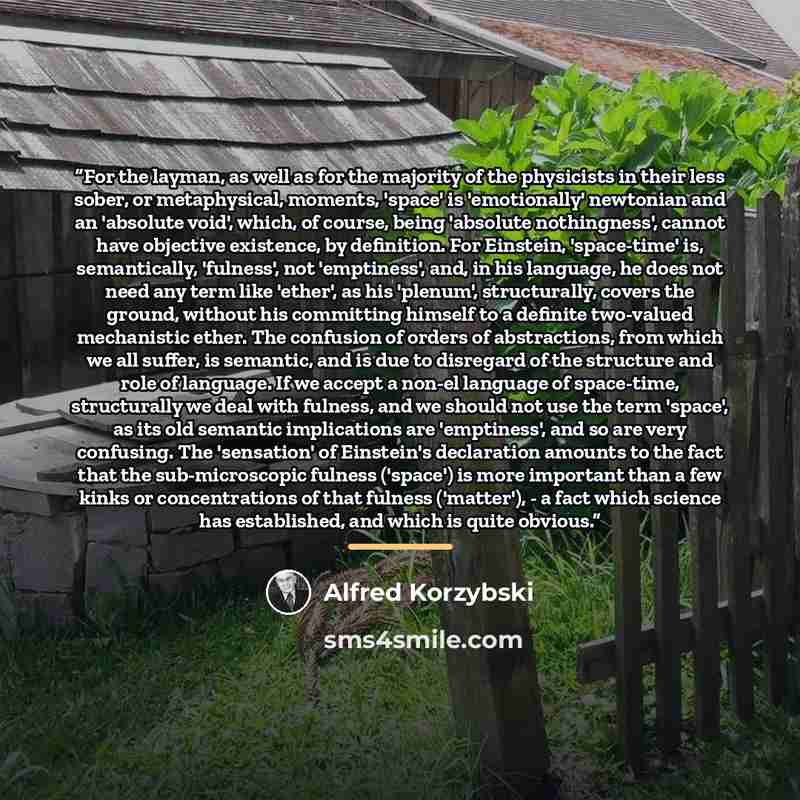
Human nature Quote by Alfred Korzybski

““There are several important remarks which can be made about this 'absolute emptiness' and 'absolute nothingness'. First of all, we now know, theoretically and empirically, that such a thing does not exist. There may be more or less of something, but never an unlimited 'perfect vacuum'. In the second place, our nervous make-up, being in accord with experience, is such that 'absolute emptiness' requires 'outside walls'. The question at once arises, is the world 'finite' or 'infinite'? If we say 'finite', it has to have outside walls, and then the question arises: What is 'behind the walls'? If we say it is 'infinite', the problem of the psychological 'walls' is not eliminated. and we still have the semantic need for walls, and then ask what is beyond the walls. So we see the such a world suspended in some sort of an 'absolute void' represents a nature against human nature, and so we had to invent something supernatural to account for such assumed nature against human nature. In the third place, and this remark is the most fundamental of all, because a symbol must stand for something to be a symbol at all, 'absolute nothingness' cannot be objective and cannot be symbolized at all. This ends the argument, as all we may say about it is neither true nor false, but non-sense. We can make noises, but say nothing about the external world. It is easy to see that 'absolute nothingness' is a label for a semantic disturbance, for verbal objectification, for a pathological state inside our skin, for a fancy, but not a symbol, for a something which has objective existence outside our skin.””
About This Quote
Source Book: Science and Sanity, Alfred Korzybski, 1933
The concept of absolute emptiness or nothingness is untenable because reality always contains some degree of something, and our minds impose boundaries that cannot be truly outside.
In simple terms: Absolute nothingness cannot exist; our minds create false walls.
Key Takeaway
Recognize limits of language and avoid treating emptiness as a literal reality.
Themes
philosophy
epistemology
psychology
language
metaphysics
Mood
thoughtful
inquisitive
critical
Type
philosophical
analytical
reflective
When to use this quote
- scientific inquiry
- philosophical debate
- psychological self‑analysis
- creative writing
- spiritual contemplation
Key Concepts
semantic limits
symbolic representation
human cognition
Questions to Reflect On
- How do we talk about what we cannot fully perceive?
- What are the consequences of treating emptiness as a symbol?
A Different Perspective
The argument may overlook that some scientific models use vacuum concepts meaningfully, even if not truly absolute.