Life Quote by Alfred Korzybski
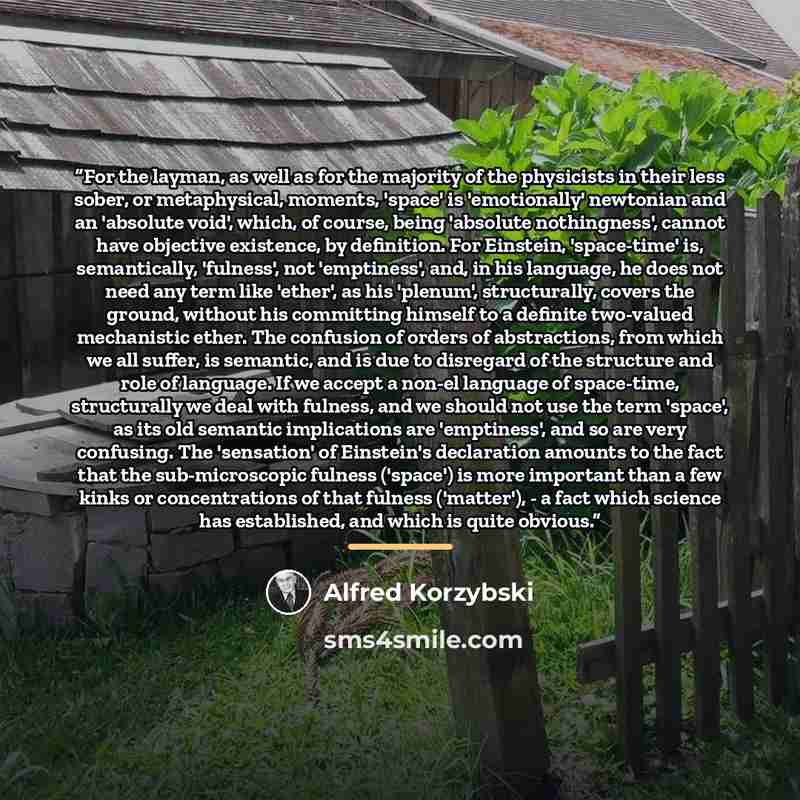
““For the layman, as well as for the majority of the physicists in their less sober, or metaphysical, moments, 'space' is 'emotionally' newtonian and an 'absolute void', which, of course, being 'absolute nothingness', cannot have objective existence, by definition. For Einstein, 'space-time' is, semantically, 'fulness', not 'emptiness', and, in his language, he does not need any term like 'ether', as his 'plenum', structurally, covers the ground, without his committing himself to a definite two-valued mechanistic ether. The confusion of orders of abstractions, from which we all suffer, is semantic, and is due to disregard of the structure and role of language. If we accept a non-el language of space-time, structurally we deal with fulness, and we should not use the term 'space', as its old semantic implications are 'emptiness', and so are very confusing. The 'sensation' of Einstein's declaration amounts to the fact that the sub-microscopic fulness ('space') is more important than a few kinks or concentrations of that fulness ('matter'), - a fact which science has established, and which is quite obvious.””
About This Quote
Source Book: Science and Sanity, Alfred Korzybski, 1933, discussion on language and physics
The term “space” carries outdated notions of emptiness; modern physics describes space‑time as full, so using “space” misleads perception
In simple terms: Old language suggests emptiness, but space‑time is full, so we should change terminology
Key Takeaway
Adopt language that reflects the fullness of space‑time
Themes
physics
language
philosophy
Mood
analytical
thought‑provoking
Type
scientific
philosophical
When to use this quote
- scientific writing
- education
- public lectures
- media reporting
Key Concepts
semantics
ontology
relativity
Questions to Reflect On
- How does language shape scientific understanding?
- What alternatives better convey space‑time’s nature?
A Different Perspective
Changing entrenched terminology may meet resistance and cause confusion






![“[The Community's] crosses and trials give me confidence. But I derive my hope above all, and most especially, from our utter incapacity, for it is always upon nothingness that God is pleased to rear His works. If at any day we accomplish some good here, the glory will certainly be His alone, since…” quote by Theodore Guerin](https://sms4smile.com/quotes/img-quotes/2b8/theodore-guerin-54729_accomplish_the-community-s-crosses-and-trials-give_7176.jpg)