“The results showed that the more times people were exposed to a photo of a completed action, the more often they thought… — David DiSalvo Copy Share Image
“most views, short-term memory has extremely limited capacity—about seven items at a time. Long-term memory includes anything that is not currently active… — David DiSalvo Copy Share Image
“transactive memory—which simply means that over time relationship partners are able to rely on each other to remember things.3 They become a… — David DiSalvo Copy Share Image
“we engage in something called episodic future thinking, which means that we simulate the future by using elements from the past.” — David DiSalvo Copy Share Image
“episodic future thinking, which means that we simulate the future by using elements from the past.” — David DiSalvo Copy Share Image
“to tell a friend that he is acting recklessly—and know we are risking the friendship—or just try to support him through a… — David DiSalvo Copy Share Image
“once we invest trust in a particular source of knowledge, we're less likely to scrutinize information from that source in the future.” — David DiSalvo Copy Share Image
“The flip side of this reality is that our big brains, advanced as they are, come with an array of complex shortcomings and are… — David DiSalvo Copy Share Image
“Participants who anticipated more rapid feedback scored the highest on the test.” — David DiSalvo Copy Share Image
“The best way to think of how our brains frame information is to imagine a picture frame, except unlike a normal frame, this one… — David DiSalvo Copy Share Image
“the amPFC and PCC were shown to play a large role in self-referential thinking and autobiographical memory (essentially, the “me” part of your brain).” — David DiSalvo Copy Share Image
“those who ask themselves whether they will perform a task generally do better than those who tell themselves that they will.” — David DiSalvo Copy Share Image
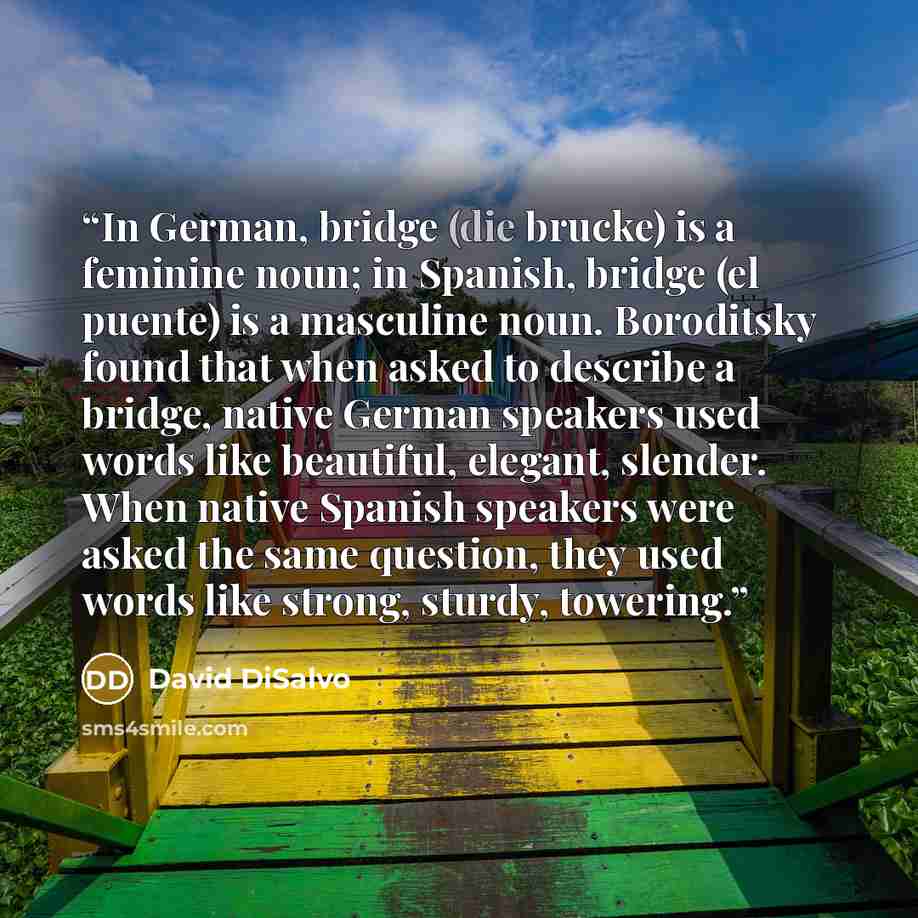
“In German, bridge (die brucke) is a feminine noun; in Spanish, bridge (el puente) is a masculine noun. Boroditsky found that when asked to… — David DiSalvo Copy Share Image
“selective attention,” also called “selectivity bias”—the tendency to orient oneself toward and process information from only one part of our environment to the exclusion… — David DiSalvo Copy Share Image
“great deal of “green” marketing is predicated on the assumption that people will buy a green product to make themselves feel better about moral… — David DiSalvo Copy Share Image
“appears that our first instinct is for idleness, but when given an excuse to be busy (even a meaningless one), we're liable to act… — David DiSalvo Copy Share Image
“The reason that persuasive messages are short, pithy, and digestible in seconds is that we process them so quickly that they become familiar without… — David DiSalvo Copy Share Image
“schema (singular form of schemata) is like a mental map of concepts that hangs together by association.” — David DiSalvo Copy Share Image