In educating the young we steer them by the rudders of pleasure and pain — Aristotle Copy Share Image
Everything that depends on the action of nature is by nature as good as it can be. — Aristotle Copy Share Image
It is possible to fail in many ways...while to succeed is possible only in one way. — Aristotle Copy Share Image
For pleasure is a state of soul, and to each man that which he is said to be a lover of is… — Aristotle Copy Share Image
It is the mark of an educated man to look for precision in each class of things just so far as the… — Aristotle Copy Share Image
Some vices miss what is right because they are deficient, others because they are excessive, in feelings or in actions, while virtue… — Aristotle Copy Share Image
Happiness is thought to depend on leisure; for we are busy that we may have leisure, and make war that we may… — Aristotle Copy Share Image
The vices respectively fall short of or exceed what is right in both passions and actions, while virtue both finds and chooses… — Aristotle Copy Share Image
Neither by nature, then, nor contrary to nature do the virtues arise in us; rather we are adapted by nature to receive… — Aristotle Copy Share Image
When people are friends, they have no need of justice, but when they are just, they need friendship in addition. — Aristotle Copy Share Image
To be conscious that we are perceiving or thinking is to be conscious of our own existence. — Aristotle Copy Share Image
For legislators make the citizens good by forming habits in them, and this is the wish of every legislator, and those who… — Aristotle Copy Share Image
It is possible to fail in many ways . . . while to succeed is possible only in one way (for which… — Aristotle Copy Share Image
“Anyone can become angry —that is easy. But to be angry with the right person, to the right degree, at the right… — Daniel Goleman Copy Share Image
In a word, acts of any kind produce habits or characters of the same kind. Hence we ought to make sure that… — Aristotle Copy Share Image
If there is some end of the things we do, which we desire for its own sake, clearly this must be the… — Aristotle Copy Share Image
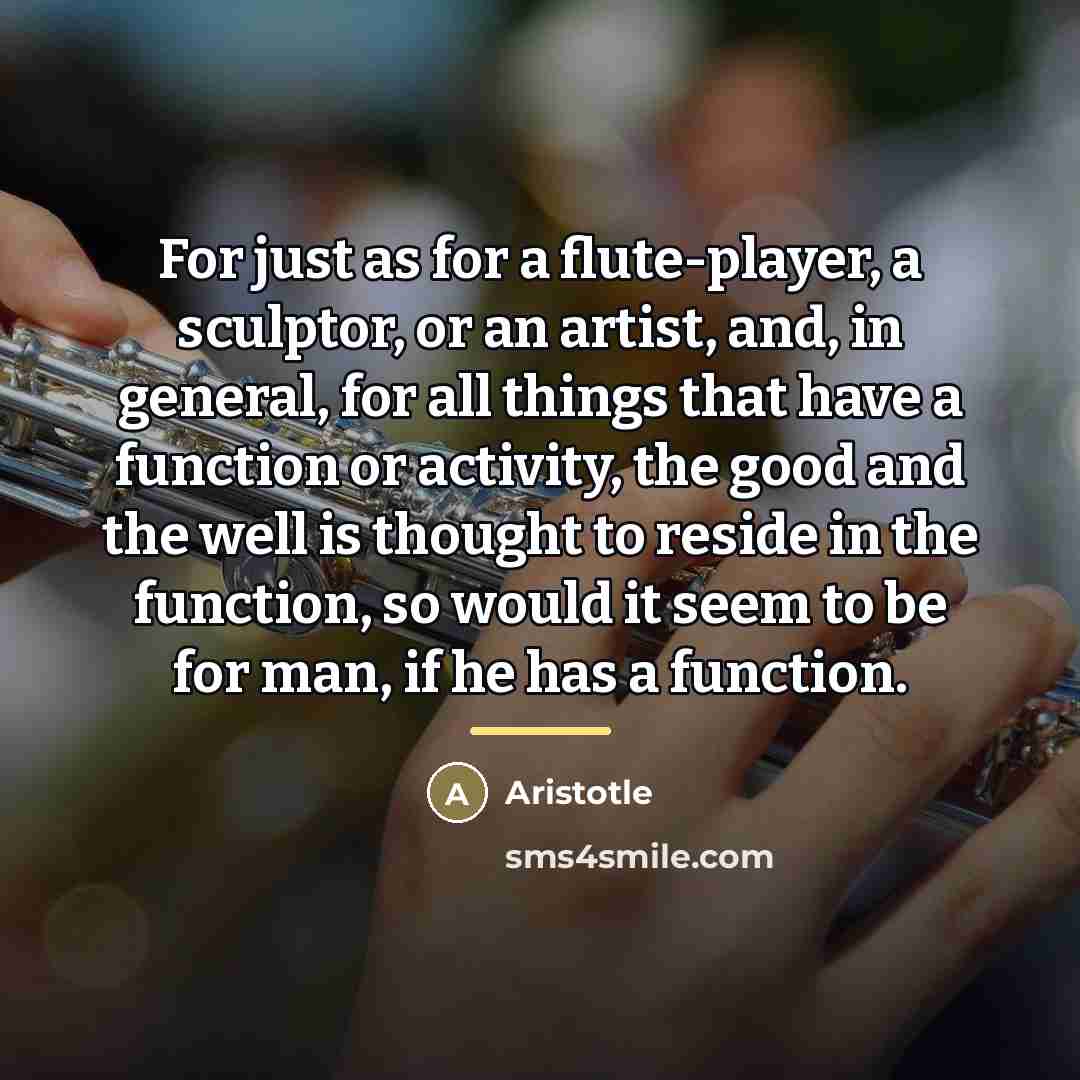
For just as for a flute-player, a sculptor, or an artist, and, in general, for all things that have a function or… — Aristotle Copy Share Image
The virtues [moral excellence] therefore are engendered in us neither by nature nor yet in violation of nature; nature gives us the… — Aristotle Copy Share Image
Everything that depends on the action of nature is by nature as good as it can be, and similarly everything that depends… — Aristotle Copy Share Image
If we state the function of man to be a certain kind of life, and this to be an activity or actions… — Aristotle Copy Share Image
A young man is not a proper hearer of lectures on political science; for he is inexperienced in the actions that occur… — Aristotle Copy Share Image
Again, it is possible to fail in many ways (for evil belongs to the class of the unlimited and good to that… — Aristotle Copy Share Image
It is well said, then, that it is by doing just acts that the just man is produced, and by doing temperate… — Aristotle Copy Share Image
“But happiness is a difficult thing-it is, as Aristotle posited in The Nicomachean Ethics, an activity, is is about good social behavior,… — Elizabeth Wurtzel Copy Share Image
The mass of mankind are evidently slavish in their tastes, preferring a life suitable to beasts — Aristotle Copy Share Image
We assume therefore that moral virtue is the quality of acting in the best way in relation to pleasures and pains, and… — Aristotle Copy Share Image
Pleasure causes us to do base actions and pain causes us to abstain from doing noble actions. — Aristotle Copy Share Image
It is evidently equally foolish to accept probable reasoning from a mathematician and to demand from a rhetorician demonstrative proofs. — Aristotle Copy Share Image
“Aristotle wrote in Nicomachean Ethics, “hold that it is by nature that people become good, others that it is by habit, and… — Charles Duhigg Copy Share Image
The truly good and wise man will bear all kinds of fortune in a seemly way, and will always act in the… — Aristotle Copy Share Image



![“The virtues [moral excellence] therefore are engendered in us neither by nature nor yet in violation of nature; nature gives us the capacity to receive them, and this capacity is brought to maturity by habit.” quote by Aristotle](https://sms4smile.com/quotes/img-quotes/653/aristotle-78_capacity_the-virtues-moral-excellence-therefore-a_1076391.jpg)