We must not feel a childish disgust at the investigations of the meaner animals. For there is something marvelous in all natural… — Aristotle Copy Share Image
Rhetoric is useful because truth and justice are in their nature stronger than their opposites; so that if decisions be made, not… — Aristotle Copy Share Image
If the consequences are the same it is always better to assume the more limited antecedent, since in things of nature the… — Aristotle Copy Share Image
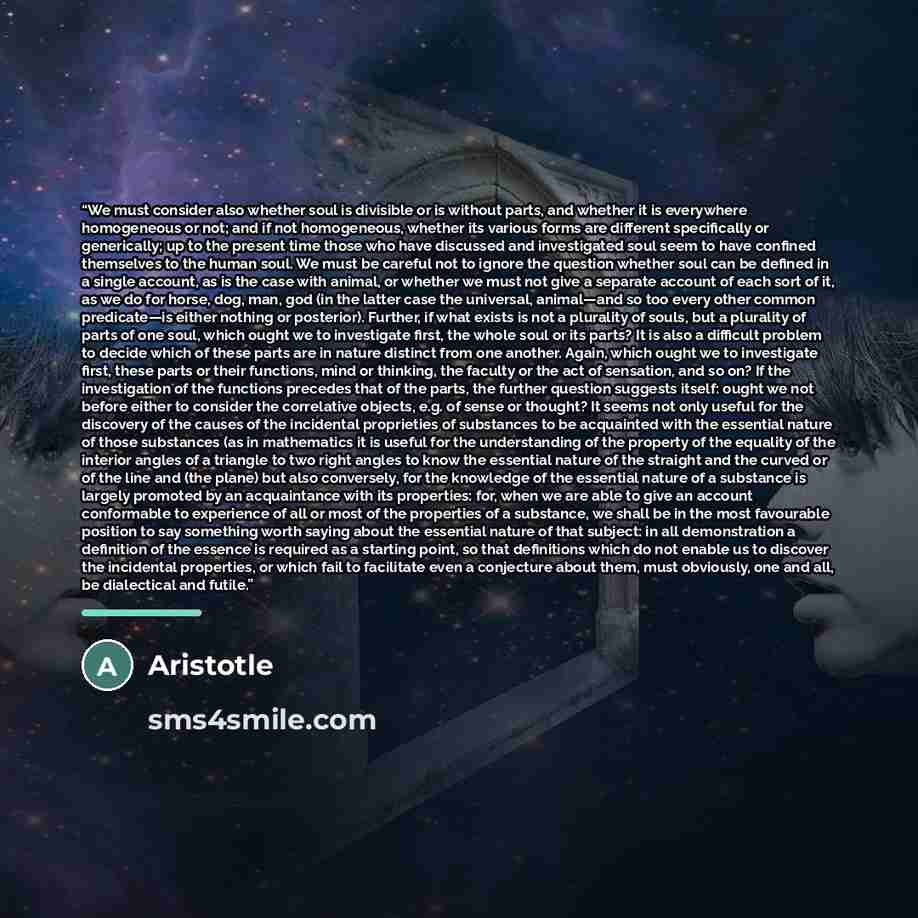
“We must consider also whether soul is divisible or is without parts, and whether it is everywhere homogeneous or not; and if… — Aristotle Copy Share Image
If the art of ship-building were in the wood, ships would exist by nature. — Aristotle Copy Share Image
Of the irrational part of the soul again one division appears to be common to all living things, and of a vegetative… — Aristotle Copy Share Image
For nature by the same cause, provided it remain in the same condition, always produces the same effect, so that either coming-to-be… — Aristotle Copy Share Image
If then nature makes nothing without some end in view, nothing to no purpose, it must be that nature has made all… — Aristotle Copy Share Image
It is clear that the earth does not move, and that it does not lie elsewhere than at the center. — Aristotle Copy Share Image
...in this way the structure of the universe- I mean, of the heavens and the earth and the whole world- was arranged… — Aristotle Copy Share Image
He who sees things grow from the beginning will have the best view of them. — Aristotle Copy Share Image
All are agreed that the various moral qualities are in a sense bestowed by nature: we are just, and capable of temperance,… — Aristotle Copy Share Image
He who can be, and therefore is, another's, and he who participates in reason enough to apprehend, but not to have, is… — Aristotle Copy Share Image
It is clear, then, that the earth must be at the centre and immovable, not only for the reasons already given, but… — Aristotle Copy Share Image
Every formed disposition of the soul realizes its full nature in relation to and dealing with that class of objects by which… — Aristotle Copy Share Image
The knowledge of the soul admittedly contributes greatly to the advance of truth in general, and, above all, to our understanding of Nature, for… — Aristotle Copy Share Image
Young men have strong passions and tend to gratify them indiscriminately. Of the bodily desires, it is the sexual by which they are most… — Aristotle Copy Share Image
The body is at its best between the ages of thirty and thirty-five; the mind is at its best about the age of forty-nine. — Aristotle Copy Share Image
The ensouled is distinguished from the unsouled by its being alive. Now since being alive is spoken of in many ways, even if only… — Aristotle Copy Share Image
Although it may be difficult in theory to know what is just and equal, the practical difficulty of inducing those to forbear who can,… — Aristotle Copy Share Image
The true forms of government, therefore, are those in which the one, or the few, or the many, govern with a view to the… — Aristotle Copy Share Image
All persons ought to endeavor to follow what is right, and not what is established. — Aristotle Copy Share Image
Give a man a fish, you feed him for a day. Give a man a poisoned fish, you feed him for the rest of… — Aristotle Copy Share Image
The man who confers a favour would rather not be repaid in the same coin. — Aristotle Copy Share Image
Obstinate people can be divided into the opinionated, the ignorant, and the boorish. — Aristotle Copy Share Image