At first he who invented any art that went beyond the common perceptions of man was naturally admired by men, not only… — Aristotle Copy Share Image
There are branches of learning and education which we must study merely with a view to leisure spent in intellectual activity, and… — Aristotle Copy Share Image
The wise man knows of all things, as far as possible, although he has no knowledge of each of them in detail — Aristotle Copy Share Image
All teaching and all intellectual learning come about from already existing knowledge. — Aristotle Copy Share Image
The ultimate value of life depends upon awareness and the power of contemplation rather than upon mere survival. — Aristotle Copy Share Image
Actual knowledge is identical with its object: in the individual, potential knowledge is in time prior to actual knowledge, but in the… — Aristotle Copy Share Image
For it is owing to their wonder that men both now begin and at first began to philosophize... They were pursuing science… — Aristotle Copy Share Image
It will contribute towards one's object, who wishes to acquire a facility in the gaining of knowledge, to doubt judiciously. — Aristotle Copy Share Image
To attain any assured knowledge about the soul is one of the most difficult things in the world. — Aristotle Copy Share Image
All men naturally desire knowledge. An indication of this is our esteem for the senses; for apart from their use we esteem… — Aristotle Copy Share Image
“Holding as we do that, while knowledge of any kind is a thing to be honoured and prized, one kind of it… — Aristotle Copy Share Image
It is clear, then, that wisdom is knowledge having to do with certain principles and causes. But now, since it is this… — Aristotle Copy Share Image
For knowing is spoken of in three ways: it may be either universal knowledge or knowledge proper to the matter in hand… — Aristotle Copy Share Image
Metaphysics involves intuitive knowledge of unprovable starting-points concepts and truth and demonstrative knowledge of what follows from them. — Aristotle Copy Share Image
The purpose of the present study is not as it is in other inquiries, the attainment of knowledge, we are not conducting… — Aristotle Copy Share Image
If there is some end of the things we do, which we desire for its own sake, clearly this must be the… — Aristotle Copy Share Image
In practical matters the end is not mere speculative knowledge of what is to be done, but rather the doing of it.… — Aristotle Copy Share Image
Whereas young people become accomplished in geometry and mathematics, and wise within these limits, prudent young people do not seem to be… — Aristotle Copy Share Image
The intelligence consists not only in the knowledge but also in the skill to apply the knowledge into practice. — Aristotle Copy Share Image
What we know is not capable of being otherwise; of things capable of being otherwise we do not know, when they have… — Aristotle Copy Share Image
Knowledge of the fact differs from knowledge of the reason for the fact. — Aristotle Copy Share Image
The knowledge of the soul admittedly contributes greatly to the advance of truth in general, and, above all, to our understanding of Nature, for… — Aristotle Copy Share Image
Young men have strong passions and tend to gratify them indiscriminately. Of the bodily desires, it is the sexual by which they are most… — Aristotle Copy Share Image
The body is at its best between the ages of thirty and thirty-five; the mind is at its best about the age of forty-nine. — Aristotle Copy Share Image
The ensouled is distinguished from the unsouled by its being alive. Now since being alive is spoken of in many ways, even if only… — Aristotle Copy Share Image
Although it may be difficult in theory to know what is just and equal, the practical difficulty of inducing those to forbear who can,… — Aristotle Copy Share Image
The true forms of government, therefore, are those in which the one, or the few, or the many, govern with a view to the… — Aristotle Copy Share Image
All persons ought to endeavor to follow what is right, and not what is established. — Aristotle Copy Share Image
Give a man a fish, you feed him for a day. Give a man a poisoned fish, you feed him for the rest of… — Aristotle Copy Share Image
The man who confers a favour would rather not be repaid in the same coin. — Aristotle Copy Share Image
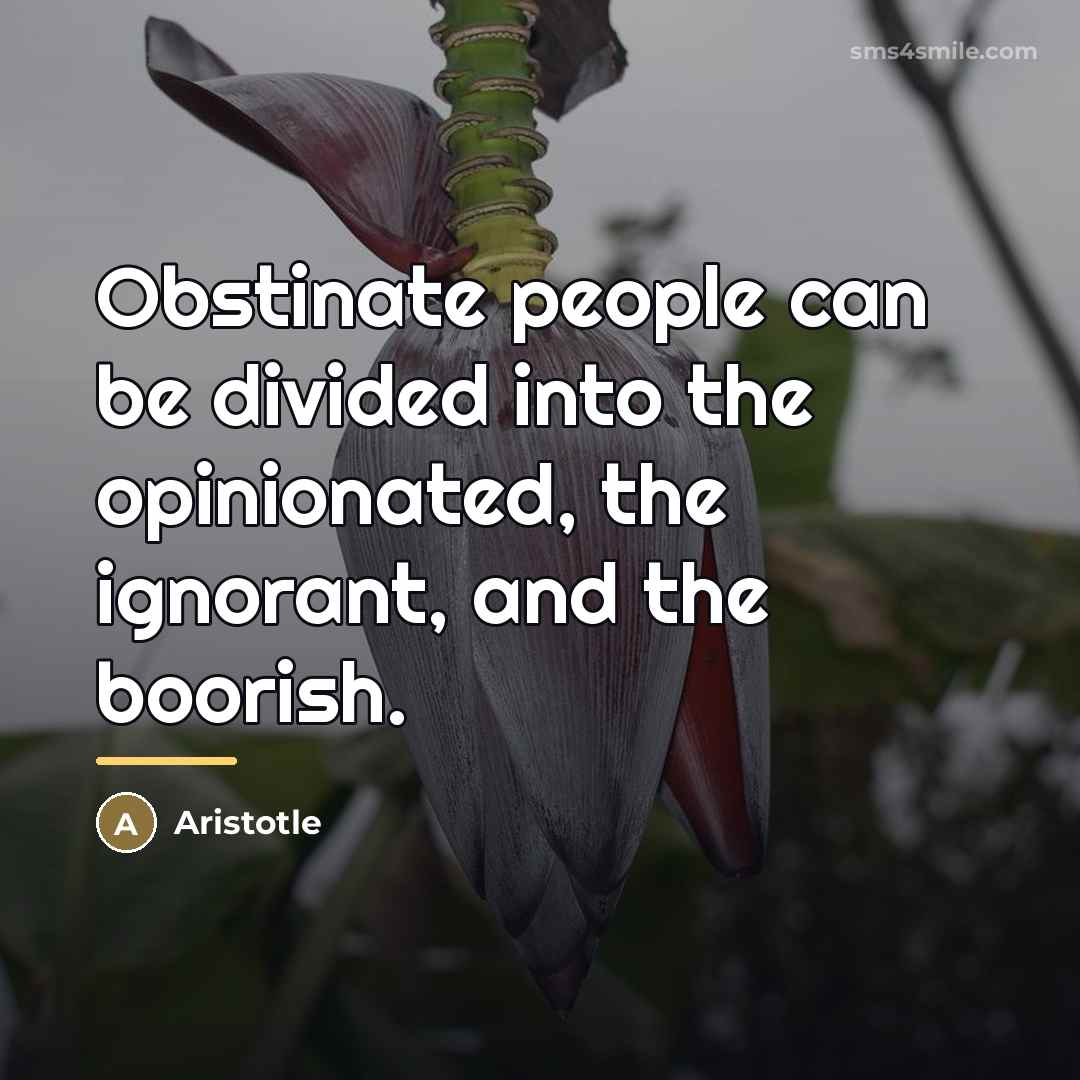
Obstinate people can be divided into the opinionated, the ignorant, and the boorish. — Aristotle Copy Share Image