Chroniclers of the role of paper in history are given to extravagant pronouncements: Architecture would not have been possible without paper. Without… — Mark Kurlansky Copy Share Image
“Most nations argue that they are a natural and eternal entity, created in some primordial epoch by mixing the soil of the… — Yuval Noah Harari Copy Share Image
To change our national economic story from one of financial speculation to one of future growth, we need a third industrial revolution:… — Chris Huhne Copy Share Image
“Corporate interests raised a nearly unified voice heralding automation as a certain and universal beneficial advancement. However, some observers saw the new… — Stephen M. Ward Copy Share Image
I don't. We've had three technological revolutions that have changed the course of human history, all driven by physics. In the first,… — Michio Kaku Copy Share Image
Conditions have changed, but we are still operating financially by the rules established during the Industrial Revolution-rules based on creating more material… — Joseph R. Dominguez Copy Share Image
As a technologist, I see how AI and the fourth industrial revolution will impact every aspect of people's lives. — Fei-Fei Li Copy Share Image
The world is poised on the cusp of an economic and cultural shift as dramatic as that of the Industrial Revolution. — Steven Levy Copy Share Image
Coding is like writing, and we live in a time of the new industrial revolution. What's happened is that maybe everybody knows… — Susan Wojcicki Copy Share Image
The fact that we have been able to perturb the carbon cycle with our industrial revolution is evidence of how vulnerable we… — Annalee Newitz Copy Share Image
Market capitalism survived and prospered after the boom-bust industrial revolution of the 19th century, and the Great Depression and world wars of… — Mark Skousen Copy Share Image
National boundaries these days are not that important because of transformative technological development. Now we are talking about the fourth industrial revolution. — Ban Ki-moon Copy Share Image
“Drug addicts perplex me. They're a relatively recent development, historically speaking. Everyone has their theories - monotheists like to blame it on… — Kevin Hearne Copy Share Image
“Tinkerers built America. Benjamin Franklin, Thomas Edison, Henry Ford, all were tinkerers in their childhood. Everything from the airplane to the computer… — Mark Steyn Copy Share Image
“A GPT is seen as an epoch-defining technology which spreads through many industries, allowing costs to fall and, equivalently, productivity to increase.… — Edward A. Hudson Copy Share Image
Conserving habitats is a wellspring for the next industrial revolution. — Janine Benyus Copy Share Image
From Caesar's legions to the Napoleonic wars. From the Reformation, the Enlightenment and the industrial revolution to the defeat of nazism. We… — David Cameron Copy Share Image
It is essential to ensure that the Fourth Industrial Revolution is a sustainable one for people and planet. It could even drive… — Johan Rockstrom Copy Share Image
“that the power of technology will keep increasing, while the price for this power will keep decreasing. With Moore’s Law proving to… — Max Isaacman Copy Share Image
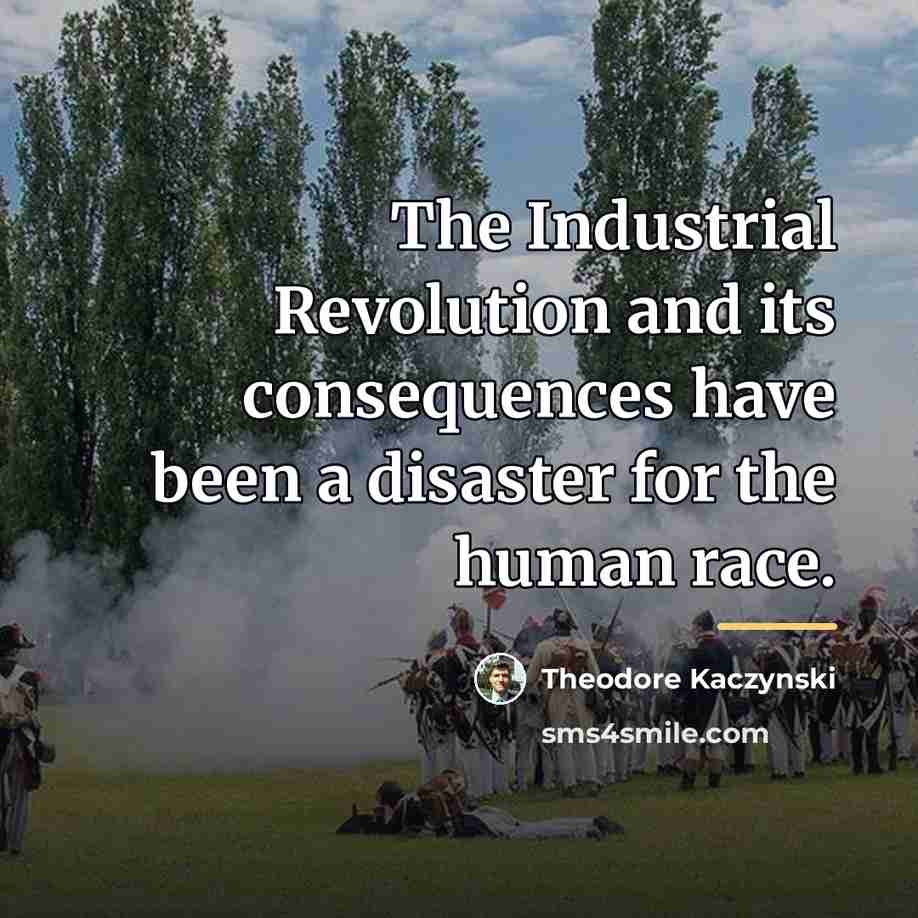
The Industrial Revolution and its consequences have been a disaster for the human race. — Theodore Kaczynski Copy Share Image
For more than 3,000 years, China and India accounted for half of the world's economic output. But then the Industrial Revolution gave… — Paul Achleitner Copy Share Image
We need to develop the new green industrial revolution that develops the new technologies that can confront and overcome the challenge of… — Tony Blair Copy Share Image
The society was so different [in China] - it was a feudalistic society. It didn't come to a point of industrial revolution… — Ai Weiwei Copy Share Image
My government has taken significant measures to enable the rise of the Fourth Industrial Revolution in our country. — Ali Bongo Ondimba Copy Share Image
I am always struck by the fact that human awareness of our place in nature, like so much of modern science, began… — Kenneth R. Miller Copy Share Image

![“The society was so different [in China] - it was…” quote by Ai Weiwei](https://sms4smile.com/quotes/img-quotes/644/ai-weiwei-824_china_the-society-was-so-different-in-china-it_2965691.jpg)