The word happiness is used to indicate at least three related things, which we might roughly call emotional happiness, moral happiness, and… — Daniel Gilbert Copy Share Image
The secret of happiness is variety, but the secret of variety, like the secret of all spices, is knowing when to use… — Daniel Gilbert Copy Share Image
People are happiest when they're trying to achieve goals that are difficult but not out of reach. — Daniel Gilbert Copy Share Image
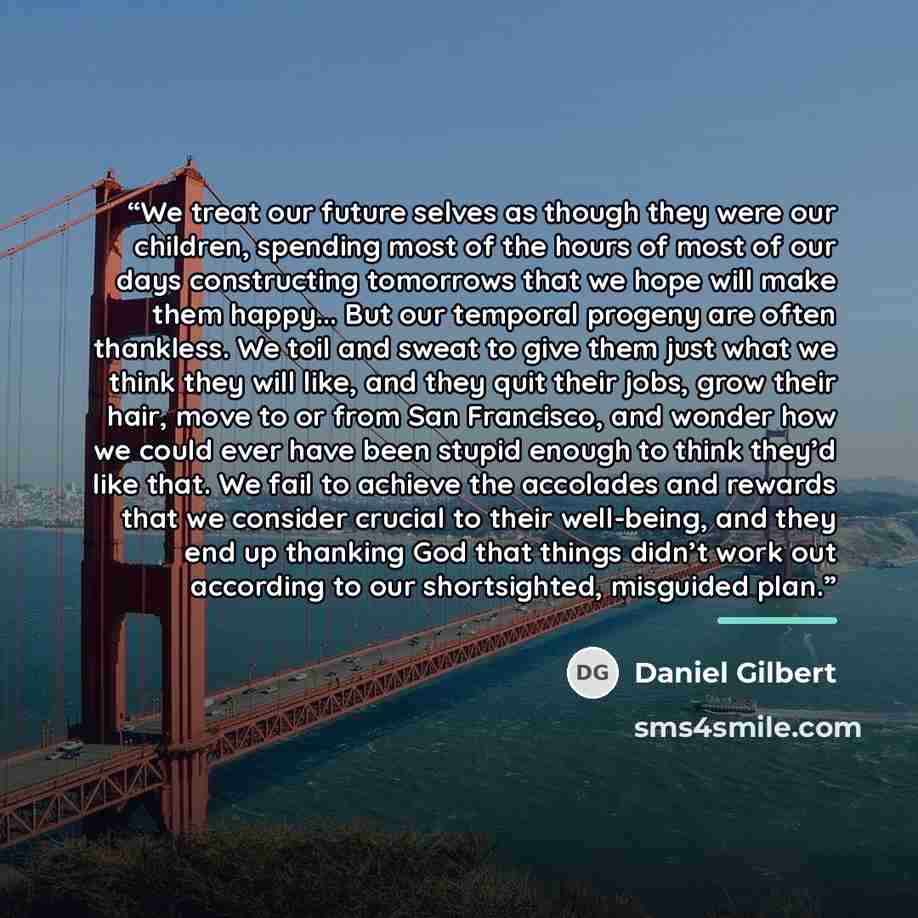
We treat our future selves as though they were our children, spending most of the hours of most of our days constructing… — Daniel Gilbert Copy Share Image
“We cannot feel good about an imaginary future when we are busy feeling bad about an actual present.” — Daniel Gilbert Copy Share Image
Your emotions are meant to fluctuate, just like your blood pressure is meant to fluctuate. It's a system that's supposed to move… — Daniel Gilbert Copy Share Image
“As the philosopher John Stuart Mill wrote, "It is better to be a human being dissatisfied than a pig satisfied; better to… — Daniel Gilbert Copy Share Image
People want to be happy, and all the other things they want are typically meant to be a means to that end. — Daniel Gilbert Copy Share Image
The data says that with the poor, a little money can buy a lot of happiness. If you're rich, a lot of… — Daniel Gilbert Copy Share Image
We are happy when we have family, we are happy when we have friends and almost all the other things we think… — Daniel Gilbert Copy Share Image
Happiness refers to feelings, virtue refers to actions, and those actions can cause those feelings. But not necessarily and not exclusively. — Daniel Gilbert Copy Share Image
Everyone who has observed human behavior for more than thirty continuous seconds seems to have noticed that people are strongly, perhaps even… — Daniel Gilbert Copy Share Image
Lower your cortisol level. The happiest people have the lowest level of cortisol, a stress hormone that raises blood pressure and weakens… — Daniel Gilbert Copy Share Image
I actually think the same things do make most people happy. The differences are extremely small, and around the margins. You like… — Daniel Gilbert Copy Share Image
“The belief-transmission network of which we are a part cannot operate without a continuously replenished supply of people to do the transmitting,… — Daniel Gilbert Copy Share Image
We all have direct experience with things that do or don't make us happy, we all have friends, therapists, cabdrivers, and talk-show… — Daniel Gilbert Copy Share Image
Because your brain uses information from the areas around the blind spot to make a reasonable guess about what the blind spot would see… — Daniel Gilbert Copy Share Image
Your emotions are meant to fluctuate, just like your blood pressure is meant to fluctuate. It's a system that's supposed to move back and… — Daniel Gilbert Copy Share Image
No one likes to be criticized, of course, but if the things we successfully strive for do not make our future selves happy, or… — Daniel Gilbert Copy Share Image
The mistakes we make when we try to imagine our personal futures are also lawful, regular, and systematic. They, too, have a pattern that… — Daniel Gilbert Copy Share Image
“As students of the silver screen recall, Bogart's admonition about future regret led Bergman to board the plane and fly away with her husband.… — Daniel Gilbert Copy Share Image
Reality' is a movie generated by our brains. Because we don't realize this, we are far too confident that the stuff appearing in the… — Daniel Gilbert Copy Share Image
“Despite the third word of the title, this is not an instruction manual that will tell you anything useful about how to be happy.… — Daniel Gilbert Copy Share Image
The truth is, bad things don't affect us as profoundly as we expect them to. That's true of good things, too. We adapt very… — Daniel Gilbert Copy Share Image
Our brain accepts what the eyes see and our eye looks for whatever our brain wants. — Daniel Gilbert Copy Share Image
Perceptions are portraits, not photographs, and their form reveals the artist’s hand every bit as much as it reflects the things portrayed — Daniel Gilbert Copy Share Image
“We treat our future selves as though they were our children, spending most of the hours of most of our days constructing tomorrows that… — Daniel Gilbert Copy Share Image
“The brain and the eye may have a contractual relationship in which the brain has agreed to believe what they eye sees, but in… — Daniel Gilbert Copy Share Image