The lesson from behavioral economics is that people only save if it's automatic. — Richard Thaler Copy Share Image
One of the big lessons from behavioral economics is that we make decisions as a function of the environment that we're in. — Dan Ariely Copy Share Image
“Dan Ariely, author of Predictably Irrational, a book that offers an entertaining and engaging overview of behavioral economics.” — Daniel H. Pink Copy Share Image
“Wouldn't economics make a lot more sense if it were based on how people actually behave, instead of how they should behave?” — Dan Ariely Copy Share Image
Behavioral economics can explain some things, but it's hard to explain a lot of the underlying processes that generate these decisions, much… — Edward Boyden Copy Share Image
In the world of traditional economics, it shouldn't matter whether you use an opt-in or opt-out system. So long as the costs… — Richard Thaler Copy Share Image
The lesson of my field, behavioral economics, is that we need to understand the ways in which we differ from the rational… — Richard Thaler Copy Share Image
January is always a good month for behavioral economics: Few things illustrate self-control as vividly as New Year's resolutions. February is even… — Sendhil Mullainathan Copy Share Image
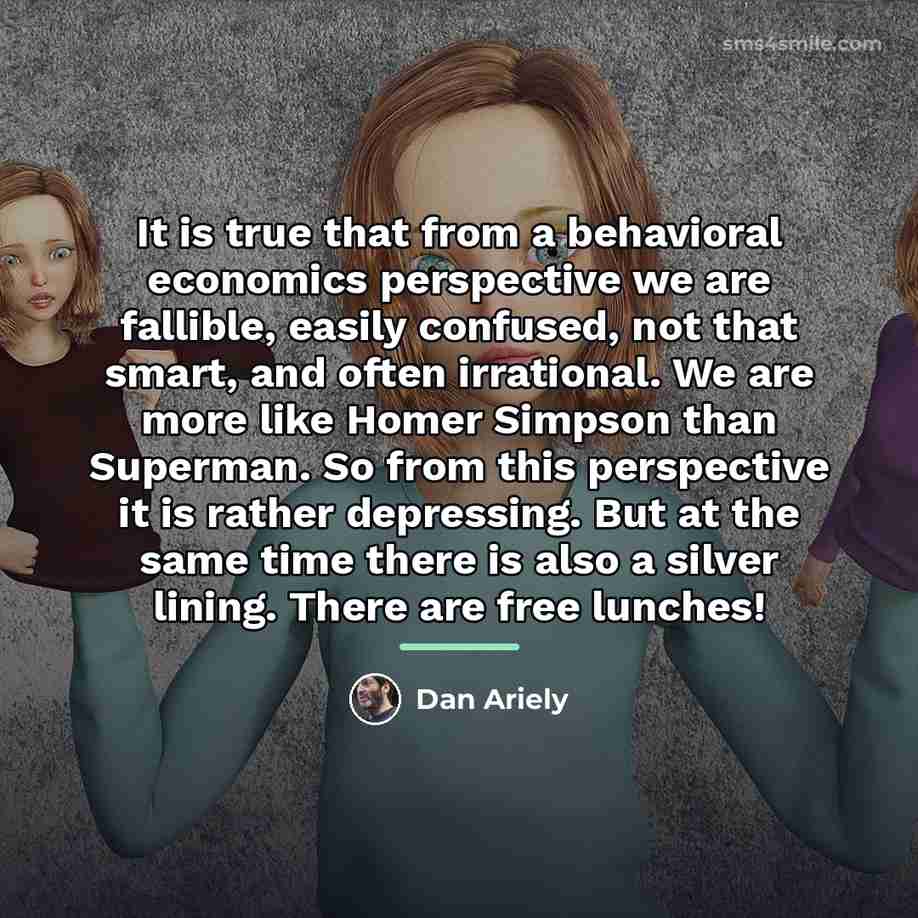
It is true that from a behavioral economics perspective we are fallible, easily confused, not that smart, and often irrational. We are… — Dan Ariely Copy Share Image
[There will be movement toward] behavioral economics... [which] involves study of those aspects of men's images, or cognitive and affective structures that… — Kenneth E. Boulding Copy Share Image
Retirement savings is probably behavioral economists' greatest success story. It is a prototypical behavioral-economics problem because saving for retirement is cognitively hard… — Richard Thaler Copy Share Image
How should the best parts of psychology and economics interrelate in an enlightened economist's mind?... I think that these behavioral economics...or economists… — Charlie Munger Copy Share Image
“In fact quite generally, commercial advertising is fundamentally an effort to undermine markets. We should recognize that. If you’ve taken an economics… — Noam Chomsky Copy Share Image
“In the field of behavioral economics, neoliberalism allows that human behavior often deviates from the model of Homo economicus. The deviations considered,… — Susan Neiman Copy Share Image
“The inconsistencies that haunt our relationships with animals also result from the quirks of human cognition. We like to think of ourselves… — Hal Herzog Copy Share Image
“Neoclassical economics has effectively insulated itself from the great advances made in science and engineering over the last 40 years. This self-imposed… — Steve Keen Copy Share Image
“ONE OF THE main differences between standard and behavioral economics involves this concept of “free lunches.” According to the assumptions of standard… — Dan Ariely Copy Share Image
“Groups have powerful self-reinforcing mechanisms at work. These can lead to group polarization—a tendency for members of the group to end up… — James Montier Copy Share Image
The concept of loss aversion is certainly the most significant contribution of psychology to behavioral economics. — Daniel Kahneman Copy Share Image
I started to read as obsessively about Star Wars as I once did about Kant - and still do about behavioral economics… — Cass Sunstein Copy Share Image
“... confidence, fairness, corruption, money illusion, and stories. These are real motivations for real people. They are ubiquitous. The presumption of mainstream… — Anonymous Copy Share Image
Behavioral economics offers a plausible explanation for overreactions by the market. For example, a long period of bad performance can lead to… — Richard Thaler Copy Share Image
It is true that I am one of the co-authors of 'Nudge,' and I am a behavioral economist, but it does not… — Richard Thaler Copy Share Image
“Standard economics assumes that we are rational... But, as the results presented in this book (and others) show, we are far less… — Dan Ariely Copy Share Image
Everyone's lost a lot of money on their 401k plans. I've heard some people calling them 201k plans. So it's even more… — Richard Thaler Copy Share Image
“From this failure to expunge the microeconomic foundations of neoclassical economics from post-Great Depression theory arose the "microfoundations of macroeconomics" debate, which… — Steve Keen Copy Share Image
![“[There will be movement toward] behavioral economics... [which] involves study of those aspects of men's images, or cognitive and affective structures that are more relevant to economic decisions.” quote by Kenneth E. Boulding](https://sms4smile.com/quotes/img-quotes/f32/kenneth-e-boulding-3728_aspect_there-will-be-movement-toward-behavioral_842854.jpg)