Lacan, as we have seen in our discussion of Freud, regards…
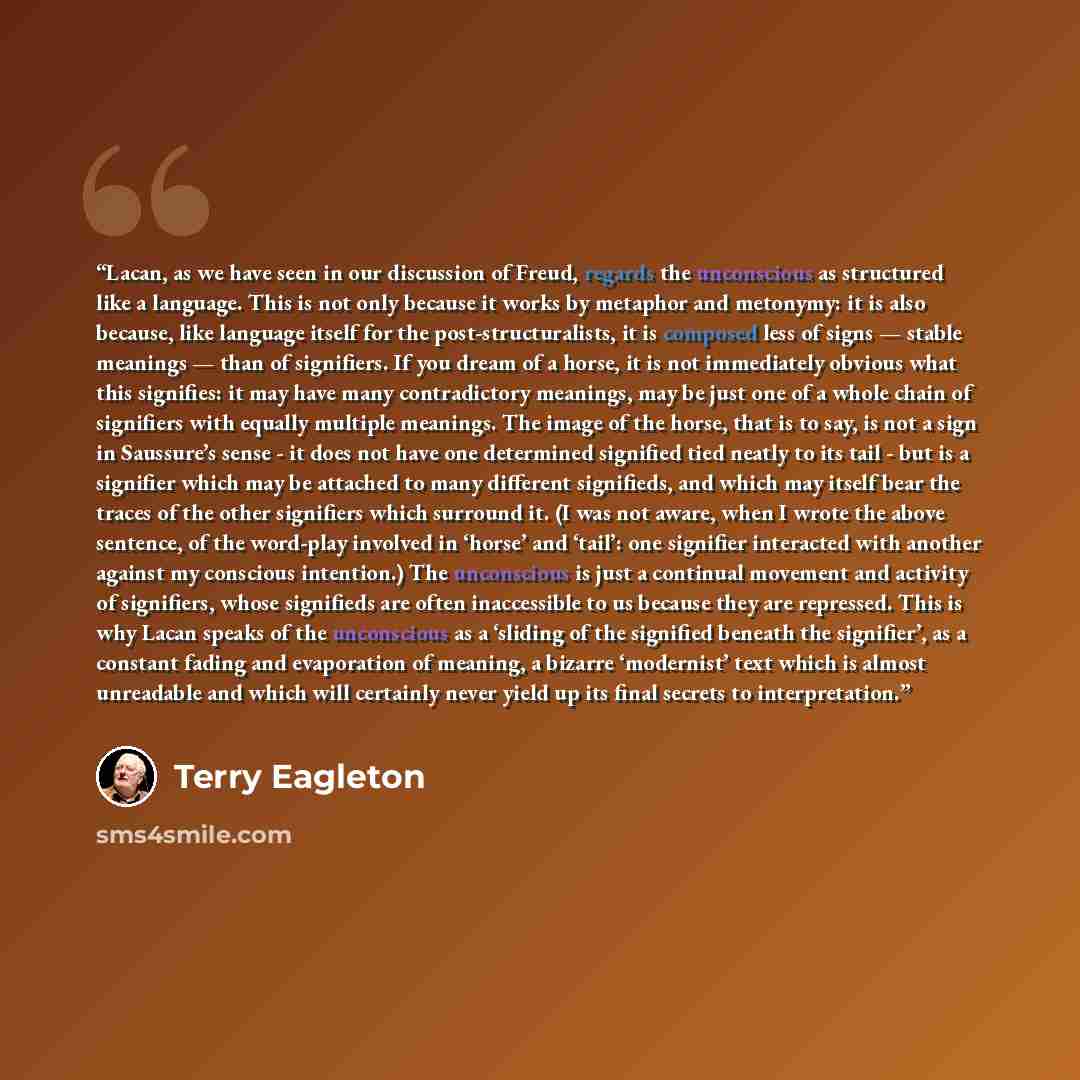
““Lacan, as we have seen in our discussion of Freud, regards the unconscious as structured like a language. This is not only because it works by metaphor and metonymy: it is also because, like language itself for the post-structuralists, it is composed less of signs — stable meanings — than of signifiers. If you dream of a horse, it is not immediately obvious what this signifies: it may have many contradictory meanings, may be just one of a whole chain of signifiers with equally multiple meanings. The image of the horse, that is to say, is not a sign in Saussure’s sense - it does not have one determined signified tied neatly to its tail - but is a signifier which may be attached to many different signifieds, and which may itself bear the traces of the other signifiers which surround it. (I was not aware, when I wrote the above sentence, of the word-play involved in ‘horse’ and ‘tail’: one signifier interacted with another against my conscious intention.) The unconscious is just a continual movement and activity of signifiers, whose signifieds are often inaccessible to us because they are repressed. This is why Lacan speaks of the unconscious as a ‘sliding of the signified beneath the signifier’, as a constant fading and evaporation of meaning, a bizarre ‘modernist’ text which is almost unreadable and which will certainly never yield up its final secrets to interpretation.””
About This Quote
This interpretation was drafted with AI assistance. It is one reading of the quote, not the author's own explanation.
Eagleton explains Lacan’s view that the unconscious operates like language, composed of shifting signifiers rather than fixed meanings.
In simple terms: The unconscious is a fluid system of signs, not static meanings.
Key Takeaway
Understand the unconscious as ever‑changing sign networks.
Themes
psychoanalysis
language
structuralism
post‑structuralism
Mood
intellectual
analytical
Type
theoretical
philosophical
When to use this quote
- clinical therapy
- literary criticism
- philosophical debate
Key Concepts
signifiers
meaning
repression
Questions to Reflect On
- How does viewing the unconscious as language affect therapeutic practice?
- What are the implications for interpreting literary texts?
A Different Perspective
The metaphorical nature of language can limit precise interpretation.