Our understanding of the sociology of knowledge leads to…
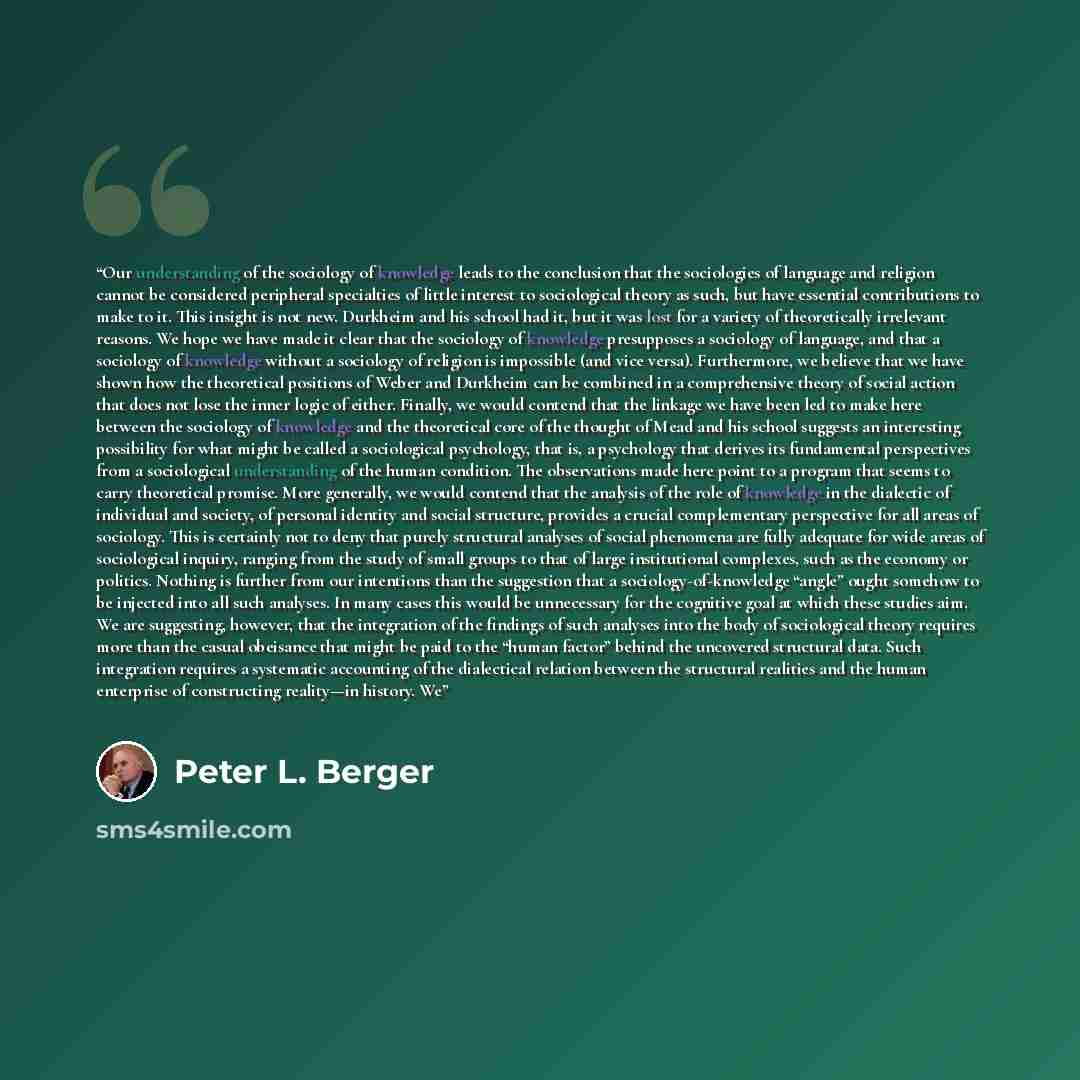
““Our understanding of the sociology of knowledge leads to the conclusion that the sociologies of language and religion cannot be considered peripheral specialties of little interest to sociological theory as such, but have essential contributions to make to it. This insight is not new. Durkheim and his school had it, but it was lost for a variety of theoretically irrelevant reasons. We hope we have made it clear that the sociology of knowledge presupposes a sociology of language, and that a sociology of knowledge without a sociology of religion is impossible (and vice versa). Furthermore, we believe that we have shown how the theoretical positions of Weber and Durkheim can be combined in a comprehensive theory of social action that does not lose the inner logic of either. Finally, we would contend that the linkage we have been led to make here between the sociology of knowledge and the theoretical core of the thought of Mead and his school suggests an interesting possibility for what might be called a sociological psychology, that is, a psychology that derives its fundamental perspectives from a sociological understanding of the human condition. The observations made here point to a program that seems to carry theoretical promise. More generally, we would contend that the analysis of the role of knowledge in the dialectic of individual and society, of personal identity and social structure, provides a crucial complementary perspective for all areas of sociology. This is certainly not to deny that purely structural analyses of social phenomena are fully adequate for wide areas of sociological inquiry, ranging from the study of small groups to that of large institutional complexes, such as the economy or politics. Nothing is further from our intentions than the suggestion that a sociology-of-knowledge “angle” ought somehow to be injected into all such analyses. In many cases this would be unnecessary for the cognitive goal at which these studies aim. We are suggesting, however, that the integration of the findings of such analyses into the body of sociological theory requires more than the casual obeisance that might be paid to the “human factor” behind the uncovered structural data. Such integration requires a systematic accounting of the dialectical relation between the structural realities and the human enterprise of constructing reality—in history. We””
About This Quote
This interpretation was drafted with AI assistance. It is one reading of the quote, not the author's own explanation.
Understanding knowledge requires integrating language and religion, merging Weber and Durkheim’s ideas, and linking to Mead’s sociological psychology.
In simple terms: Knowledge, language, and religion are interlinked in sociology.
Key Takeaway
Study social action through these lenses.
Themes
sociology
knowledge
language
religion
theory integration
Mood
analytical
thoughtful
Type
academic
theoretical
When to use this quote
- academic research
- curriculum design
- policy analysis
- community studies
Key Concepts
Durkheim
Weber
Mead
social action
sociological psychology
Questions to Reflect On
- How can these concepts improve everyday social interactions?
- What challenges arise when merging differing theoretical frameworks?
A Different Perspective
Complex theories can be hard to apply practically.