As William Bouwsma pointed out, the late medieval and…
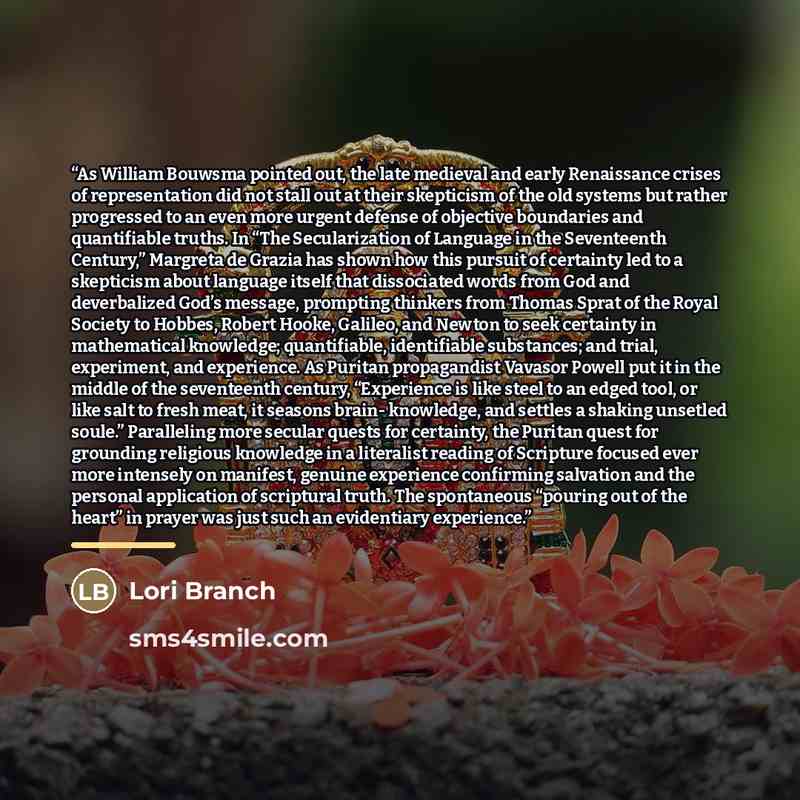
““As William Bouwsma pointed out, the late medieval and early Renaissance crises of representation did not stall out at their skepticism of the old systems but rather progressed to an even more urgent defense of objective boundaries and quantifiable truths. In “The Secularization of Language in the Seventeenth Century,” Margreta de Grazia has shown how this pursuit of certainty led to a skepticism about language itself that dissociated words from God and deverbalized God’s message, prompting thinkers from Thomas Sprat of the Royal Society to Hobbes, Robert Hooke, Galileo, and Newton to seek certainty in mathematical knowledge; quantifiable, identifiable substances; and trial, experiment, and experience. As Puritan propagandist Vavasor Powell put it in the middle of the seventeenth century, “Experience is like steel to an edged tool, or like salt to fresh meat, it seasons brain- knowledge, and settles a shaking unsetled soule.” Paralleling more secular quests for certainty, the Puritan quest for grounding religious knowledge in a literalist reading of Scripture focused ever more intensely on manifest, genuine experience confirming salvation and the personal application of scriptural truth. The spontaneous “pouring out of the heart” in prayer was just such an evidentiary experience.””
About This Quote
This interpretation was drafted with AI assistance. It is one reading of the quote, not the author's own explanation.
The quest for certainty moved from religious to scientific realms, separating language from divine authority.
In simple terms: Science sought certainty, distancing words from God.
Key Takeaway
Recognize how certainty drives both faith and science.
Themes
philosophy
history
science
religion
Mood
thoughtful
inquisitive
Type
academic
reflective
When to use this quote
- academic lectures
- theological debates
- scientific research
- historical analysis
Key Concepts
epistemology
secularization
empiricism
Questions to Reflect On
- How does certainty limit imagination?
- Can faith and science coexist peacefully?
A Different Perspective
Certainty can also breed rigidity and exclusion.