History is a narrative enterprise, and the telling of…
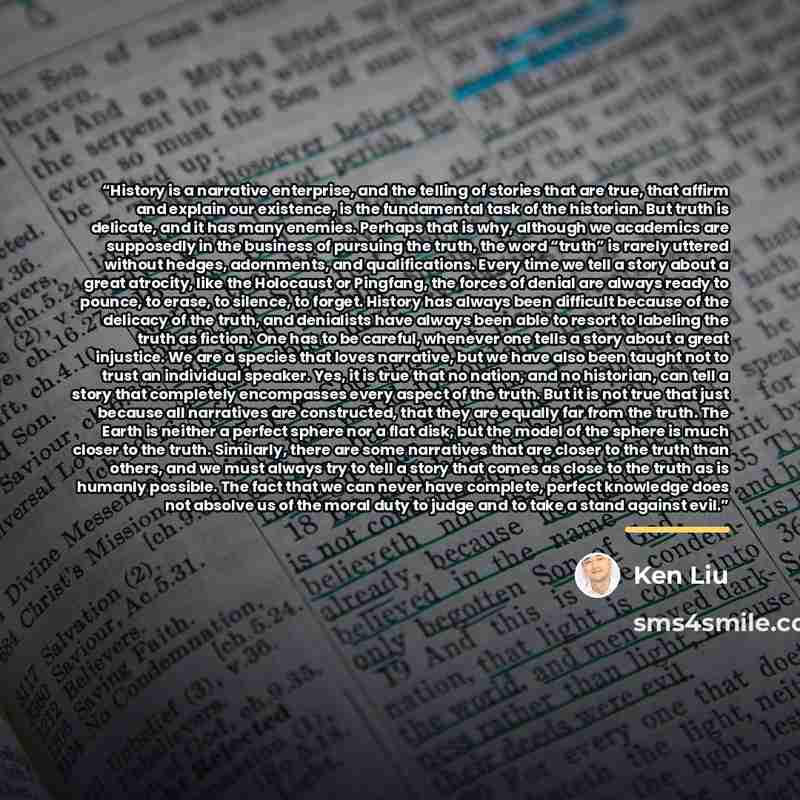
““History is a narrative enterprise, and the telling of stories that are true, that affirm and explain our existence, is the fundamental task of the historian. But truth is delicate, and it has many enemies. Perhaps that is why, although we academics are supposedly in the business of pursuing the truth, the word “truth” is rarely uttered without hedges, adornments, and qualifications. Every time we tell a story about a great atrocity, like the Holocaust or Pingfang, the forces of denial are always ready to pounce, to erase, to silence, to forget. History has always been difficult because of the delicacy of the truth, and denialists have always been able to resort to labeling the truth as fiction. One has to be careful, whenever one tells a story about a great injustice. We are a species that loves narrative, but we have also been taught not to trust an individual speaker. Yes, it is true that no nation, and no historian, can tell a story that completely encompasses every aspect of the truth. But it is not true that just because all narratives are constructed, that they are equally far from the truth. The Earth is neither a perfect sphere nor a flat disk, but the model of the sphere is much closer to the truth. Similarly, there are some narratives that are closer to the truth than others, and we must always try to tell a story that comes as close to the truth as is humanly possible. The fact that we can never have complete, perfect knowledge does not absolve us of the moral duty to judge and to take a stand against evil.””
About This Quote
This interpretation was drafted with AI assistance. It is one reading of the quote, not the author's own explanation.
History requires balancing narrative with rigorous truth‑seeking, acknowledging bias, and confronting denial while striving for the most accurate account possible.
In simple terms: History must tell truthful stories despite bias and denial.
Key Takeaway
Seek truth, acknowledge limits, and oppose denial.
Themes
history
truth
narrative
ethics
memory
Mood
reflective
serious
determined
Type
philosophical
ethical
historical
When to use this quote
- academic writing
- public discourse
- education
- memorials
- policy debates
Key Concepts
Epistemology
moral responsibility
historical methodology
Questions to Reflect On
- How do we assess a narrative’s closeness to truth?
- What responsibilities do historians have when confronting denial?
A Different Perspective
Truth is always partial; narratives can be manipulated for power.