...Turn our thoughts, in the next place, to the characters…
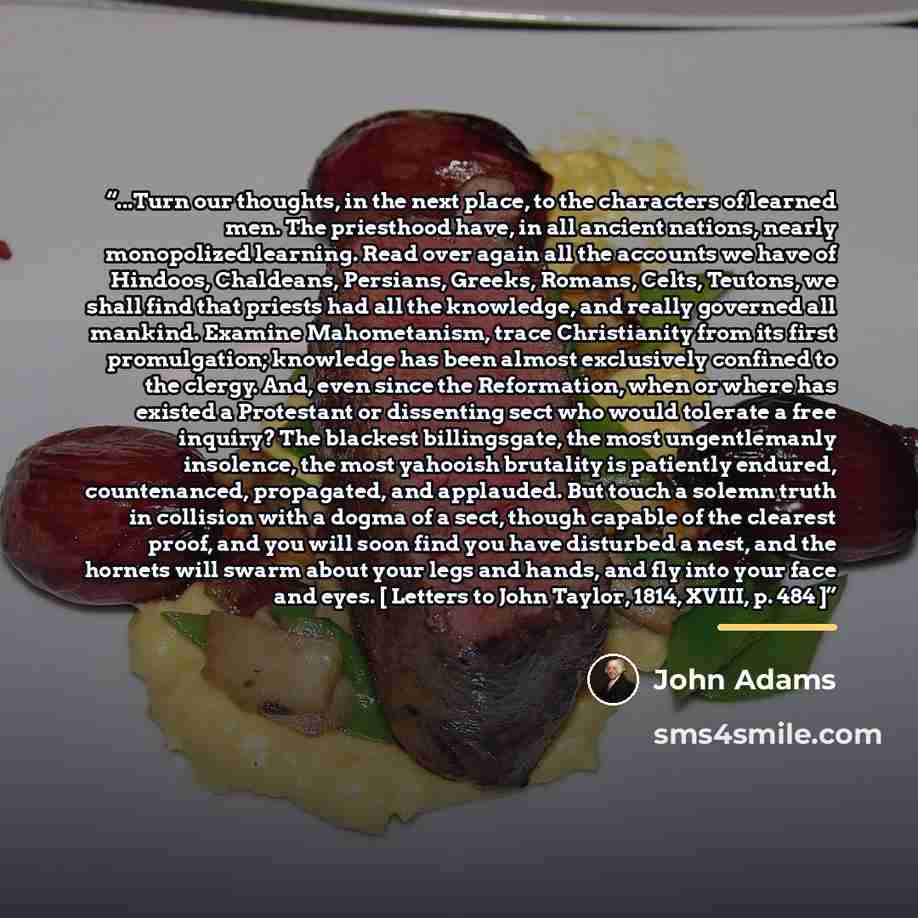
““...Turn our thoughts, in the next place, to the characters of learned men. The priesthood have, in all ancient nations, nearly monopolized learning. Read over again all the accounts we have of Hindoos, Chaldeans, Persians, Greeks, Romans, Celts, Teutons, we shall find that priests had all the knowledge, and really governed all mankind. Examine Mahometanism, trace Christianity from its first promulgation; knowledge has been almost exclusively confined to the clergy. And, even since the Reformation, when or where has existed a Protestant or dissenting sect who would tolerate a free inquiry? The blackest billingsgate, the most ungentlemanly insolence, the most yahooish brutality is patiently endured, countenanced, propagated, and applauded. But touch a solemn truth in collision with a dogma of a sect, though capable of the clearest proof, and you will soon find you have disturbed a nest, and the hornets will swarm about your legs and hands, and fly into your face and eyes. [ Letters to John Taylor, 1814, XVIII, p. 484 ]””
About This Quote
This interpretation was drafted with AI assistance. It is one reading of the quote, not the author's own explanation.
The author argues that religious institutions have historically monopolized knowledge, suppressing free inquiry and punishing challenges to dogma.
In simple terms: Priests hoarded knowledge, stifling free thought.
Key Takeaway
Question authority and seek independent understanding.
Themes
knowledge
authority
religion
inquiry
censorship
Mood
critical
reflective
Type
historical
analytical
When to use this quote
- academic research
- journalistic investigation
- personal belief questioning
- education reform
- public discourse
Key Concepts
intellectual freedom
power dynamics
historical context
Questions to Reflect On
- How does modern secular education challenge this view?
- What role do religious scholars play in contemporary knowledge production?
A Different Perspective
The argument may overgeneralize and ignore secular scholarship and reformist movements within religions.