The essence of this knowledge was the ability to 'see all'…
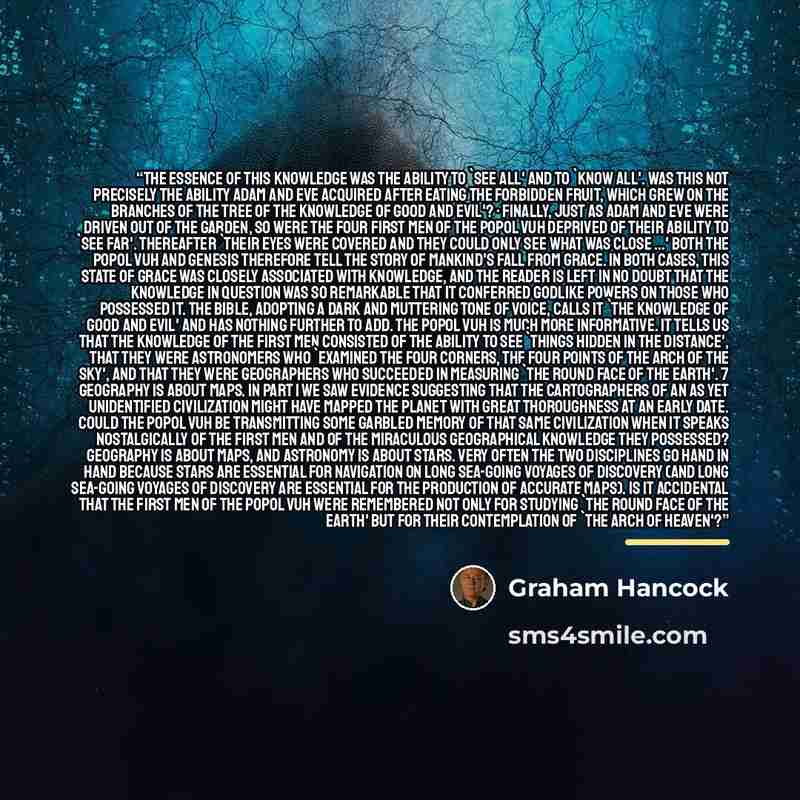
““The essence of this knowledge was the ability to 'see all' and to 'know all'. Was this not precisely the ability Adam and Eve acquired after eating the forbidden fruit, which grew on the branches of the tree of the knowledge of good and evil'? · Finally, just as Adam and Eve were driven out of the Garden, so were the four First Men of the Popol Vuh deprived of their ability to 'see far'. Thereafter 'their eyes were covered and they could only see what was close ...' Both the Popol Vuh and Genesis therefore tell the story of mankind's fall from grace. In both cases, this state of grace was closely associated with knowledge, and the reader is left in no doubt that the knowledge in question was so remarkable that it conferred godlike powers on those who possessed it. The Bible, adopting a dark and muttering tone of voice, calls it 'the knowledge of good and evil' and has nothing further to add. The Popol Vuh is much more informative. It tells us that the knowledge of the First Men consisted of the ability to see 'things hidden in the distance', that they were astronomers who 'examined the four corners, the four points of the arch of the sky', and that they were geographers who succeeded in measuring 'the round face of the earth'. 7 Geography is about maps. In Part I we saw evidence suggesting that the cartographers of an as yet unidentified civilization might have mapped the planet with great thoroughness at an early date. Could the Popol Vuh be transmitting some garbled memory of that same civilization when it speaks nostalgically of the First Men and of the miraculous geographical knowledge they possessed? Geography is about maps, and astronomy is about stars. Very often the two disciplines go hand in hand because stars are essential for navigation on long sea-going voyages of discovery (and long sea-going voyages of discovery are essential for the production of accurate maps). Is it accidental that the First Men of the Popol Vuh were remembered not only for studying 'the round face of the earth' but for their contemplation of 'the arch of heaven'?””
About This Quote
This interpretation was drafted with AI assistance. It is one reading of the quote, not the author's own explanation.
The passage compares ancient myths of lost knowledge, linking the biblical fall and the Popol Vuh’s loss of far‑seeing power, suggesting that early civilizations possessed advanced astronomical and geographical insight.
In simple terms: Ancient stories warn of lost great knowledge.
Key Takeaway
Seek and preserve deep knowledge.
Themes
myth
history
knowledge
loss
ancient civilization
Mood
inquisitive
speculative
Type
mythological
analytical
When to use this quote
- archaeology
- history of science
- education
- cultural heritage
- philosophy
Key Concepts
cosmology
cartography
astronomy
mythology
epistemology
Questions to Reflect On
- What evidence supports the claim of advanced ancient knowledge?
- How do myths shape our understanding of history?
A Different Perspective
It may romanticize speculative connections without solid evidence.