"Ha! ha! ha! But after all, if you like, in reality there…
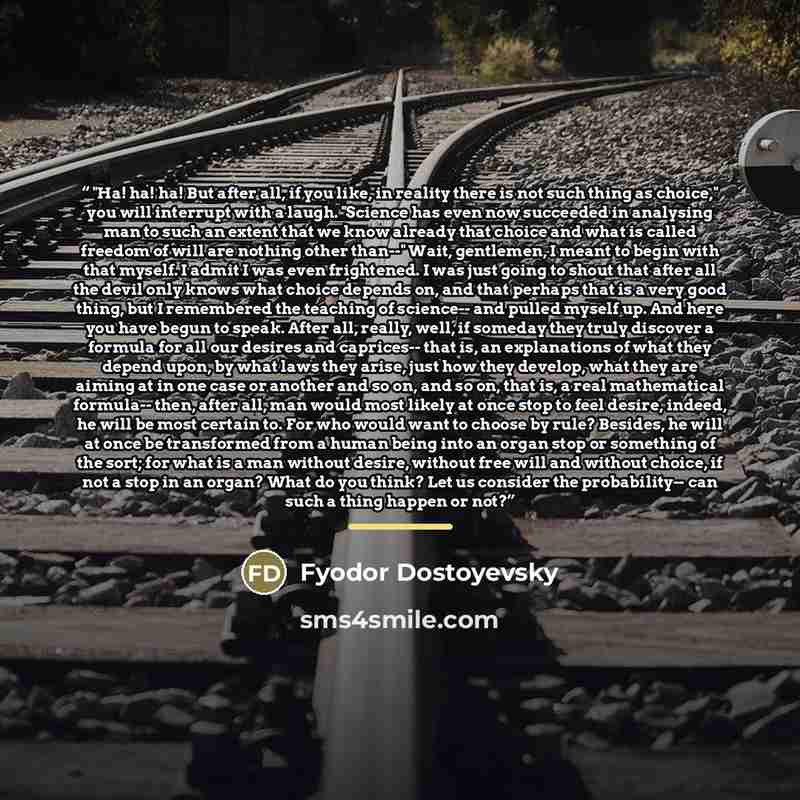
““ "Ha! ha! ha! But after all, if you like, in reality there is not such thing as choice," you will interrupt with a laugh. "Science has even now succeeded in analysing man to such an extent that we know already that choice and what is called freedom of will are nothing other than--" Wait, gentlemen, I meant to begin with that myself. I admit I was even frightened. I was just going to shout that after all the devil only knows what choice depends on, and that perhaps that is a very good thing, but I remembered the teaching of science-- and pulled myself up. And here you have begun to speak. After all, really, well, if someday they truly discover a formula for all our desires and caprices-- that is, an explanations of what they depend upon, by what laws they arise, just how they develop, what they are aiming at in one case or another and so on, and so on, that is, a real mathematical formula-- then, after all, man would most likely at once stop to feel desire, indeed, he will be most certain to. For who would want to choose by rule? Besides, he will at once be transformed from a human being into an organ stop or something of the sort; for what is a man without desire, without free will and without choice, if not a stop in an organ? What do you think? Let us consider the probability-- can such a thing happen or not?””
About This Quote
This interpretation was drafted with AI assistance. It is one reading of the quote, not the author's own explanation.
If free will were fully explained by science, desire and choice would vanish, reducing humanity to mechanistic beings.
In simple terms: Science could eliminate free will, making us like machines.
Key Takeaway
Consider the value of desire and choice.
Themes
determinism
philosophy
science
Mood
speculative
introspective
Type
philosophical
literary
When to use this quote
- ethical debates
- AI development
- psychology research
- education
Key Concepts
free will
determinism
human nature
Questions to Reflect On
- Do you value desire over certainty?
- Can morality exist without free will?
A Different Perspective
Science may never fully capture consciousness.