Suppose a human being has thus put his ear, as it were, to…
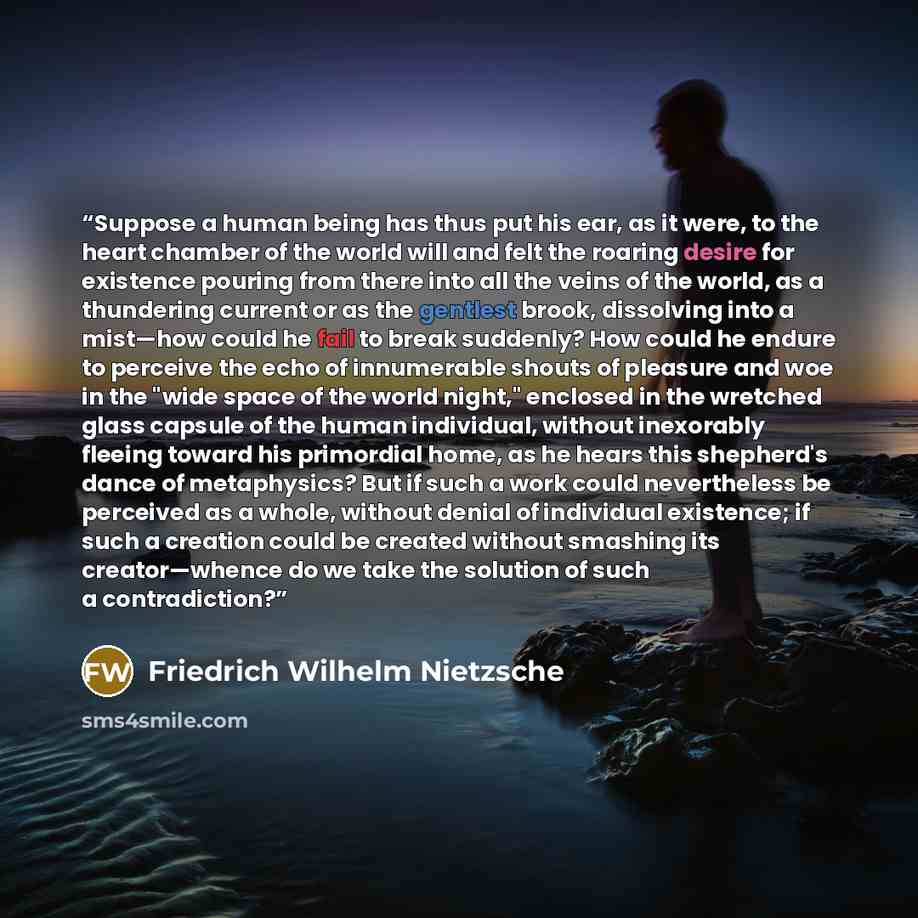
““Suppose a human being has thus put his ear, as it were, to the heart chamber of the world will and felt the roaring desire for existence pouring from there into all the veins of the world, as a thundering current or as the gentlest brook, dissolving into a mist—how could he fail to break suddenly? How could he endure to perceive the echo of innumerable shouts of pleasure and woe in the "wide space of the world night," enclosed in the wretched glass capsule of the human individual, without inexorably fleeing toward his primordial home, as he hears this shepherd's dance of metaphysics? But if such a work could nevertheless be perceived as a whole, without denial of individual existence; if such a creation could be created without smashing its creator—whence do we take the solution of such a contradiction?””
About This Quote
This interpretation was drafted with AI assistance. It is one reading of the quote, not the author's own explanation.
Human beings feel the world’s intense desire for existence, yet struggle with the paradox of individual existence versus universal unity.
In simple terms: We sense life's drive but face a conflict between self and whole.
Key Takeaway
Seek harmony between personal identity and collective existence.
Themes
existential
paradox
unity
Mood
introspective
enigmatic
Type
philosophical
poetic
When to use this quote
- artistic creation
- spiritual practice
- scientific inquiry
Key Concepts
metaphysics
psychology
cosmology
Questions to Reflect On
- What does “shepherd’s dance of metaphysics” mean to you?
- Can you reconcile individuality with universal purpose?
A Different Perspective
The abstract language may be inaccessible to many.