Whatever any of us may have thought about Hatsumomo, she…
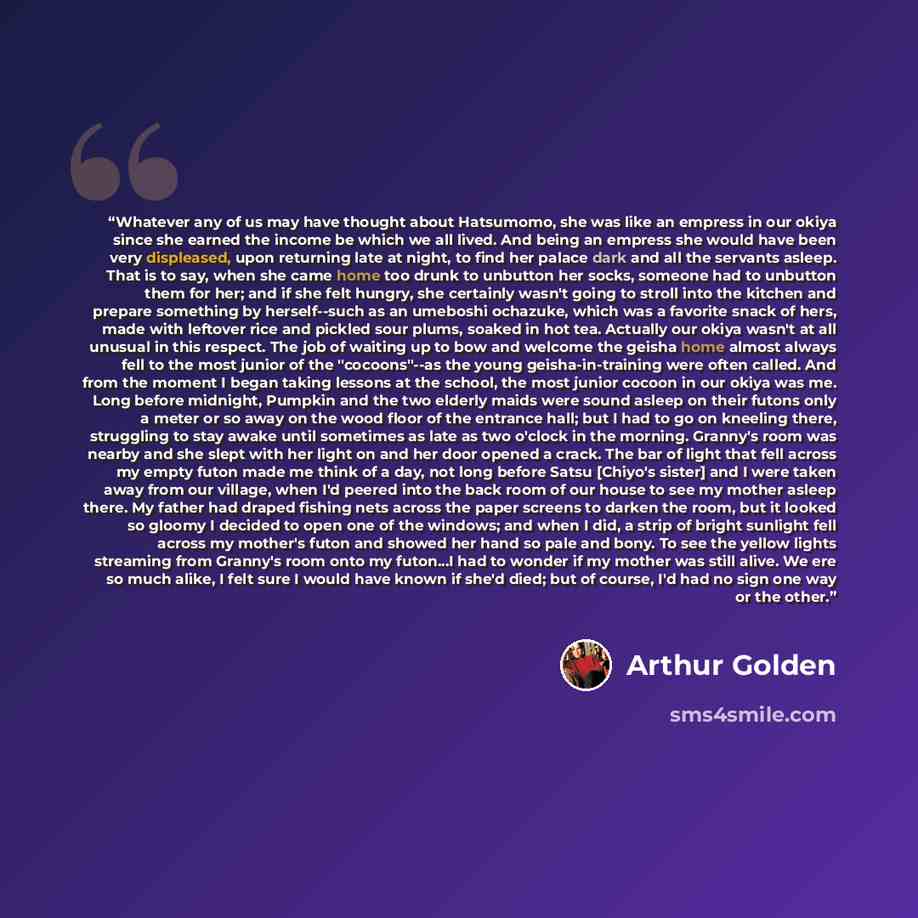
““Whatever any of us may have thought about Hatsumomo, she was like an empress in our okiya since she earned the income be which we all lived. And being an empress she would have been very displeased, upon returning late at night, to find her palace dark and all the servants asleep. That is to say, when she came home too drunk to unbutton her socks, someone had to unbutton them for her; and if she felt hungry, she certainly wasn't going to stroll into the kitchen and prepare something by herself--such as an umeboshi ochazuke, which was a favorite snack of hers, made with leftover rice and pickled sour plums, soaked in hot tea. Actually our okiya wasn't at all unusual in this respect. The job of waiting up to bow and welcome the geisha home almost always fell to the most junior of the "cocoons"--as the young geisha-in-training were often called. And from the moment I began taking lessons at the school, the most junior cocoon in our okiya was me. Long before midnight, Pumpkin and the two elderly maids were sound asleep on their futons only a meter or so away on the wood floor of the entrance hall; but I had to go on kneeling there, struggling to stay awake until sometimes as late as two o'clock in the morning. Granny's room was nearby and she slept with her light on and her door opened a crack. The bar of light that fell across my empty futon made me think of a day, not long before Satsu [Chiyo's sister] and I were taken away from our village, when I'd peered into the back room of our house to see my mother asleep there. My father had draped fishing nets across the paper screens to darken the room, but it looked so gloomy I decided to open one of the windows; and when I did, a strip of bright sunlight fell across my mother's futon and showed her hand so pale and bony. To see the yellow lights streaming from Granny's room onto my futon...I had to wonder if my mother was still alive. We ere so much alike, I felt sure I would have known if she'd died; but of course, I'd had no sign one way or the other.””
About This Quote
This interpretation was drafted with AI assistance. It is one reading of the quote, not the author's own explanation.
The narrator describes the strict hierarchy and daily rituals of a geisha house, highlighting the burdens placed on junior members.
In simple terms: Junior geisha endure demanding duties and lack autonomy.
Key Takeaway
Recognize and respect the labor of those in subordinate roles.
Themes
hierarchy
labor
tradition
Mood
reflective
empathetic
Type
cultural
historical
When to use this quote
- geisha houses
- apprenticeship programs
- service industries
Key Concepts
social structures
gender roles
cultural expectations
Questions to Reflect On
- How do power dynamics shape daily life?
- What responsibilities do senior members have toward juniors?
A Different Perspective
The narrative may romanticize hardship, overlooking exploitation.