“The dominant view was that children were essentially defective adults. They were defined by the things they didn’t know and couldn’t do.” — Alison Gopnik Copy Share Image
Adults tend to think they have much free will. Kids younger than six are less sure. They may be more realistic! — Alison Gopnik Copy Share Image
One of the most distinctive evolutionary features of human beings is our unusually long, protected childhood. — Alison Gopnik Copy Share Image
“If the child is a budding psychologist, we parents are the laboratory rats.” — Alison Gopnik Copy Share Image
I'm afraid the parenting advice to come out of developmental psychology is very boring: pay attention to your kids and love them. — Alison Gopnik Copy Share Image
Children have a very good idea of how to distinguish between fantasies and realities. It's just they are equally interested in exploring… — Alison Gopnik Copy Share Image
There is a tension between our desire to get our kids to turn out a particular way versus letting them develop to… — Alison Gopnik Copy Share Image
Young children seem to be learning who to share this toy with and figure out how it works, while adolescents seem to… — Alison Gopnik Copy Share Image
Some people say that parents don't matter, and that's not true at all. The irony is that we pay attention to all… — Alison Gopnik Copy Share Image
If parents are the fixed stars in the child's universe, the vaguely understood, distant but constant celestial spheres, siblings are the dazzling,… — Alison Gopnik Copy Share Image
Childhood is a fundamental part of all human lives, parents or not, since that's how we all start out. And yet babies… — Alison Gopnik Copy Share Image
Caring for children has always been one of the deepest and most satisfying things that a human being does, and yet it… — Alison Gopnik Copy Share Image
If you just got enough expertise and enough special techniques and read up enough, then you could shape a child into the… — Alison Gopnik Copy Share Image
From an evolutionary perspective children are, literally, designed to learn. Childhood is a special period of protected immaturity. It gives the young… — Alison Gopnik Copy Share Image
“So our job as parents is not to make a particular kind of child. Instead, our job is to provide a protected… — Alison Gopnik Copy Share Image
We pass our values, ideas and moral character on to our children, but we do that knowing that our children are going… — Alison Gopnik Copy Share Image
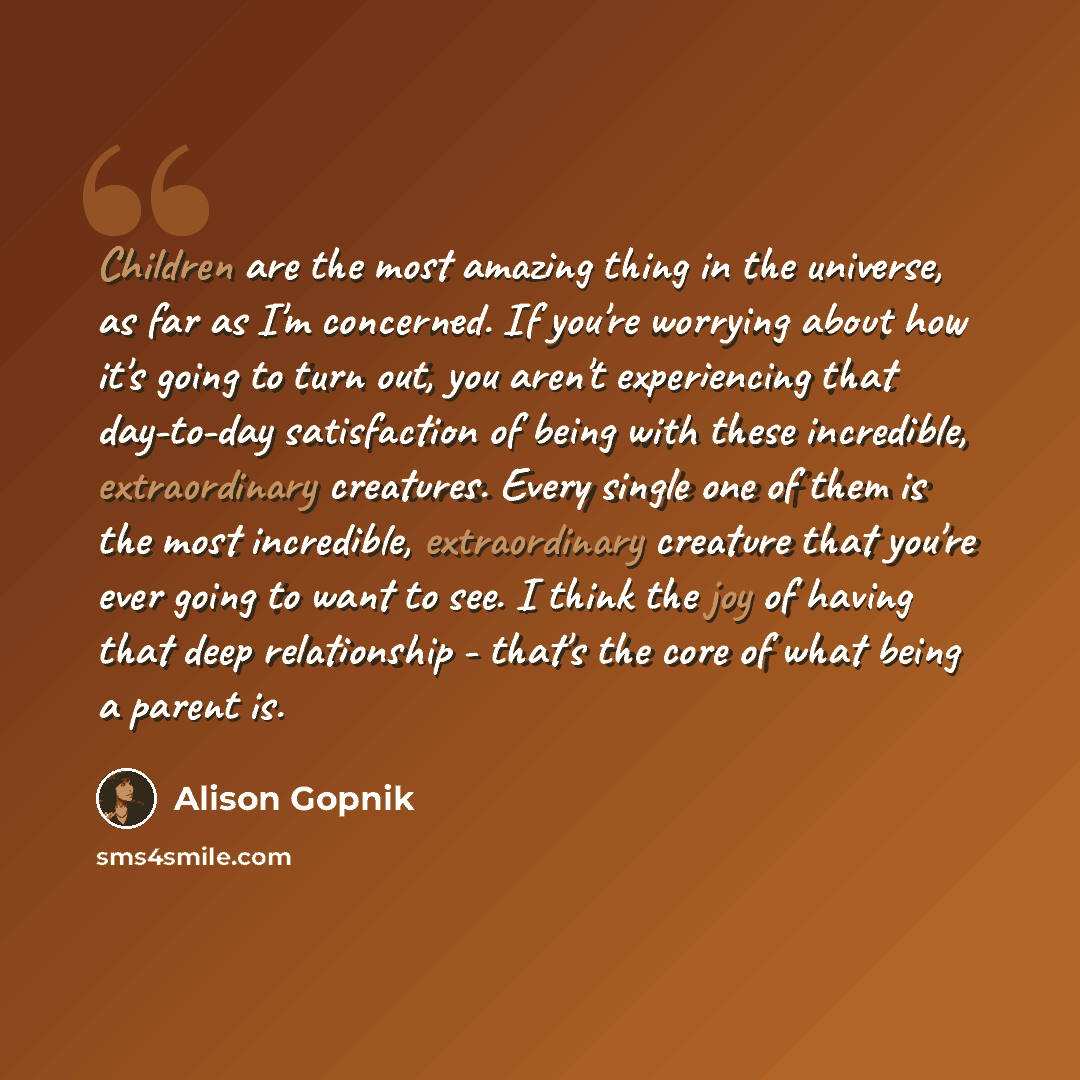
Children are the most amazing thing in the universe, as far as I'm concerned. If you're worrying about how it's going to… — Alison Gopnik Copy Share Image
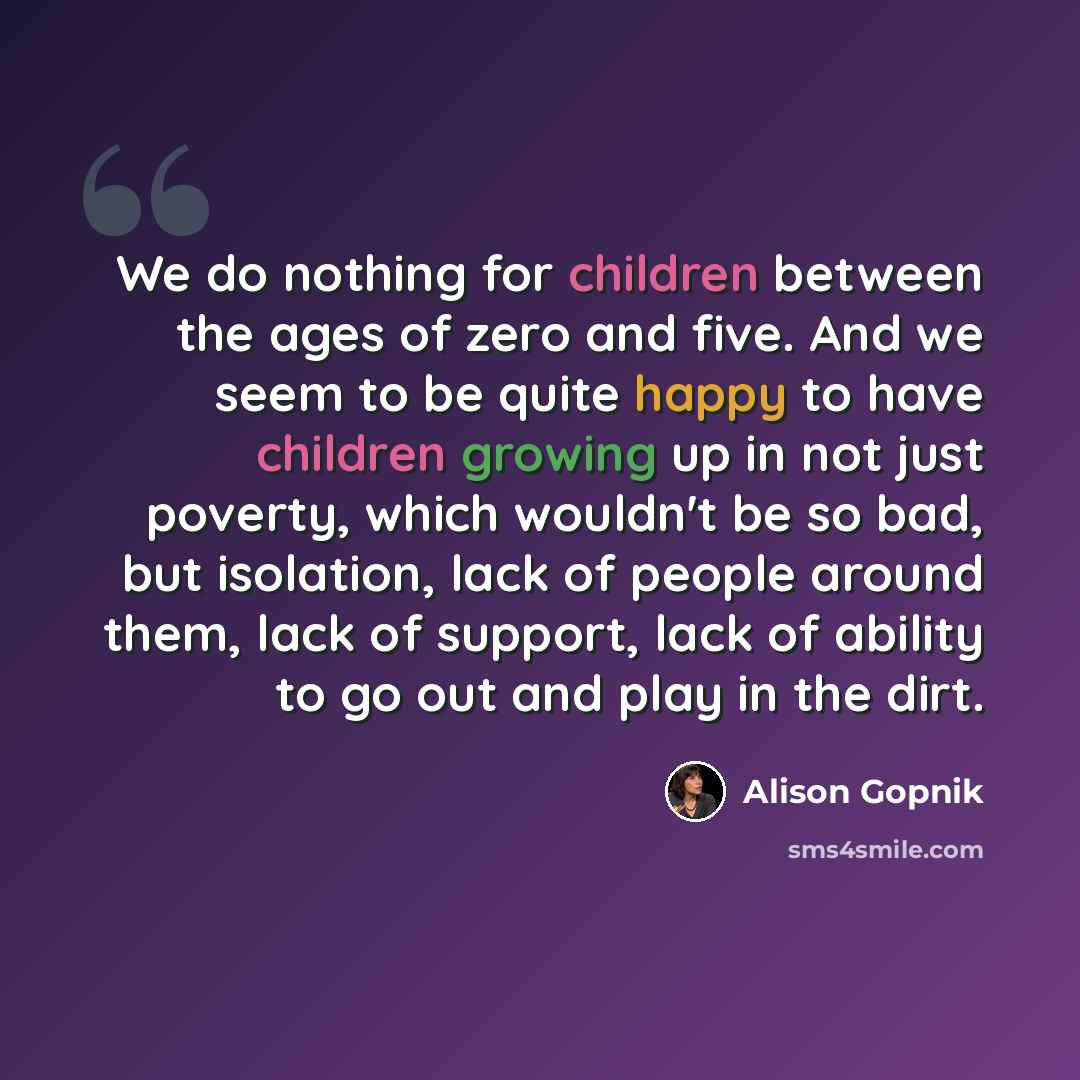
We do nothing for children between the ages of zero and five. And we seem to be quite happy to have children… — Alison Gopnik Copy Share Image
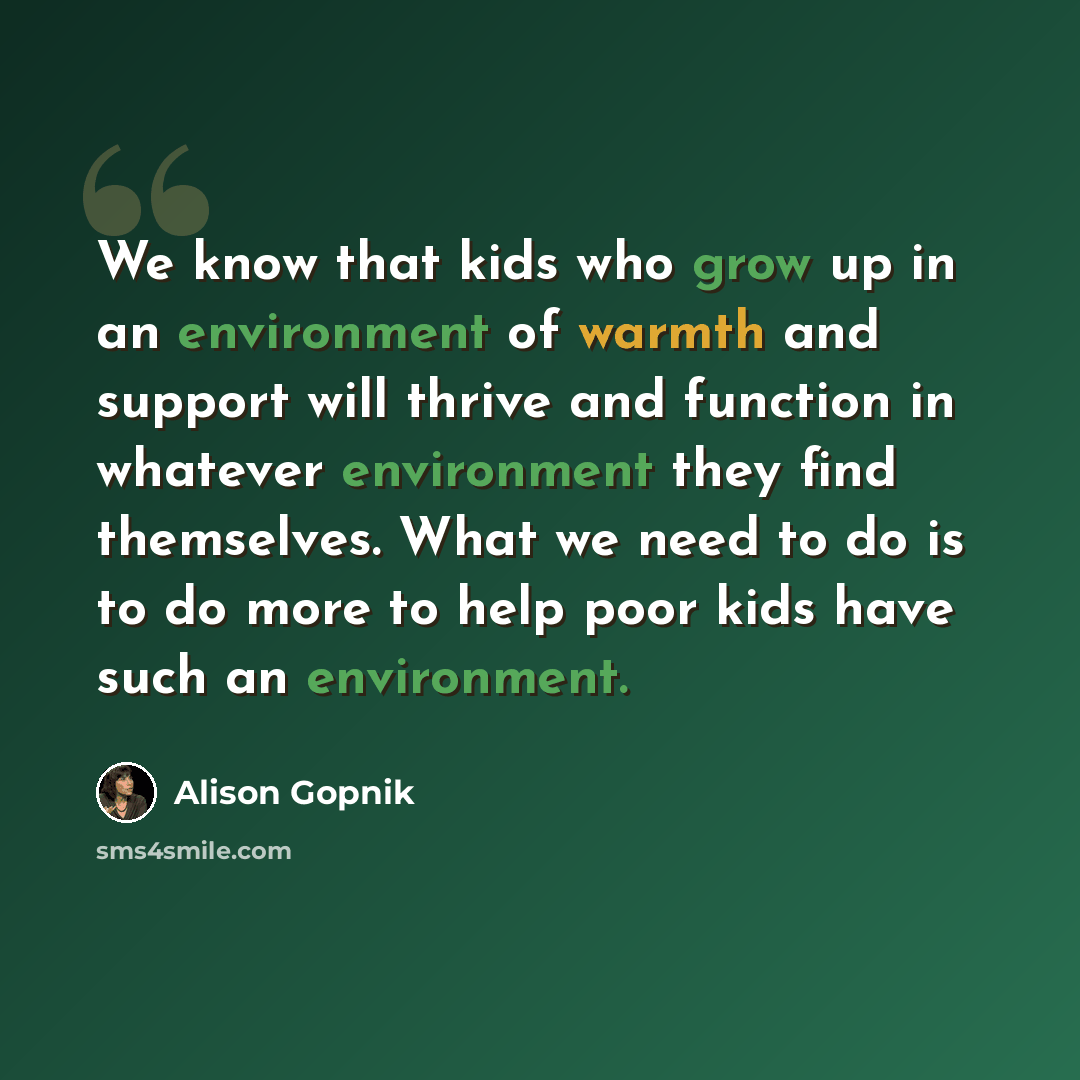
We know that kids who grow up in an environment of warmth and support will thrive and function in whatever environment they… — Alison Gopnik Copy Share Image
Philosophers and psychologists have long puzzled over the question of how we know as much as we do despite our limited experiences. One way… — Alison Gopnik Copy Share
Adults often assume that most learning is the result of teaching and that exploratory, spontaneous learning is unusual. But actually, spontaneous learning is more… — Alison Gopnik Copy Share
Adults tend to think they have much free will. Kids younger than six are less sure. They may be more realistic! — Alison Gopnik Copy Share
From an evolutionary perspective children are, literally, designed to learn. Childhood is a special period of protected immaturity. It gives the young breathing time… — Alison Gopnik Copy Share
There is a tension between our desire to get our kids to turn out a particular way versus letting them develop to be their… — Alison Gopnik Copy Share
“Instead, it may be that experience itself has changed our brains so that we perceive and interpret the world in a certain way. Once… — Alison Gopnik Copy Share
Caring for children has always been one of the deepest and most satisfying things that a human being does, and yet it is hard… — Alison Gopnik Copy Share
Imaginary friends are one of the weirder forms of pretend play in childhood. But the research shows that imaginary friends actually help children understand… — Alison Gopnik Copy Share
“Like their parents, the Korean children used more verbs than the English-speaking kids, while the English-speaking kids used more nouns. But in addition, the… — Alison Gopnik Copy Share
“We decided to become development psychologists and study children because there aren't any Martians. These brilliant beings with the little bodies and big heads… — Alison Gopnik Copy Share
Each new generation of children grows up in the new environment its parents have created, and each generation of brains becomes wired in a… — Alison Gopnik Copy Share
I'm the oldest of six children and I had my own first baby when I was 23. So I've always been interested in babies,… — Alison Gopnik Copy Share
“Literature is the equivalent of the climate scientist’s computer simulations: set up some new starting conditions, run the whole complicated process and see what… — Alison Gopnik Copy Share
The brain knows the real secret of seduction, more effective than even music and martinis. Just keep whispering, 'Gee, you are really special' to… — Alison Gopnik Copy Share