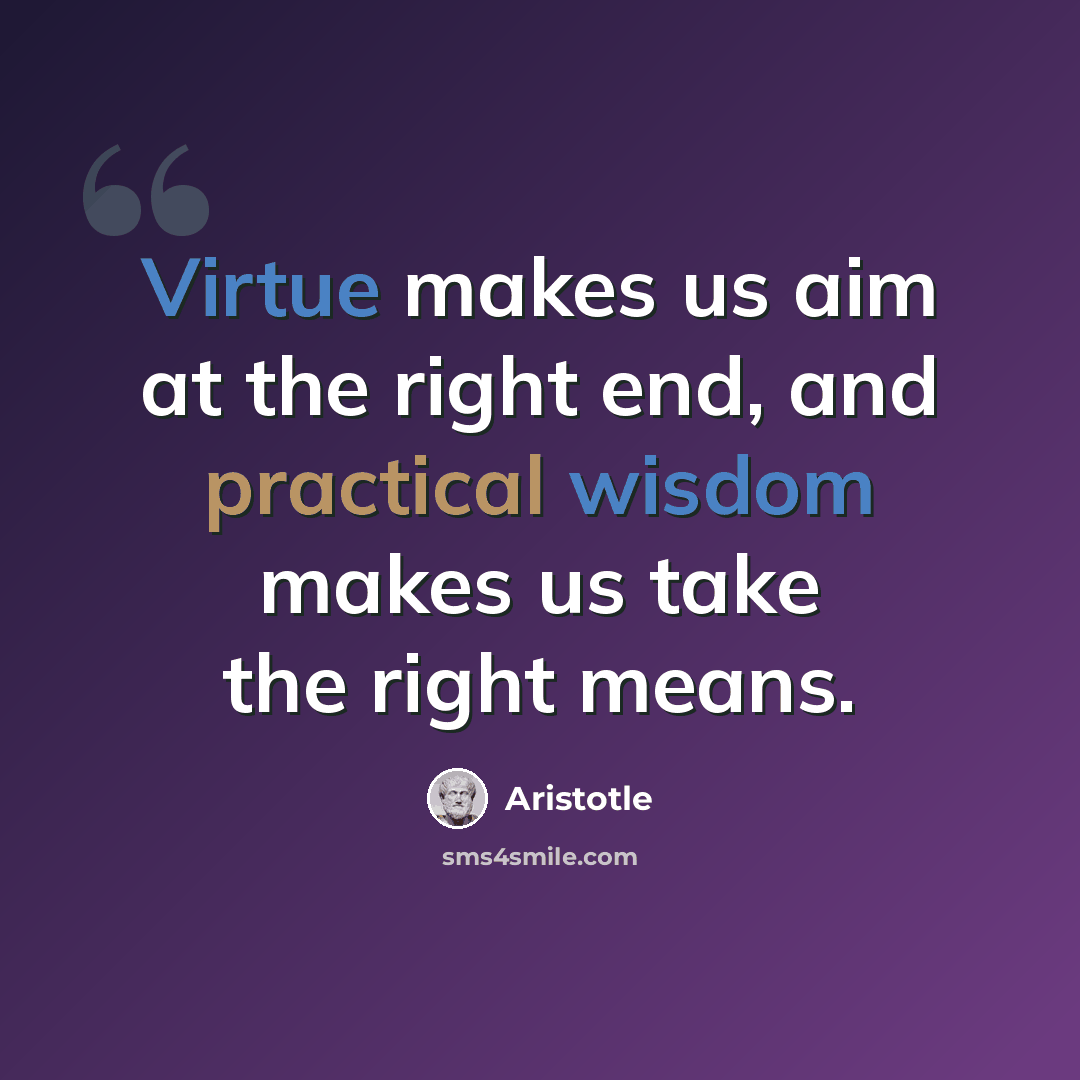
Virtue makes us aim at the right end, and practical wisdom makes us take the right means. — Aristotle Copy Share Image
A good character carries with it the highest power of causing a thing to be believed. — Aristotle Copy Share Image
Virtue is more clearly shown in the performance of fine ACTIONS than in the non-performance of base ones. — Aristotle Copy Share Image
“Courage is the first of human virtues because it makes all others possible.” — Aristotle Copy Share Image
Character gives us qualities, but it is in our actions — what we do — that we are happy or the reverse. — Aristotle Copy Share Image
Some vices miss what is right because they are deficient, others because they are excessive, in feelings or in actions, while virtue… — Aristotle Copy Share Image
The virtue as the art consecrates itself constantly to what's difficult to do, and the harder the task, the shinier the success. — Aristotle Copy Share Image
Neither by nature, then, nor contrary to nature do the virtues arise in us; rather we are adapted by nature to receive… — Aristotle Copy Share Image
Even if we could suppose the citizen body to be virtuous, without each of them being so, yet the latter would be… — Aristotle Copy Share Image
To know what virtue is is not enough; we must endeavor to possess and to practice it, or in some other manner… — Aristotle Copy Share Image
for we are inquiring not in order to know what virtue is, but in order to become good, since otherwise our inquiry… — Aristotle Copy Share Image
“Man's work as Man is accomplished by virtue of Practical Wisdom and Moral Virtue, the latter giving the right aim and direction,… — Aristotle Copy Share Image
... the good for man is an activity of the soul in accordance with virtue, or if there are more kinds of… — Aristotle Copy Share Image
Now the soul of man is divided into two parts, one of which has a rational principle in itself, and the other,… — Aristotle Copy Share Image
If what was said in the Ethics is true, that the happy life is the life according to virtue lived without impediment,… — Aristotle Copy Share Image
Happiness, whether consisting in pleasure or virtue, or both, is more often found with those who are highly cultivated in their minds… — Aristotle Copy Share Image
Virtue also depends on ourselves. And so also does vice. For where we are free to act we are also free to… — Aristotle Copy Share Image
Both Self-restraint and Unrestraint are a matter of extremes as compared with the character of the mass of mankind; the restrained man… — Aristotle Copy Share Image
Music directly imitates the passions or states of the soul...when one listens to music that imitates a certain passion, he becomes imbued… — Aristotle Copy Share Image
Again, it is possible to fail in many ways (for evil belongs to the class of the unlimited and good to that… — Aristotle Copy Share Image
For it is not true, as some treatise-mongers lay down in their systems, of the probity of the speaker, that it contributes… — Aristotle Copy Share Image
Justice is that virtue of the soul which is distributive according to desert. — Aristotle Copy Share Image
Virtue is the golden mean between two vices, the one of excess and the other of deficiency. — Aristotle Copy Share Image
The honors and rewards fall to those who show their good qualities in action. — Aristotle Copy Share Image
Emotions of any kind can be evoked by melody and rhythm; therefore music has the power to form character. — Aristotle Copy Share Image
The good citizen need not of necessity possess the virtue which makes a good man. — Aristotle Copy Share Image
It is our choice of good or evil that determines our character, not our opinion about good or evil. — Aristotle Copy Share Image
Education and morals make the good man, the good statesman, the good ruler. — Aristotle Copy Share Image
Character is that which reveals moral purpose, exposing the class of things a man chooses and avoids. — Aristotle Copy Share Image
“[I]n speaking about someone's character, we do not say that he is wise or comprehending, but that he is gentle or moderate.” — Aristotle Copy Share Image
“No excellent soul is exempt from a mixture of madness. - Aristotle (Attributed by Seneca in Moral Essays, "De Tranquillitate Animi" On… — Aristotle Copy Share Image
We assume therefore that moral virtue is the quality of acting in the best way in relation to pleasures and pains, and… — Aristotle Copy Share Image
Since the things we do determine the character of life, no blessed person can become unhappy. For he will never do those… — Aristotle Copy Share Image
The moral virtues, then, are produced in us neither by nature nor against nature. Nature, indeed, prepares in us the ground for… — Aristotle Copy Share Image
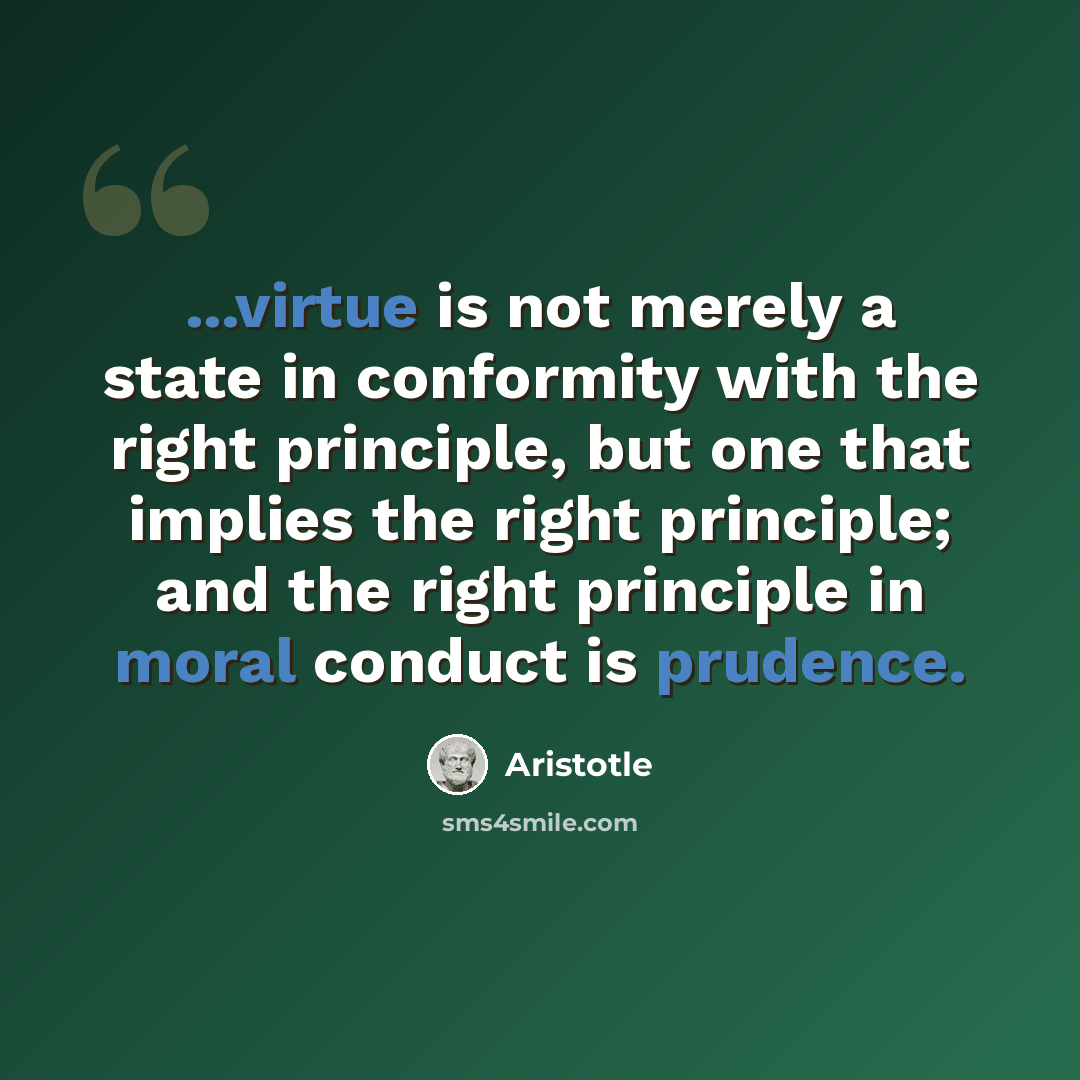
...virtue is not merely a state in conformity with the right principle, but one that implies the right principle; and the right… — Aristotle Copy Share Image
The knowledge of the soul admittedly contributes greatly to the advance of truth in general, and, above all, to our understanding of Nature, for… — Aristotle Copy Share
Young men have strong passions and tend to gratify them indiscriminately. Of the bodily desires, it is the sexual by which they are most… — Aristotle Copy Share
The body is at its best between the ages of thirty and thirty-five; the mind is at its best about the age of forty-nine. — Aristotle Copy Share
The ensouled is distinguished from the unsouled by its being alive. Now since being alive is spoken of in many ways, even if only… — Aristotle Copy Share
Although it may be difficult in theory to know what is just and equal, the practical difficulty of inducing those to forbear who can,… — Aristotle Copy Share
The true forms of government, therefore, are those in which the one, or the few, or the many, govern with a view to the… — Aristotle Copy Share
All persons ought to endeavor to follow what is right, and not what is established. — Aristotle Copy Share
Give a man a fish, you feed him for a day. Give a man a poisoned fish, you feed him for the rest of… — Aristotle Copy Share
Obstinate people can be divided into the opinionated, the ignorant, and the boorish. — Aristotle Copy Share
Happiness does not consist in pastimes and amusements but in virtuous activities. — Aristotle Copy Share
To learn is a natural pleasure, not confined to philosophers, but common to all men. — Aristotle Copy Share
![“[I]n speaking about someone's character, we do not say that he is wise or comprehending, but that he is gentle or moderate.” quote by Aristotle](https://sms4smile.com/q/img-quotes/901/aristotle-78_character_i-n-speaking-about-someone-s-character-w_2983052.png)