Cancer was not disorganized chromosomal chaos. It was organized chromosomal chaos — Siddhartha Mukherjee Copy Share Image
“In God we trust. All others [must] have data. - Bernard Fisher” — Siddhartha Mukherjee Copy Share Image
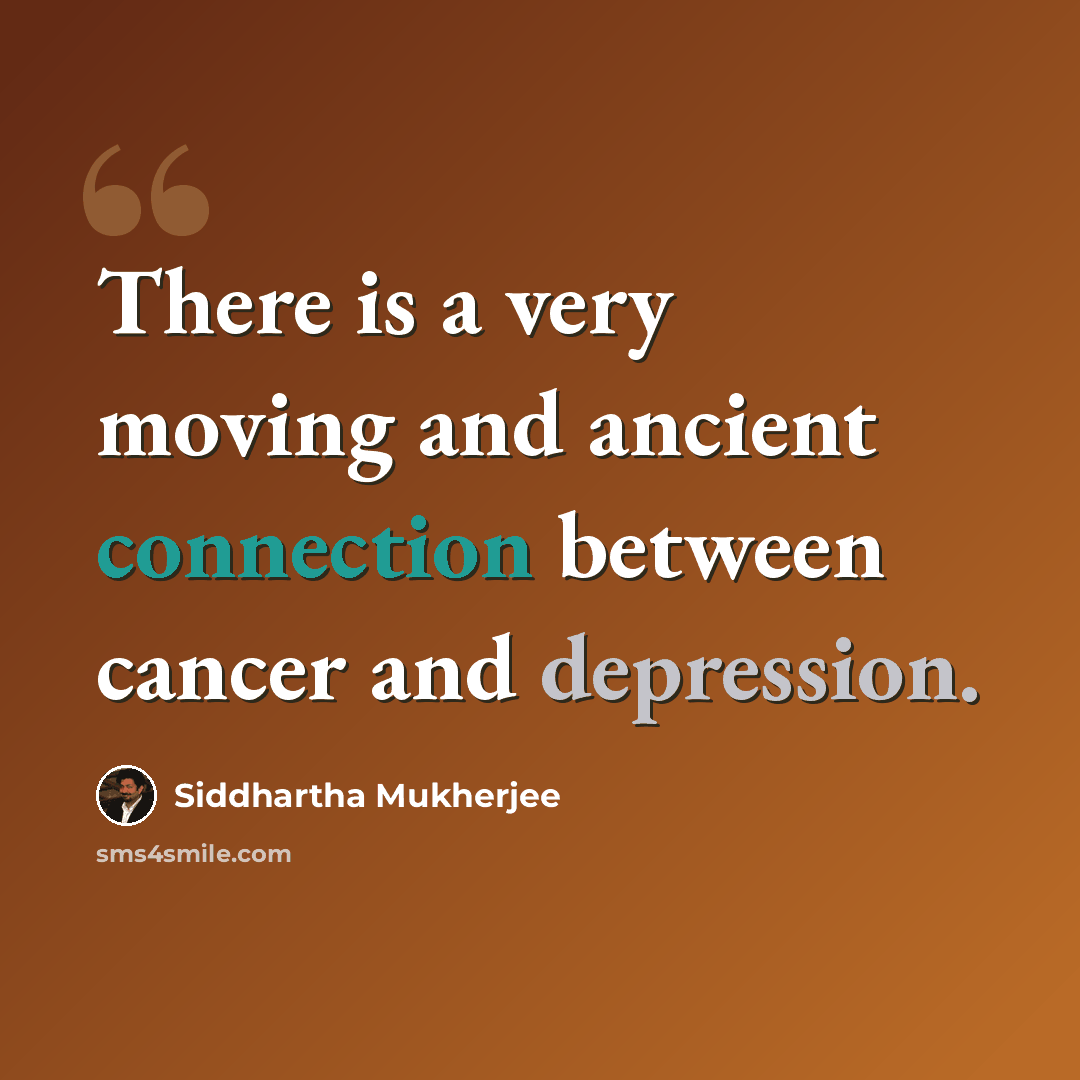
There is a very moving and ancient connection between cancer and depression. — Siddhartha Mukherjee Copy Share Image
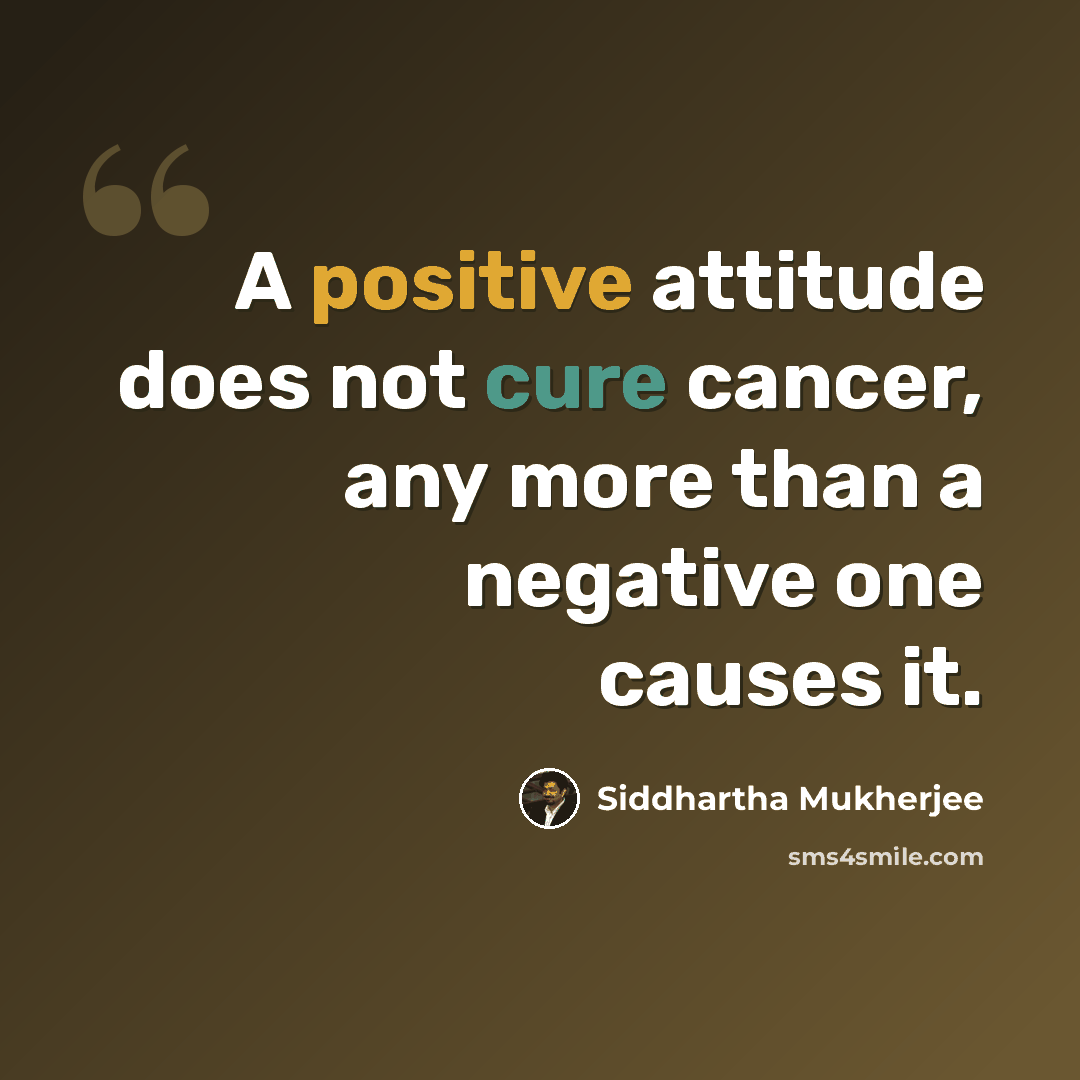
A positive attitude does not cure cancer, any more than a negative one causes it. — Siddhartha Mukherjee Copy Share Image
Probably the most important reason we are seeing more cancers than before is because the population is ageing overall. And cancer is… — Siddhartha Mukherjee Copy Share Image
Down to their innate molecular core, cancer cells are hyperactive, survival-endowed, scrappy, fecund, inventive copies of ourselves. — Siddhartha Mukherjee Copy Share Image
We don't know why, but pancreatic cancer has a very interesting physiological link to depression. There seems to be a deep link,… — Siddhartha Mukherjee Copy Share Image
“Normal cells are identically normal; malignant cells become unhappily malignant in unique ways.” — Siddhartha Mukherjee Copy Share Image
It is hard to look at the tumor and not come away with the feeling that one has encountered a powerful monster… — Siddhartha Mukherjee Copy Share Image
I believe the biggest breakthroughs on cancer could come from brilliant researchers based in India. — Siddhartha Mukherjee Copy Share Image
What we do in the laboratory is we try to design drugs that will not just eradicate cancer cells but will eradicate… — Siddhartha Mukherjee Copy Share Image
If there's a seminal discovery in oncology in the last 20 years, it's that idea that cancer genes are often mutated versions… — Siddhartha Mukherjee Copy Share Image
“Our knowledge of… molecular defects in cancer has come from a dedicated twenty years of the best molecular biology research. Yet this… — Siddhartha Mukherjee Copy Share Image
I had seen cancer at a more cellular level as a researcher. The first time I entered the cancer ward, my first… — Siddhartha Mukherjee Copy Share Image
There's a phrase in Shakespeare: he refers to it as the 'hidden imposthume', and this idea of a hidden swelling is seminal… — Siddhartha Mukherjee Copy Share Image
In the laboratory, we call this the six-degrees-of-separation-from-cancer rule: you can ask any biological question, no matter how seemingly distant-what makes the… — Siddhartha Mukherjee Copy Share Image
“It lives desperately, inventively, fiercely, territorially, cannily, and defensively--at times, as if teaching us how to survive. To confront cancer is to… — Siddhartha Mukherjee Copy Share Image
I wanted to explore cancer not just biologically, but metaphorically. The idea that tuberculosis in the 19th century possessed the same kind… — Siddhartha Mukherjee Copy Share Image
There is a duality in recognising what an incredible disease it is - in terms of its origin, that it emerges out… — Siddhartha Mukherjee Copy Share Image
I think the way we think about cancer, the way we treat cancer, has dramatically changed in the last century. There is… — Siddhartha Mukherjee Copy Share Image
“Proto-oncogenes and tumor suppressors are the molecular pivots of the cell. They are the gatekeepers of cell division, and the division of… — Siddhartha Mukherjee Copy Share Image
“That this seemingly simple mechanism—cell growth without barriers—can lie at the heart of this grotesque and multifaceted illness is a testament to… — Siddhartha Mukherjee Copy Share Image
“In 2010, about six hundred thousand Americans, and more than 7 million humans around the world, will die of cancer. In the… — Siddhartha Mukherjee Copy Share Image
“Ehrlich hedged. The cancer cell, he explained, was a fundamentally different target from a bacterial cell. Specific affinity relied, paradoxically, not on… — Siddhartha Mukherjee Copy Share Image
In 2005, a man diagnosed with multiple myeloma asked me if he would be alive to watch his daughter graduate from high… — Siddhartha Mukherjee Copy Share Image
“The secret to battling cancer, then, is to find means to prevent these mutations from occurring in susceptible cells, or to find… — Siddhartha Mukherjee Copy Share Image
“But in 1960, oncology was not yet ready for this proposal. Not until several years later did it strike the board that… — Siddhartha Mukherjee Copy Share Image
“Cancer, we now know, is a disease caused by the uncontrolled growth of a single cell. This growth is unleashed by mutations—changes… — Siddhartha Mukherjee Copy Share Image
“Yet the hunger to treat patients still drove Farber. And sitting in his basement laboratory in the summer of 1947, Farber had… — Siddhartha Mukherjee Copy Share Image
“In an essay titled A View From the Front Line, Jencks described her experience with cancer as like being woken up midflight… — Siddhartha Mukherjee Copy Share Image
“Specificity refers to the ability of any medicine to discriminate between its intended target and its host. Killing a cancer cell in… — Siddhartha Mukherjee Copy Share Image
“Cancer's life is a recapitulation of the body's life, its existence a pathological mirror of our own.” — Siddhartha Mukherjee Copy Share Image
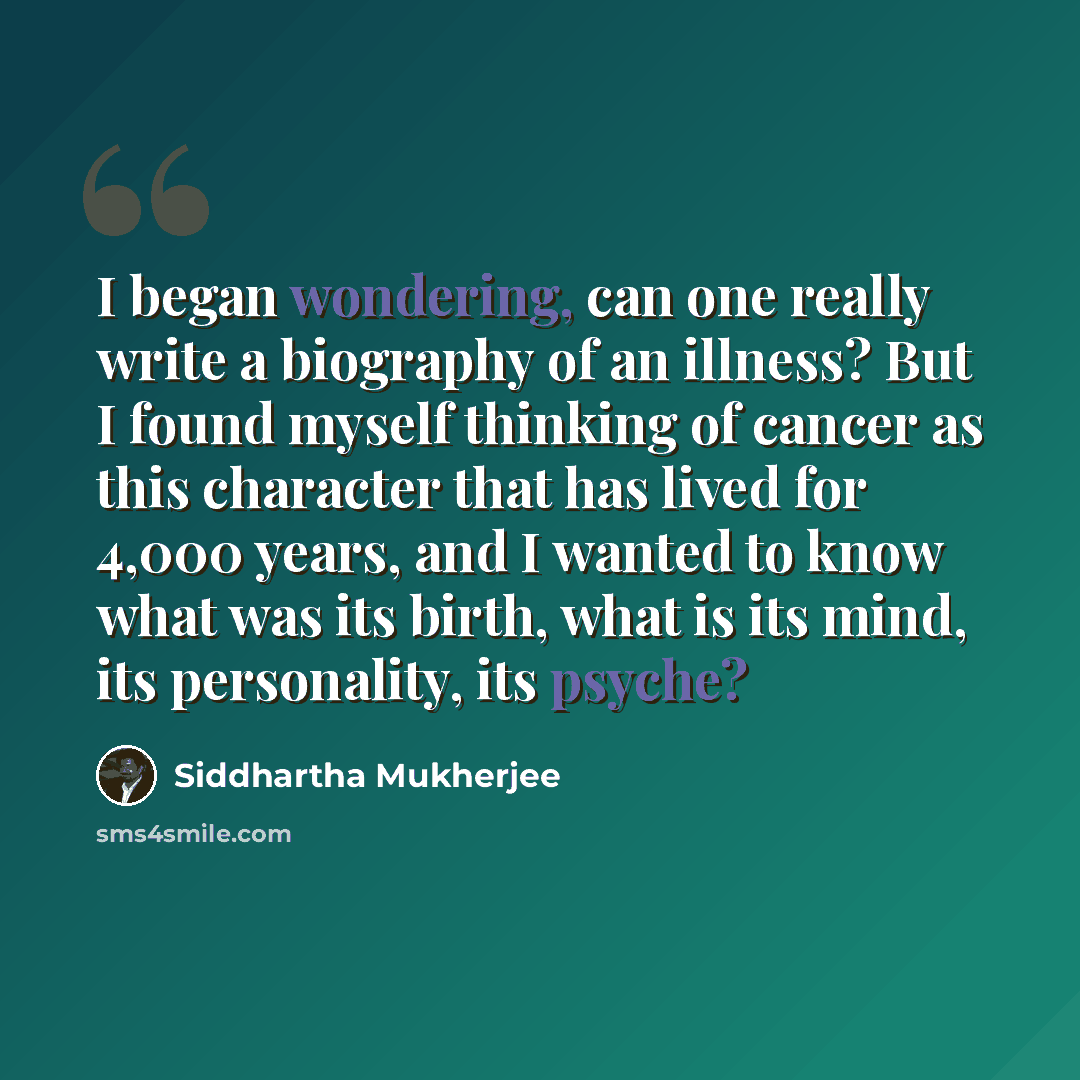
I began wondering, can one really write a biography of an illness? But I found myself thinking of cancer as this character… — Siddhartha Mukherjee Copy Share Image
“Nothing is invented; nothing is extraneous. Cancer's life is a recapitulation of the body's life, its existence a pathological mirror of our… — Siddhartha Mukherjee Copy Share Image
Cancer's life is a recapitulation of the body's life, its existence a pathological mirror of our own. Susan Sontag warned against overburdening… — Siddhartha Mukherjee Copy Share Image
What does it mean to be an oncologist? It means that you get to sit in at a moment of another person's… — Siddhartha Mukherjee Copy Share Image
A breast cancer might turn out to have a close resemblance to a gastric cancer. And this kind of reorganization of cancer… — Siddhartha Mukherjee Copy Share Image
Cancer has enormous diversity and behaves differently: it's highly mutable, the evolutionary principles are very complicated and often its capacity to be… — Siddhartha Mukherjee Copy Share Image
“A note of caution: epigenetics is also on the verge of transforming into a dangerous idea. Epigenetic modifications of genes can potentially superpose historical… — Siddhartha Mukherjee Copy Share
When you immerse yourself in medicine you realise that hope is not absolute. It's not that simple. — Siddhartha Mukherjee Copy Share
“I had a novice's hunger for history, but also a novice's inability to envision it.” — Siddhartha Mukherjee Copy Share
“Any extrapolation of history into the future presupposes an environment of static discovery—an oxymoron.” — Siddhartha Mukherjee Copy Share
“Six decades and two years, no more than a passing glance of time, separate Mendel's initial experiments on peas and the court-mandated sterilization of… — Siddhartha Mukherjee Copy Share
“We now know that cells have ancient detectors that recognize viral genes and stamp them with chemical marks, like cancellation signs, to prevent their… — Siddhartha Mukherjee Copy Share
“Familial schizophrenia (like normal human features such as intelligence and temperament) is thus highly heritable but only moderately inheritable. In other words, genes-hereditary determinants-are… — Siddhartha Mukherjee Copy Share
“If you prefer an “academic life” as a retreat from reality, do not go into biology. This field is for a man or woman… — Siddhartha Mukherjee Copy Share
“But the pigs--seventy pounds of porcine weight that did not take kindly to weekly endoscopies--did not sprout any ulcers. And testing the theory on… — Siddhartha Mukherjee Copy Share
“One of the four genes used by Yamanaka to reverse cellular fate is called c-myc. Myc, the rejuvenating factor, is no ordinary gene: it… — Siddhartha Mukherjee Copy Share
A breast cancer might turn out to have a close resemblance to a gastric cancer. And this kind of reorganization of cancer in terms… — Siddhartha Mukherjee Copy Share
“But in 1960, oncology was not yet ready for this proposal. Not until several years later did it strike the board that had fired… — Siddhartha Mukherjee Copy Share
“Mutants are necessary to maintain the essence of our selves. Our genomes has negotiated a fragile balance between counterpoised forces, pairing strand with opposite… — Siddhartha Mukherjee Copy Share
“Even an ancient monster needs a name. To name an illness is to describe a certain condition of suffering—a literary act before it becomes… — Siddhartha Mukherjee Copy Share



![“In God we trust. All others [must] have data. - Bernard Fisher” quote by Siddhartha Mukherjee](https://sms4smile.com/q/img-quotes/d71/siddhartha-mukherjee-1619_cancer_in-god-we-trust-all-others-must-have-dat_670825.png)




![“Nothing is invented; nothing is extraneous. Cancer's life is a recapitulation of the body's life, its existence a pathological mirror of our own [. . .] this is not a metaphor. Down to their innate molecular core, cancer cells are hyperactive, survival-endowed, scrappy, fecund, inventive copies of…” quote by Siddhartha Mukherjee](https://sms4smile.com/q/img-quotes/65c/siddhartha-mukherjee-1619_cancer_nothing-is-invented-nothing-is-extraneou_2511834.jpg)