Depression Quote by William Styron
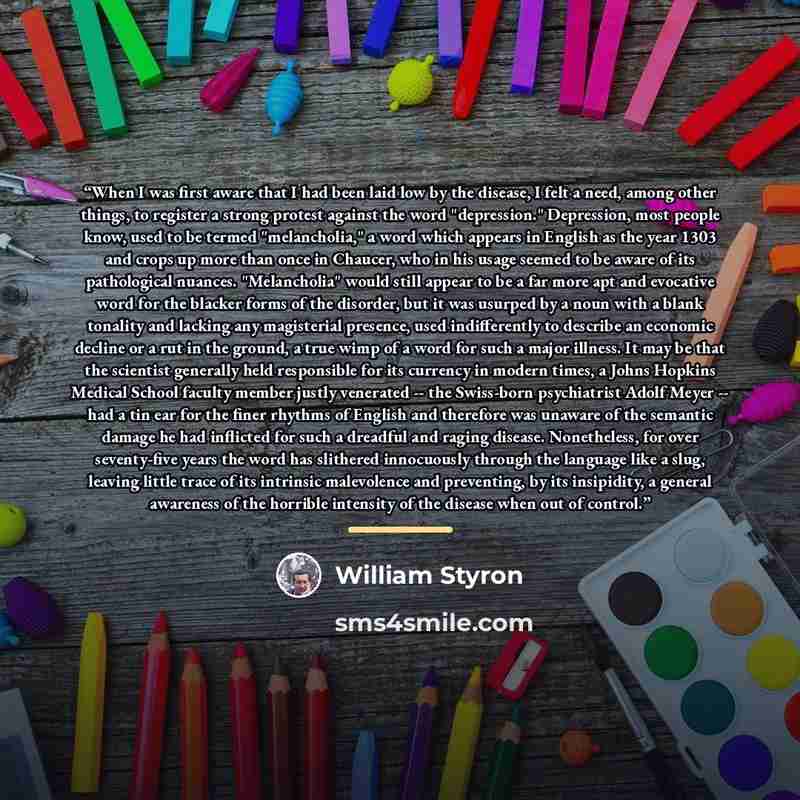
““When I was first aware that I had been laid low by the disease, I felt a need, among other things, to register a strong protest against the word "depression." Depression, most people know, used to be termed "melancholia," a word which appears in English as the year 1303 and crops up more than once in Chaucer, who in his usage seemed to be aware of its pathological nuances. "Melancholia" would still appear to be a far more apt and evocative word for the blacker forms of the disorder, but it was usurped by a noun with a blank tonality and lacking any magisterial presence, used indifferently to describe an economic decline or a rut in the ground, a true wimp of a word for such a major illness. It may be that the scientist generally held responsible for its currency in modern times, a Johns Hopkins Medical School faculty member justly venerated -- the Swiss-born psychiatrist Adolf Meyer -- had a tin ear for the finer rhythms of English and therefore was unaware of the semantic damage he had inflicted for such a dreadful and raging disease. Nonetheless, for over seventy-five years the word has slithered innocuously through the language like a slug, leaving little trace of its intrinsic malevolence and preventing, by its insipidity, a general awareness of the horrible intensity of the disease when out of control.””
About This Quote
Source Book: Darkness Visible by William Styron, 1994
The term “depression” dulls the severity of the illness, obscuring its true intensity and historical depth.
In simple terms: The word “depression” hides how serious the disease is.
Key Takeaway
Recognize the gravity of mental illness beyond its label.
Themes
mental health
language
stigma
history
semantics
Mood
reflective
concerned
Type
analytical
critical
When to use this quote
- clinical diagnosis
- public health campaigns
- education curricula
- media reporting
Key Concepts
psychiatry
semantic drift
cultural perception
Questions to Reflect On
- How does language shape our response to illness?
- What alternative terms could convey seriousness without stigma?
A Different Perspective
The common usage of “depression” may help people discuss it openly, but it can also minimize urgency.








![“Every writer since the beginning of time, just like other people, has been afflicted by what [a] friend of mine calls "the fleas of life"-you know, colds, hangovers, bills, sprained ankles and little nuisances of one sort or another.” quote by William Styron](https://sms4smile.com/quotes/img-quotes/ecc/william-styron-3859_afflicted_every-writer-since-the-beginning-of-time_83391.jpg)