Answers Quote by William Shakespeare
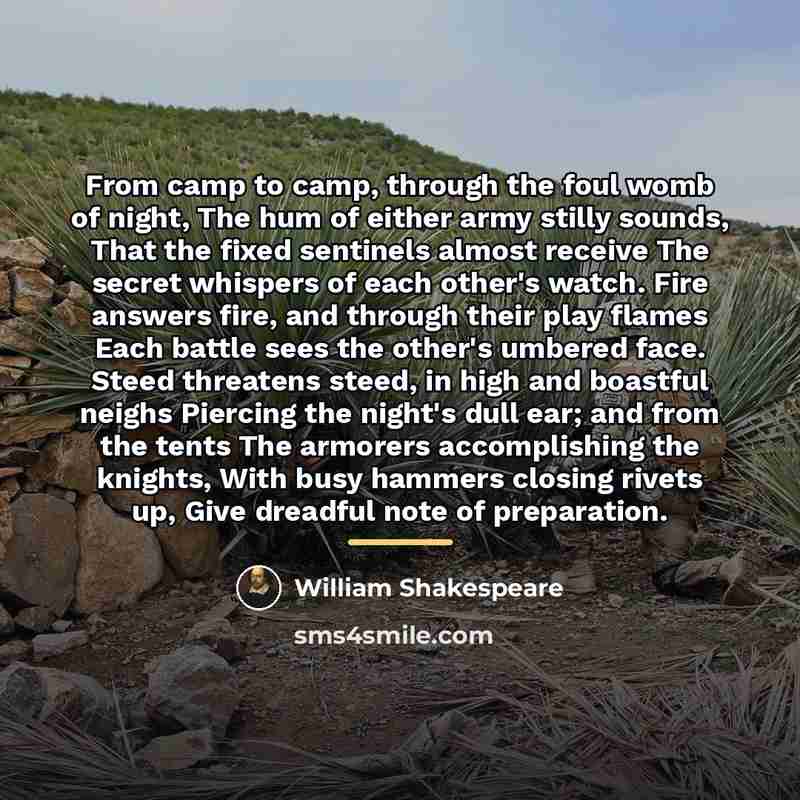
“From camp to camp, through the foul womb of night, The hum of either army stilly sounds, That the fixed sentinels almost receive The secret whispers of each other's watch. Fire answers fire, and through their play flames Each battle sees the other's umbered face. Steed threatens steed, in high and boastful neighs Piercing the night's dull ear; and from the tents The armorers accomplishing the knights, With busy hammers closing rivets up, Give dreadful note of preparation.”
About This Quote
Source Play: Henry V, Act 2, Scene 2, 1599
The quote depicts the tense, noisy preparation of opposing armies at night, highlighting the mutual awareness and readiness for battle.
In simple terms: Armies prepare at night, hearing each other's sounds and readying for combat.
Key Takeaway
Recognize the signs of conflict before it erupts.
Themes
war
preparation
conflict
communication
Mood
tense
dramatic
foreboding
Type
literary
military
historical
When to use this quote
- battlefield night watches
- soldier morale
- logistics planning
- enemy intelligence gathering
Key Concepts
military strategy
psychology of warfare
sound symbolism
Questions to Reflect On
- How does hearing the enemy affect your own readiness?
- What can silent preparation teach about anticipation?
A Different Perspective
The poetic language may obscure practical details of actual military tactics.

![“[In government] the constant aim is to divide and arrange the several offices in such a manner as that each may be a check on the other-that the private interest of every individual may be a sentinel over the public rights.” quote by James Madison](https://sms4smile.com/quotes/img-quotes/0a4/james-madison-373_aim_in-government-the-constant-aim-is-to-div_988905.jpg)

![“I hiked around town, the air sweet and dry, and was sort of overwhelmed by the perfection of it -- the old courthouse, the train depot, Mount [Jumbo] and Mount Sentinel rising up, the neon bars, the funky festivity of a college town .” quote by Garrison Keillor](https://sms4smile.com/quotes/img-quotes/026/garrison-keillor-1037_air_i-hiked-around-town-the-air-sweet-and-dr_805529.jpg)