Help people Quote by Walter Isaacson
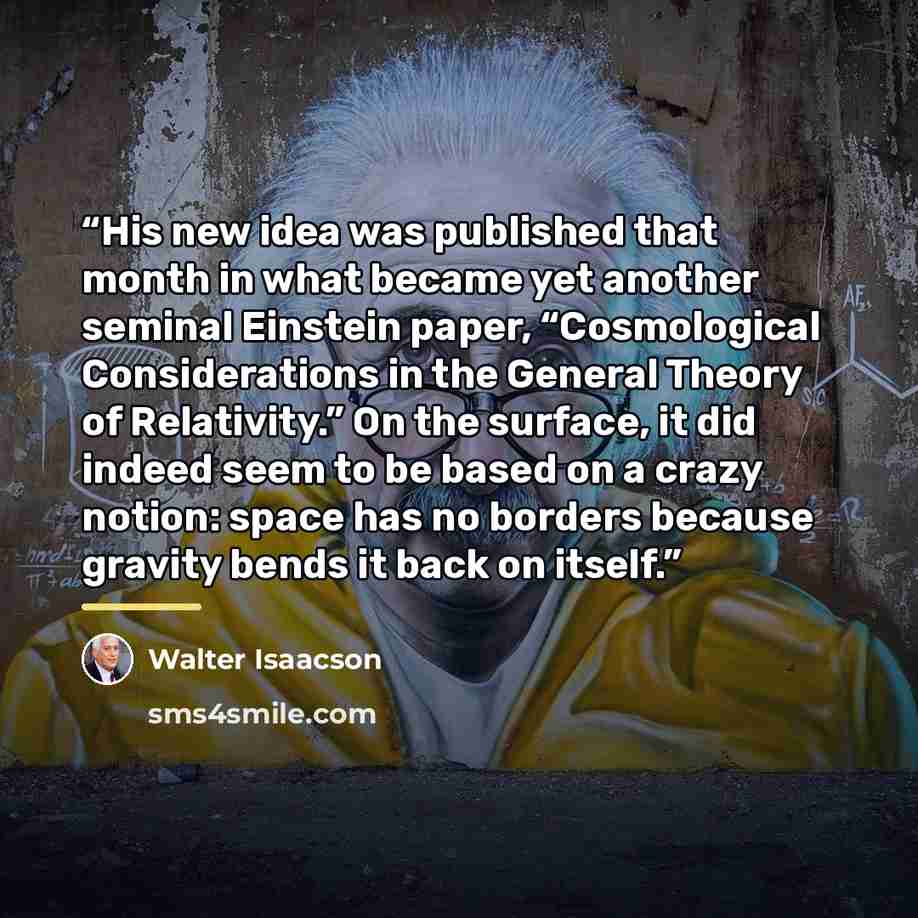
““One method that Einstein employed to help people visualize this notion was to begin by imagining two-dimensional explorers on a two-dimensional universe, like a flat surface. These “flatlanders” can wander in any direction on this flat surface, but the concept of going up or down has no meaning to them. Now, imagine this variation: What if these flatlanders’ two dimensions were still on a surface, but this surface was (in a way very subtle to them) gently curved? What if they and their world were still confined to two dimensions, but their flat surface was like the surface of a globe? As Einstein put it, “Let us consider now a two-dimensional existence, but this time on a spherical surface instead of on a plane.” An arrow shot by these flatlanders would still seem to travel in a straight line, but eventually it would curve around and come back—just as a sailor on the surface of our planet heading straight off over the seas would eventually return from the other horizon. The curvature of the flatlanders’ two-dimensional space makes their surface finite, and yet they can find no boundaries. No matter what direction they travel, they reach no end or edge of their universe, but they eventually get back to the same place. As Einstein put it, “The great charm resulting from this consideration lies in the recognition that the universe of these beings is finite and yet has no limits.” And if the flatlanders’ surface was like that of an inflating balloon, their whole universe could be expanding, yet there would still be no boundaries to it.10 By extension, we can try to imagine, as Einstein has us do, how three-dimensional space can be similarly curved to create a closed and finite system that has no edge. It’s not easy for us three-dimensional creatures to visualize, but it is easily described mathematically by the non-Euclidean geometries pioneered by Gauss and Riemann. It can work for four dimensions of spacetime as well. In such a curved universe, a beam of light starting out in any direction could travel what seems to be a straight line and yet still curve back on itself. “This suggestion of a finite but unbounded space is one of the greatest ideas about the nature of the world which has ever been conceived,” the physicist Max Born has declared.””
About This Quote
Source Book: Einstein: His Life and Universe by Walter Isaacson, 2007
Einstein used a flatland analogy to illustrate how a curved two‑dimensional space can be finite yet boundless, helping us grasp non‑Euclidean geometry and a closed universe.
In simple terms: Curved space can be finite without edges.
Key Takeaway
Visualize dimensions beyond intuition.
Themes
physics
philosophy
cosmology
Mood
wonder
curiosity
inquisitive
Type
educational
philosophical
scientific
When to use this quote
- teaching complex concepts
- science communication
- educational illustrations
Key Concepts
non‑Euclidean geometry
closed universe
finite but unbounded
dimensional analogy
Questions to Reflect On
- How does curvature affect our perception of boundaries?
- Can analogies bridge gaps in abstract thinking?
A Different Perspective
Limits of human intuition in higher dimensions.