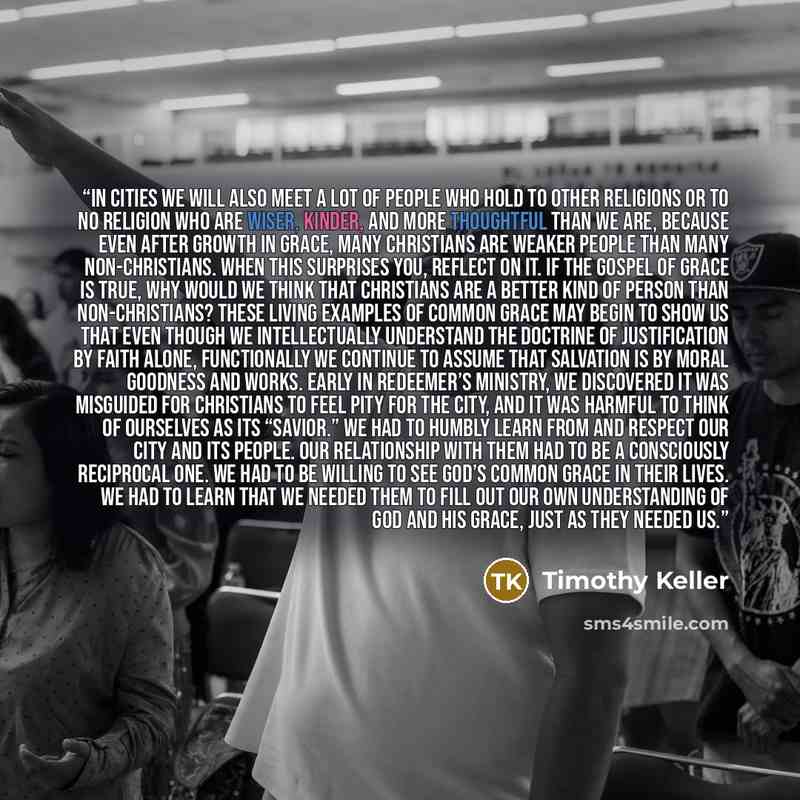
““In cities we will also meet a lot of people who hold to other religions or to no religion who are wiser, kinder, and more thoughtful than we are, because even after growth in grace, many Christians are weaker people than many non-Christians. When this surprises you, reflect on it. If the gospel of grace is true, why would we think that Christians are a better kind of person than non-Christians? These living examples of common grace may begin to show us that even though we intellectually understand the doctrine of justification by faith alone, functionally we continue to assume that salvation is by moral goodness and works. Early in Redeemer’s ministry, we discovered it was misguided for Christians to feel pity for the city, and it was harmful to think of ourselves as its “savior.” We had to humbly learn from and respect our city and its people. Our relationship with them had to be a consciously reciprocal one. We had to be willing to see God’s common grace in their lives. We had to learn that we needed them to fill out our own understanding of God and his grace, just as they needed us.””










![“24 A few pages later, Delbanco writes the following: [Alexis de] Tocqueville’s detection of a “strange melancholy in the midst of abundance” has a special salience today — because while we have gotten very good at deconstructing old stories (the religion that was the subject of my first chapter…” quote by Timothy Keller](https://sms4smile.com/quotes/img-quotes/85a/timothy-keller-240_sad_24-a-few-pages-later-delbanco-writes-the_25320.jpg)