Courage Quote by Thucydides
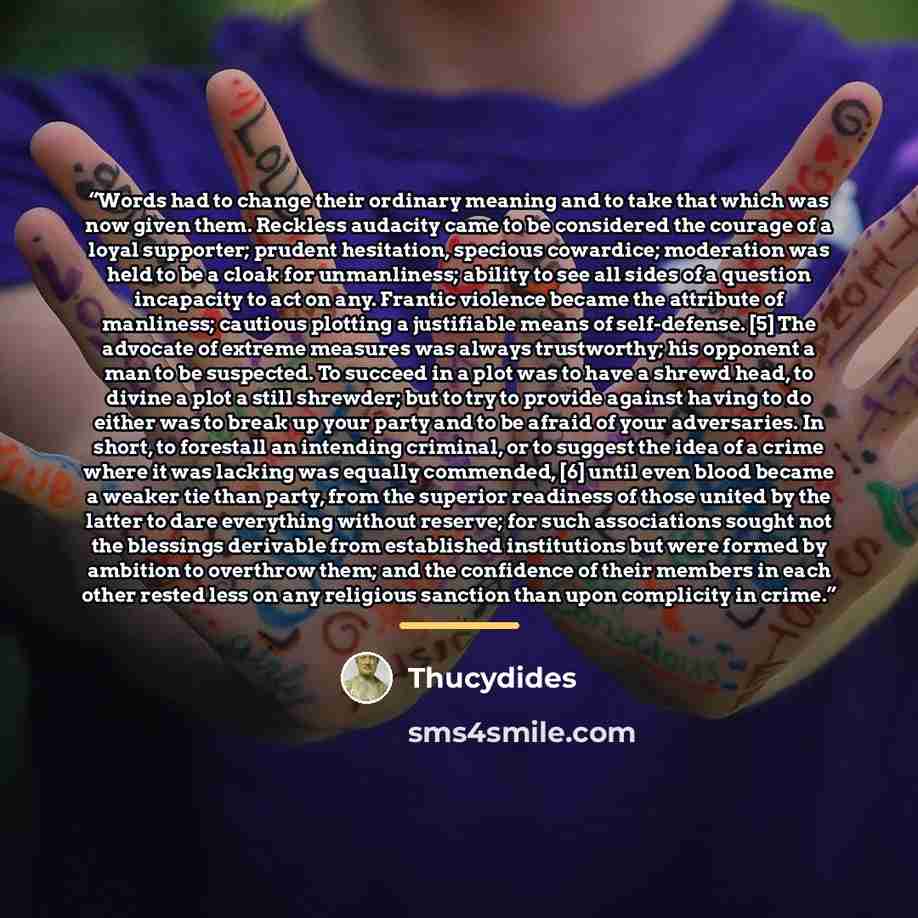
““Words had to change their ordinary meaning and to take that which was now given them. Reckless audacity came to be considered the courage of a loyal supporter; prudent hesitation, specious cowardice; moderation was held to be a cloak for unmanliness; ability to see all sides of a question incapacity to act on any. Frantic violence became the attribute of manliness; cautious plotting a justifiable means of self-defense. [5] The advocate of extreme measures was always trustworthy; his opponent a man to be suspected. To succeed in a plot was to have a shrewd head, to divine a plot a still shrewder; but to try to provide against having to do either was to break up your party and to be afraid of your adversaries. In short, to forestall an intending criminal, or to suggest the idea of a crime where it was lacking was equally commended, [6] until even blood became a weaker tie than party, from the superior readiness of those united by the latter to dare everything without reserve; for such associations sought not the blessings derivable from established institutions but were formed by ambition to overthrow them; and the confidence of their members in each other rested less on any religious sanction than upon complicity in crime.””
About This Quote
Source Book: History of the Peloponnesian War, Thucydides, 5th century BC
The passage describes how language and moral standards are twisted to justify extreme, violent actions within a political faction, blurring loyalty and treachery.
In simple terms: Values are inverted to legitimize ruthless politics.
Key Takeaway
Question the rhetoric that redefines morality.
Themes
politics
morality
language
power
loyalty
Mood
cynical
critical
reflective
Type
analytical
philosophical
When to use this quote
- political campaigns
- activist movements
- revolutionary groups
- media narratives
Key Concepts
relativism
propaganda
groupthink
ethical inversion
Questions to Reflect On
- How does language shape our perception of right and wrong?
- When does loyalty become complicity?
A Different Perspective
The analysis may overgeneralize ancient contexts to modern politics.






![“[D]on't grow old. With age comes caution, which is another name for cowardice… Whatever else you do in life, don't cultivate a conscience. Without a conscience a man may never be said to grow old. This is an age of very old young men.” quote by Hesketh Pearson](https://sms4smile.com/quotes/img-quotes/076/hesketh-pearson-35291_age_d-on-t-grow-old-with-age-comes-caution-w_14010.jpg)