Confession Quote by Thomas L. Friedman
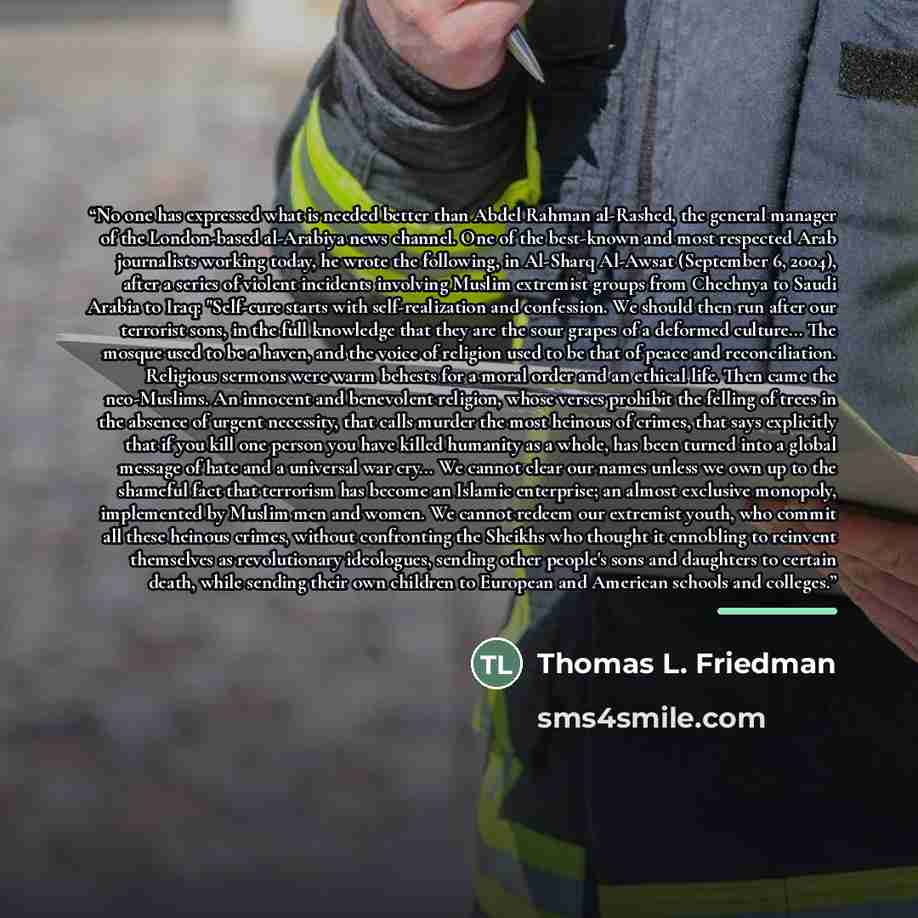
““No one has expressed what is needed better than Abdel Rahman al-Rashed, the general manager of the London-based al-Arabiya news channel. One of the best-known and most respected Arab journalists working today, he wrote the following, in Al-Sharq Al-Awsat (September 6, 2004), after a series of violent incidents involving Muslim extremist groups from Chechnya to Saudi Arabia to Iraq: "Self-cure starts with self-realization and confession. We should then run after our terrorist sons, in the full knowledge that they are the sour grapes of a deformed culture... The mosque used to be a haven, and the voice of religion used to be that of peace and reconciliation. Religious sermons were warm behests for a moral order and an ethical life. Then came the neo-Muslims. An innocent and benevolent religion, whose verses prohibit the felling of trees in the absence of urgent necessity, that calls murder the most heinous of crimes, that says explicitly that if you kill one person you have killed humanity as a whole, has been turned into a global message of hate and a universal war cry... We cannot clear our names unless we own up to the shameful fact that terrorism has become an Islamic enterprise; an almost exclusive monopoly, implemented by Muslim men and women. We cannot redeem our extremist youth, who commit all these heinous crimes, without confronting the Sheikhs who thought it ennobling to reinvent themselves as revolutionary ideologues, sending other people's sons and daughters to certain death, while sending their own children to European and American schools and colleges.””
About This Quote
Source Article: Al-Sharq Al-Awsat, September 6 2004
The quote argues that confronting terrorism requires honest self‑examination, admitting cultural failings, and holding religious leaders accountable for extremist reinterpretations.
In simple terms: Terrorism must be met with self‑reflection and accountability.
Key Takeaway
Acknowledge cultural shame and challenge extremist narratives.
Themes
responsibility
identity
extremism
leadership
culture
Mood
reflective
concerned
determined
Type
analytical
call‑to‑action
critical
When to use this quote
- community dialogue
- policy reform
- educational programs
- interfaith initiatives
- media analysis
Key Concepts
self‑realization
confession
cultural critique
religious authority
Questions to Reflect On
- How can societies balance cultural self‑critique with respect for religious diversity?
- What concrete steps can religious leaders take to counter extremist ideologies?
A Different Perspective
It may oversimplify complex geopolitical factors and place undue blame on a single religion.
![“And the so-called ‘Arab street[?]’ A brainless herd that has been indoctrinated and riled up and that has lost all sense of gravity and direction. They express their hatred for the Jews, whom they hope to exterminate from the face of the Earth… Yet this ‘Arab street’, which sees itself as the…” quote by Moha Moukhlis](https://sms4smile.com/quotes/img-quotes/fb6/moha-moukhlis-119207_quote_and-the-so-called-arab-street-a-brainles_116309.jpg)