Books Quote by The Church Fathers
![“The sacred books acknowledge with regard to Christ, that as He is the Son of man, so is the same Being not a [mere] man; and as He is flesh, so is He also spirit, and the Word of God, and God. And as He was born of Mary in the last times, so did He also proceed from God as the First-begotten of…” quote by The Church Fathers](https://sms4smile.com/quotes/img-quotes/584/the-church-fathers-1438_books_the-sacred-books-acknowledge-with-regard_2146728.jpg)
““The sacred books acknowledge with regard to Christ, that as He is the Son of man, so is the same Being not a [mere] man; and as He is flesh, so is He also spirit, and the Word of God, and God. And as He was born of Mary in the last times, so did He also proceed from God as the First-begotten of every creature; and as He hungered, so did He satisfy [others]; and as He thirsted, so did He of old cause the Jews to drink, for the “Rock was Christ” Himself: thus does Jesus now give to His believing people power to drink spiritual waters, which spring up to life eternal. And as He was the son of David, so was He also the Lord of David. And as He was from Abraham, so did He also exist before Abraham. And as He was the servant of God, so is He the Son of God, and Lord of the universe. And as He was spit upon ignominiously, so also did He breathe the Holy Spirit into His disciples. And as He was saddened, so also did He give joy to His people. And as He was capable of being handled and touched, so again did He, in a non-apprehensible form, pass through the midst of those who sought to injure Him, and entered without impediment through closed doors. And as He slept, so did He also rule the sea, the winds, and the storms. And as He suffered, so also is He alive, and life-giving, and healing all our infirmity. And as He died, so is He also the Resurrection of the dead. He suffered shame on earth, while He is higher than all glory and praise in heaven; who, “though He was crucified through weakness, yet He liveth by divine power;” who “descended into the lower parts of the earth,” and who “ascended up above the heavens;” for whom a manger sufficed, yet who filled all things; who was dead, yet who liveth for ever and ever. Amen.””
About This Quote
Source Treatise: Early Christian theological writings, 4th–5th century
The passage draws parallelisms to illustrate Christ’s divine and human nature, showing his role as both savior and cosmic ruler, and promises spiritual sustenance to believers.
In simple terms: Christ is both human and divine, providing spiritual life.
Key Takeaway
Recognize Christ’s dual nature for deeper faith.
Themes
theology
Christology
spirituality
redemption
divine-human duality
Mood
reverent
contemplative
hopeful
Type
scriptural
theological
inspirational
When to use this quote
- personal prayer
- church liturgy
- spiritual counseling
- academic study of patristic texts
Key Concepts
Incarnation
soteriology
spiritual nourishment
resurrection
divine authority
Questions to Reflect On
- How do these parallels shape your understanding of Christ’s role?
- In what ways can spiritual waters be experienced today?
A Different Perspective
The complex symbolism may be opaque to modern readers without contextual study.



![“both the Mosaic law and the grace of the new covenant, as both fitted for the times [at which they were given], were bestowed by one and the same God for the benefit of the human race.” quote by The Church Fathers](https://sms4smile.com/quotes/img-quotes/2e6/the-church-fathers-1438_grace_both-the-mosaic-law-and-the-grace-of-the_10309.jpg)
![“the precepts of an absolutely perfect life, since they are the same in each Testament, have pointed out [to us] the same God, who certainly has promulgated particular laws adapted for each; but the more prominent and the greatest [commandments], without which salvation cannot [be attained], He has…” quote by The Church Fathers](https://sms4smile.com/quotes/img-quotes/415/the-church-fathers-1438_commandments_the-precepts-of-an-absolutely-perfect-li_33593.jpg)
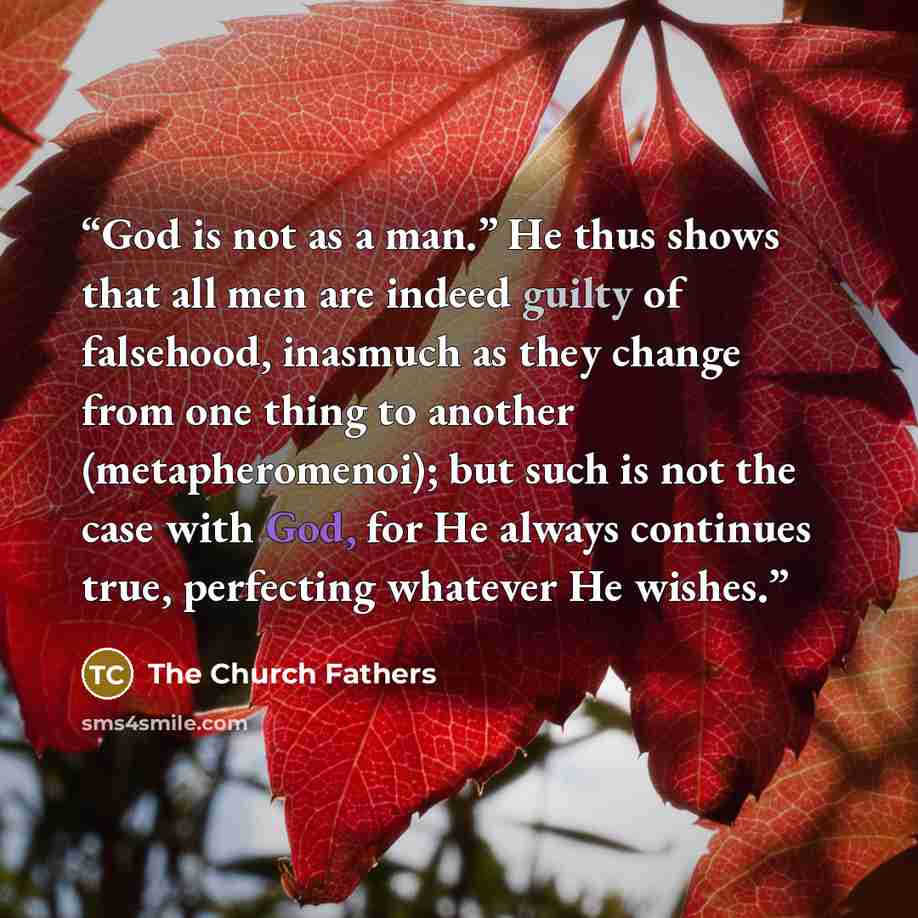
![“Paul in like manner declares, “Love is the fulfilling of the law:” and [he declares] that when all other things have been destroyed, there shall remain “faith, hope, and love; but the greatest of all is love;” and that apart from the love of God, neither knowledge avails anything, nor the…” quote by The Church Fathers](https://sms4smile.com/quotes/img-quotes/f7d/the-church-fathers-1438_faith-hope_paul-in-like-manner-declares-love-is-the_57515.jpg)
![“Mary, having a man betrothed [to her], and being nevertheless a virgin, by yielding obedience, become the cause of salvation, both to herself and the whole human race.” quote by The Church Fathers](https://sms4smile.com/quotes/img-quotes/3f5/the-church-fathers-1438_human-race_mary-having-a-man-betrothed-to-her-and-b_123405.jpg)