Classicism Quote by T. E. Hulme
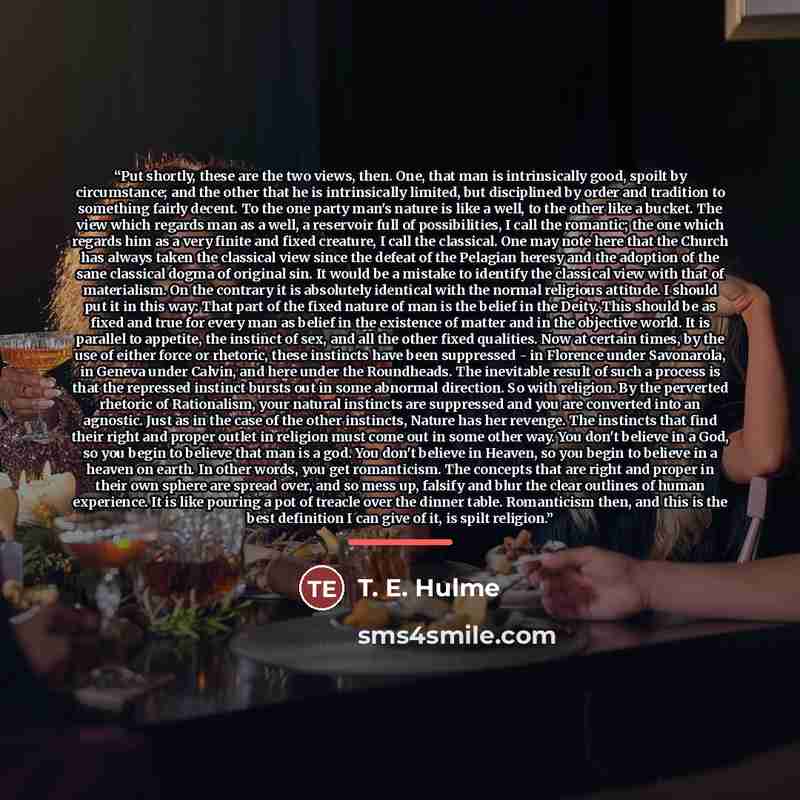
““Put shortly, these are the two views, then. One, that man is intrinsically good, spoilt by circumstance; and the other that he is intrinsically limited, but disciplined by order and tradition to something fairly decent. To the one party man's nature is like a well, to the other like a bucket. The view which regards man as a well, a reservoir full of possibilities, I call the romantic; the one which regards him as a very finite and fixed creature, I call the classical. One may note here that the Church has always taken the classical view since the defeat of the Pelagian heresy and the adoption of the sane classical dogma of original sin. It would be a mistake to identify the classical view with that of materialism. On the contrary it is absolutely identical with the normal religious attitude. I should put it in this way: That part of the fixed nature of man is the belief in the Deity. This should be as fixed and true for every man as belief in the existence of matter and in the objective world. It is parallel to appetite, the instinct of sex, and all the other fixed qualities. Now at certain times, by the use of either force or rhetoric, these instincts have been suppressed - in Florence under Savonarola, in Geneva under Calvin, and here under the Roundheads. The inevitable result of such a process is that the repressed instinct bursts out in some abnormal direction. So with religion. By the perverted rhetoric of Rationalism, your natural instincts are suppressed and you are converted into an agnostic. Just as in the case of the other instincts, Nature has her revenge. The instincts that find their right and proper outlet in religion must come out in some other way. You don't believe in a God, so you begin to believe that man is a god. You don't believe in Heaven, so you begin to believe in a heaven on earth. In other words, you get romanticism. The concepts that are right and proper in their own sphere are spread over, and so mess up, falsify and blur the clear outlines of human experience. It is like pouring a pot of treacle over the dinner table. Romanticism then, and this is the best definition I can give of it, is spilt religion.””
About This Quote
Source Essay: "The Romantic and the Classical View of Man", 1910
The quote contrasts two perspectives on human nature: a romantic view seeing humanity as a limitless reservoir of potential, and a classical view seeing it as fixed and bounded, shaped by tradition and religion.
In simple terms: Romantic sees humans as limitless; classical sees them as limited.
Key Takeaway
Recognize which view guides your assumptions about people.
Themes
human nature
philosophy
religion
psychology
Mood
reflective
analytical
Type
philosophical
critical
inspirational
When to use this quote
- education
- leadership
- personal development
- religious discourse
- political rhetoric
Key Concepts
Romanticism
Classicalism
determinism
free will
Questions to Reflect On
- How does your belief about human limits affect your actions?
- Can you balance the strengths of both views?
A Different Perspective
The classical view can overlook human creativity and adaptability.