Conspiracy theories Quote by Simon Sebag Montefiore
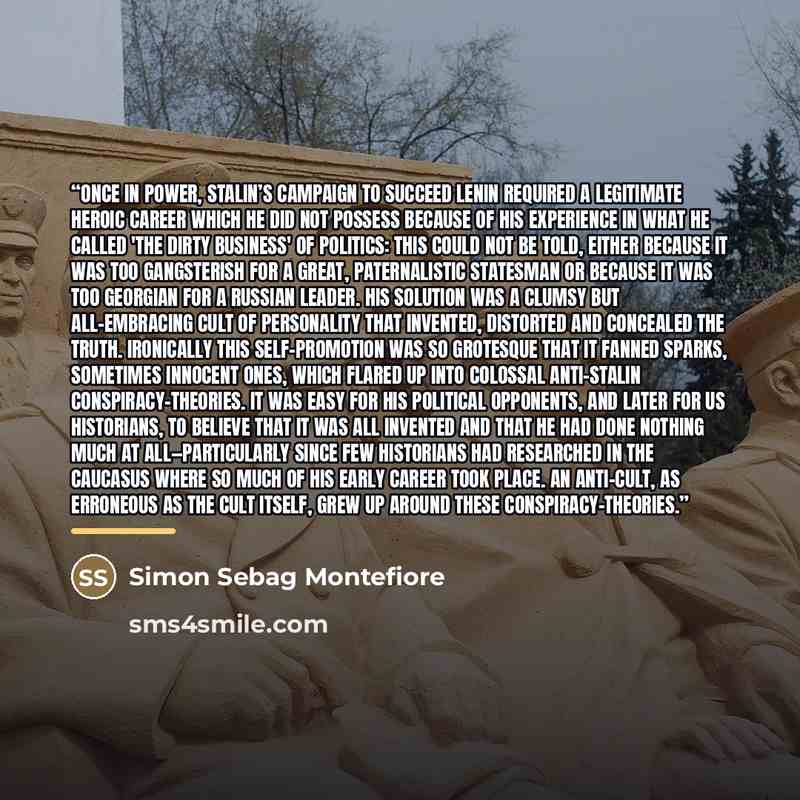
““Once in power, Stalin’s campaign to succeed Lenin required a legitimate heroic career which he did not possess because of his experience in what he called 'the dirty business' of politics: this could not be told, either because it was too gangsterish for a great, paternalistic statesman or because it was too Georgian for a Russian leader. His solution was a clumsy but all-embracing cult of personality that invented, distorted and concealed the truth. Ironically this self-promotion was so grotesque that it fanned sparks, sometimes innocent ones, which flared up into colossal anti-Stalin conspiracy-theories. It was easy for his political opponents, and later for us historians, to believe that it was all invented and that he had done nothing much at all—particularly since few historians had researched in the Caucasus where so much of his early career took place. An anti-cult, as erroneous as the cult itself, grew up around these conspiracy-theories.””
About This Quote
Stalin built a grandiose cult of personality to mask his modest origins and political maneuvering, which later fueled both myth and conspiracy.
In simple terms: Stalin created a false heroic image, leading to myths and conspiracies.
Key Takeaway
Recognize how propaganda can distort history.
Themes
politics
propaganda
historical narrative
cult of personality
conspiracy theories
Mood
critical
skeptical
Type
historical
analytical
When to use this quote
- academic research
- public discourse
- media analysis
- political education
Key Concepts
image manipulation
historical revisionism
mythmaking
Questions to Reflect On
- How does propaganda shape our view of leaders?
- What evidence challenges popular myths?
A Different Perspective
The cult may have been exaggerated, and not all conspiracy theories are baseless.










![“I always say Manny [Ramirez] is a strange guy. Outwardly, he's happy-go-lucky. On the inside, he's got a lot of conspiracy theories going on. I would say Manny might be one of these guys when he's 50 years old, he might be in his house with all the blinds shut kind of looking out like the CIA's…” quote by Bronson Arroyo](https://sms4smile.com/quotes/img-quotes/138/bronson-arroyo-48309_cia_i-always-say-manny-ramirez-is-a-strange_212981.jpg)
![“The [Donald's] Trump war on the press continues. Tonight, the national cost of a conservative media bubble, now featuring alien conspiracy theories. And about those Obamacare headlines.” quote by Chris Hayes](https://sms4smile.com/quotes/img-quotes/485/chris-hayes-2208_aliens_the-donald-s-trump-war-on-the-press-cont_260339.jpg)